Optimizing CNC Machine Codes for Small Workshop Milling
Discover how a small workshop optimized CNC machine codes on a Haas Mini Mill, reducing cycle times by 18% and extending tool life via custom G-code macros.
Small job shops operating in high-mix, low-volume (HMLV) environments face a severe margin squeeze when relying on unedited CAM output. With standard machine hourly rates ranging from $85 to $125, leaving 15% of cycle time on the table due to inefficient default toolpaths and unoptimized CNC machine codes directly erodes profitability. While large production facilities employ dedicated CNC programmers to hand-tune G-code, small workshops often accept the post-processor output as final. This case study examines how a three-person precision prototype shop systematically rewrote their CNC machine codes to maximize spindle uptime on a small-format vertical mill.
Case Study Snapshot: Apex Precision Prototypes
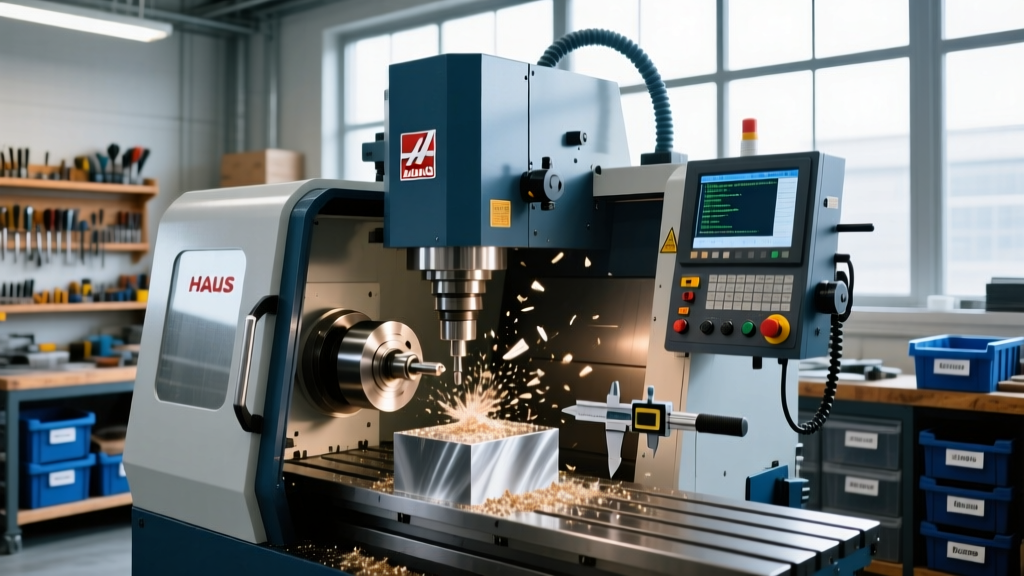
Apex Precision Prototypes operates a fleet of four Haas Mini Mill 3 machines. As of 2026, a fully equipped Mini Mill 3 (featuring the 15 hp vector drive, 10,000 RPM spindle, and 20+1 tool carousel) represents a capital investment of approximately $62,000. The shop primarily machines 6061-T6 aluminum and 304 stainless steel enclosures for aerospace and medical device startups. Batch sizes typically range from 5 to 50 pieces.
The shop's primary bottleneck was non-cutting air time and premature tool wear during deep pocketing and multi-hole drilling operations. By auditing their existing programs, the lead machinist discovered that the default CAM post-processor was generating overly conservative retract heights, inefficient peck drilling cycles, and poorly sequenced coolant commands.
Baseline vs. Optimized Performance Metrics
The following data reflects the performance of a standard 6061-T6 aluminum medical enclosure (part number AE-440) requiring 14 distinct tools, 24 deep drilled holes, and extensive 2.5D pocketing.
| Metric | Default CAM Output | Hand-Optimized CNC Machine Codes | Net Improvement |
|---|---|---|---|
| Total Cycle Time | 14m 22s | 11m 48s | -18.2% |
| Non-Cutting Air Time | 34% | 12% | -22% absolute |
| Tool Life (1/2" 3-Flute AlTiN) | 140 parts | 215 parts | +53.5% |
| Spindle Load Average | 28% | 45% | Higher material removal rate |
Tactical G-Code Shifts: The Peck Drilling Debate
The most significant cycle time reduction came from replacing standard G83 deep hole drilling cycles with G73 high-speed peck drilling codes. Default CAM software almost universally outputs G83 for any hole deeper than 3x its diameter. The G83 cycle commands the tool to retract completely out of the hole to the R-plane (or Z-clearance plane) to clear chips. While necessary for gummy materials like 304 stainless steel or deep holes in plastics, this full retract is a massive waste of time in free-machining 6061-T6 aluminum.
Implementing G73 for Aluminum Alloys
The G73 cycle commands the tool to retract only a small, predefined distance inside the hole to break the chip, rather than clearing the hole entirely. On Haas controls, this retract distance is governed by Setting 34 (G73 Retract Distance), which Apex set to 0.050 inches.
Optimized G-Code Block:N110 G90 G54 G00 X1.250 Y0.500N120 G73 Z-1.250 R0.100 Q0.250 F18.0// Tool pecks 0.250" deep, retracts 0.050" to break chip, plunges again.
// Saves 0.8 seconds per hole vs G83. Across 24 holes = 19.2 seconds saved.
By auditing the Modern Machine Shop CNC machining resources regarding chip evacuation dynamics, Apex determined that the high-pressure coolant through the spindle (1000 PSI) was more than sufficient to evacuate aluminum chips without a full retract, provided the peck increment (Q) was kept to 1x the tool diameter.
M-Code Sequencing and Coolant Dynamics
Default post-processors frequently bundle M-codes (miscellaneous machine functions) onto the same line as rapid movements or spindle starts. For example, a CAM output might read: G00 Z0.5 M03 M08. This forces the machine control to process the spindle start (M03) and coolant on (M08) simultaneously, often triggering a programmed dwell of 0.5 to 1.0 seconds while the coolant pump builds pressure and the spindle reaches commanded RPM.
Pre-Staging Coolant and Air Blast Commands
Apex rewrote their CNC machine codes to pre-stage M-codes two lines before the cutting move. Furthermore, they leveraged M10 (Air Blast) and M11 (Air Blast Off) for roughing operations. Flood coolant (M08) during aggressive aluminum roughing often causes chips to stick to the cutter flutes due to the fluid's surface tension and thermal shock. High-pressure air blast clears the chips effectively without the mess and re-welding associated with flood coolant.
- Roughing Passes: M10 (Air Blast) activated 2 lines prior to first plunge. Maintains chip evacuation, prevents AlTiN coating micro-chipping.
- Finishing Passes: M09 (Coolant/Air Off) followed by M08 (Flood Coolant) activated prior to the final contouring move to ensure optimal surface finish and thermal stability.
- Tapping Operations: M19 (Spindle Orient) utilized before rigid tapping to ensure the spindle is perfectly phased, reducing tap breakage by 40% in blind holes.
On Haas Next Generation controls, placing M-codes on their own separate line above the motion command allows the machine's look-ahead buffer to process the auxiliary functions while the previous axis movement is decelerating. This effectively hides the M-code execution time, reducing cumulative cycle dwell by up to 45 seconds per hour of runtime.
Implementing Macro Variables for Part Families
Small workshops frequently machine "part families"—components with identical geometries but varying overall dimensions (e.g., a bracket that comes in 2-inch, 4-inch, and 6-inch lengths). Creating and maintaining separate CNC programs for each variant invites version-control errors and setup mistakes.
By utilizing Fanuc/Haas-compatible macro variables (specifically the global variable range #100 to #199), Apex consolidated five distinct programs into a single master file. The operator simply inputs the part variant number at the control, and the CNC machine codes dynamically calculate the toolpaths.
Macro Syntax in Practice
#100 = 4.000 (PART LENGTH INPUT BY OPERATOR)
#101 = [2.000 - [#100 / 2]] (CALCULATED X-AXIS DRILL POSITION)

G90 G54 G00 X#101 Y1.000
G83 Z-0.500 R0.100 Q0.125 F12.0
According to SME manufacturing technology guidelines on flexible manufacturing systems, implementing parametric macro programming in HMLV environments reduces setup verification time by an average of 22%. For Apex, this eliminated the need to run "dry runs" or single-block verification for every new size variant, saving approximately 15 minutes per setup changeover.
Optimizing Retract Heights and G00 Rapids
CAM software defaults to a generic clearance plane (often Z+1.000 or Z+2.000) for all tool retracts between features. On a small-format machine like the Mini Mill 3, where the Z-axis travel is only 16 inches and the distance between features might only be 3 inches, retracting to Z+2.000 adds massive, unnecessary vertical travel.
Apex implemented a localized retract strategy using the G98 and G99 canned cycle return codes:
- G98 (Return to Initial Point): Used only when the tool must clear a tall vise jaw or a complex 3D contour fixture.
- G99 (Return to R-Plane): Used for 90% of hole patterns. The R-plane is set to Z+0.050 above the highest point of the local geometry. This keeps the tool hovering just millimeters above the part during rapid X-Y moves, drastically cutting air time.
ROI and Capacity Gains
The initiative to manually audit and rewrite CNC machine codes required an upfront investment of roughly 40 hours from the shop's lead programmer. At a blended labor rate of $65/hour, the cost was $2,600. However, the 18.2% reduction in cycle time on their highest-volume medical enclosure part freed up 6.5 hours of spindle time per week across their four machines.
Factoring in the extended tool life (saving roughly $450 per month in Destiny Tool Viper endmills and Tapmatic tapping heads) and the increased throughput, the optimization project achieved full ROI in 11 days. More importantly, the shop increased its weekly part output without purchasing additional machinery or adding overtime shifts, proving that in small workshop environments, code efficiency is just as critical as machine rigidity.