Should You Make a CNC Machine? Industrial vs Consumer Specs
Compare technical specs, rigidity, and costs to decide if you should make a CNC machine, buy a consumer router, or invest in industrial equipment.
The Core Dilemma: DIY Builds vs. Off-the-Shelf CNCs
When engineers and fabricators decide to make a CNC machine from scratch, they are usually chasing a specific combination of work envelope size, spindle power, and budget that off-the-shelf models cannot provide. However, the decision to build a DIY CNC router or mill versus purchasing a consumer-grade unit (like a Shapeoko) or an industrial machine (like a Haas or Tormach) hinges entirely on mechanical rigidity, motion control architecture, and acceptable tolerance bands. Understanding the technical specifications across these three tiers is critical before sourcing components or signing a purchase order.
Quick Decision Matrix: Which Path to Take?- Make a CNC Machine (DIY): Best for hobbyists needing custom work envelopes (e.g., 4x8ft sheets) on a sub-$3,000 budget, willing to sacrifice rigidity and accept ±0.005' tolerances.
- Consumer CNC (Shapeoko/X-Carve): Ideal for small-batch woodworking, PCB milling, and soft plastics requiring ±0.002' repeatability with zero assembly calibration.
- Industrial CNC (Tormach/Haas): Mandatory for ferrous metal machining, high-volume production, and tight-tolerance (±0.0002') aerospace or automotive parts.
Technical Specifications: Industrial vs. Consumer vs. DIY
The fundamental difference between these tiers lies in the mass of the frame and the drive system architecture. Mass dampens harmonic vibrations generated during cutting, while the drive system dictates positional accuracy under load.
| Specification | DIY Build (Make a CNC Machine) | Consumer (Carbide 3D Shapeoko 5) | Industrial (Tormach PCNC 440 / Haas Mini Mill) |
|---|---|---|---|
| Frame Material | 6061-T5 Extruded Aluminum / MDF | Extruded Aluminum & Steel Hybrids | Class 30 Cast Iron / Ductile Iron |
| Linear Motion | V-Wheels on C-Beam or TR8x2 Lead Screws | Linear Guide Rails (MGN12H) & Belts | Precision Ground Ball Screws (C3/C5 Grade) |
| Spindle Power | 0.5 - 1.25 HP (Trim Routers) | 1.5 - 2.2 HP (VFD Controlled) | 3.0 - 7.5 HP (Vector Drive Spindles) |
| Positional Tolerance | ±0.005' to ±0.010' | ±0.002' to ±0.004' | ±0.0002' to ±0.0005' |
| Tool Holding | ER11 / ER16 Collets (Manual) | ER11 / ER20 Collets (Manual) | BT30 / TTS (Auto Tool Changer Available) |
How It Works: The Mechanics of Rigidity and Precision
To understand why industrial machines command $40,000+ price tags while DIY builds cost a fraction of that, you must examine the physics of cutting forces and harmonic resonance.
Frame Damping and Harmonic Resonance
When an end mill engages steel, it generates high-frequency vibrations. If you make a CNC machine using aluminum extrusions (like the popular OpenBuilds C-Beam system), the frame will absorb and amplify these harmonics because aluminum has a relatively low damping coefficient. This results in chatter marks on the workpiece and accelerated tool wear. Industrial machines utilize cast iron frames specifically because cast iron's graphite flake microstructure provides superior vibration damping—up to 10 times greater than aluminum or welded steel. This mass and damping allow the spindle to maintain constant chip load without deflection.
Linear Motion: Backlash and Preload
Consumer machines often rely on GT2 or GT3 neoprene timing belts for the X and Y axes. While belts offer high rapid traverse rates (up to 500 IPM on a Shapeoko 5 Pro), they suffer from elastic stretch under heavy lateral cutting loads. If you are building a DIY CNC mill for aluminum, you must upgrade to ball screws. A standard SFU1605 rolled ball screw (16mm diameter, 5mm lead) with a preloaded double-nut anti-backlash assembly will eliminate the 0.010' backlash inherent in standard ACME lead screws, providing the necessary rigidity for climb milling operations.
Cost Breakdown: What It Actually Takes to Make a CNC Machine
Building your own machine requires sourcing a precise Bill of Materials (BOM). Below is a realistic cost analysis for a robust DIY 4x4 foot CNC router designed for cutting aluminum and hardwoods, compared to market alternatives.
- Mechanical Frame (Extrusions, Plates, Fasteners): $600 - $900
- Linear Motion (4x SFU1605 Ball Screws, BK10/BF10 Bearings): $350 - $500
- Drive Motors (3x NEMA 34 Closed-Loop Steppers, 12 Nm torque): $400 - $600
- Spindle (2.2kW Water-Cooled VFD Spindle, ER20): $350 - $450
- Electronics & Controller (Gecko G540 or Ethernet SmoothStepper): $250 - $400
- Total DIY BOM Cost: $1,950 - $2,850
By comparison, a consumer-grade Carbide 3D Shapeoko 5 Pro retails for roughly $2,199 but offers a much smaller work envelope (16x16 inches standard). Stepping up to an industrial entry-level mill like the Tormach PCNC 440 requires an investment starting around $5,500, while a full Haas Mini Mill easily exceeds $45,000 when equipped with a 10-tool automatic tool changer (ATC) and probing packages.
⚠️ Warning: The Hidden Costs of DIY BuildsWhen you make a CNC machine, the BOM is only the beginning. You must factor in the cost of tramming the spindle (often requiring precision machinist squares and dial indicators with 0.0001' resolution), squaring the gantry, and tuning stepper motor acceleration curves to prevent missed steps. Expect to spend 40 to 80 hours in mechanical assembly and firmware calibration before cutting your first part.
Control Systems and Firmware Architecture
The brain of the CNC dictates how smoothly the machine translates G-code into physical motion. The choice of controller is heavily dictated by the machine tier.
GRBL and Arduino-Based Controllers (DIY & Consumer)
Most DIY and consumer machines rely on GRBL firmware running on 8-bit or 32-bit microcontrollers. GRBL is highly efficient but limited by its step pulse generation rate and lack of advanced lookahead. When machining complex 3D contours, GRBL may stutter, causing dwell marks on the material. Upgrading to a 32-bit board like the Duet 3D or using a dedicated motion controller like the Centroid Acorn provides vastly superior kinematic planning.
Mach4 and LinuxCNC (Prosumer & DIY Mills)
If you are building a DIY CNC mill to cut metal, LinuxCNC or Mach4 paired with an Ethernet-based motion controller (like the Warp9 Tec ETH-ESP) is mandatory. These systems support closed-loop servo tuning, rigid tapping (synchronizing spindle encoder feedback with Z-axis feed rate), and advanced jerk-limiting algorithms that protect ball screws from sudden directional shock loads.
Proprietary Industrial Controllers (Haas NGC / Fanuc)
Industrial machines utilize proprietary, deeply integrated controllers. The Haas Next Generation Control (NGC) processes G-code at lightning speeds with massive memory buffers, allowing for seamless high-speed machining (HSM) toolpaths. These controllers also feature thermal compensation algorithms that automatically adjust axis offsets as the cast iron frame and ball screws expand from friction heat during long production runs—a feature entirely absent in DIY and consumer builds.
Final Verdict: Matching Machine Architecture to Application
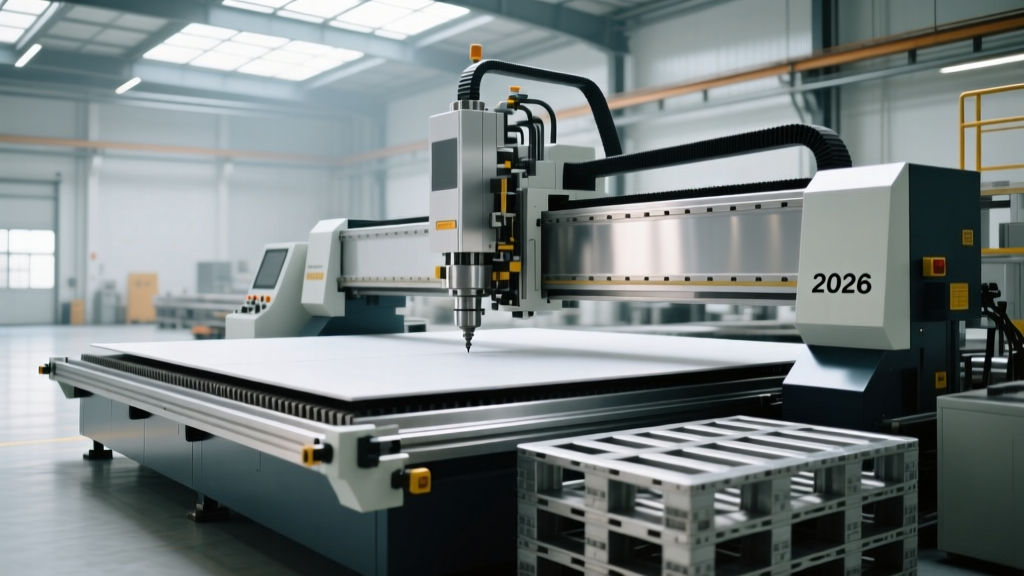
If your primary application involves cutting MDF, acrylic, or aluminum composite panels (ACM) for signage, and you require a large 4x8 foot bed, deciding to make a CNC machine using extruded aluminum and rack-and-pinion or belt drives is the most economically sound choice. You will achieve the necessary tolerances for these soft materials at a fraction of the cost of an industrial gantry router.
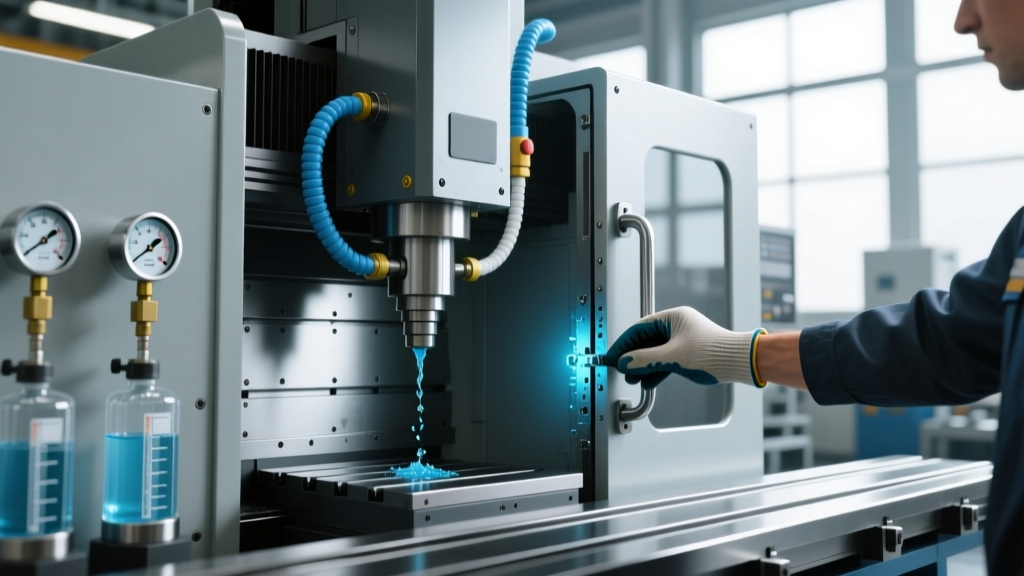
However, if your goal is to machine 6061 aluminum blocks, brass fittings, or steel tooling, consumer and DIY belt-driven routers will fail due to gantry deflection and spindle runout. For non-ferrous and light ferrous metalworking, an entry-level industrial machine with a cast-iron frame, way covers, and flood coolant capabilities is not a luxury; it is a strict mechanical requirement to maintain tool life and dimensional accuracy.