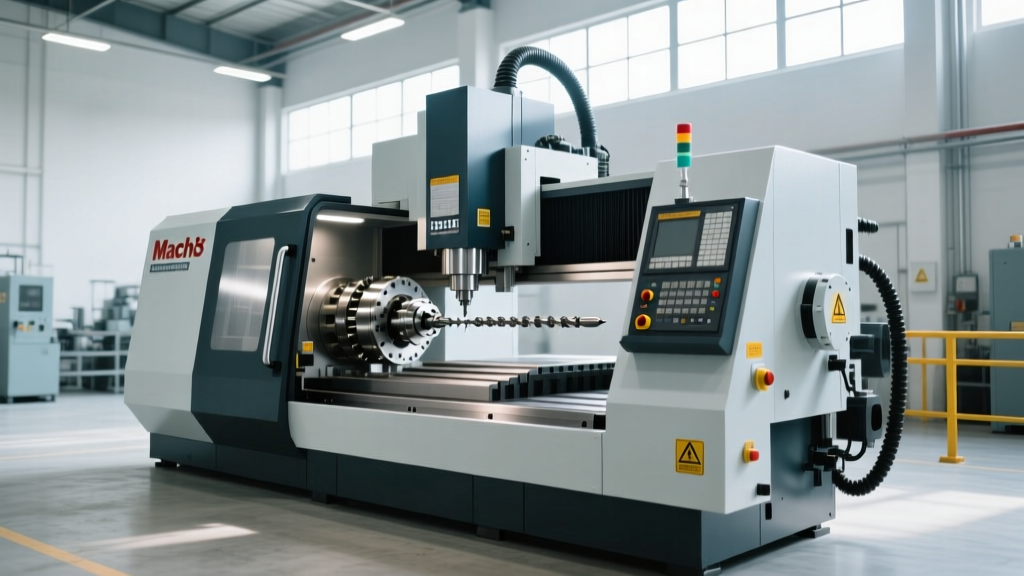
Mach3 CNC Machine ATC Retrofit: Safety & Compliance Guide
Explore safety standards, ISO 13849 compliance, and hardware interlocks for retrofitting an ATC onto a Mach3 CNC machine.
Retrofitting an Automatic Tool Changer (ATC) onto a Mach3 CNC machine introduces severe kinetic and pneumatic hazards that the legacy Mach3 software architecture cannot natively mitigate. Unlike industrial Fanuc or Siemens Sinumerik controls, which operate on certified real-time operating systems with integrated Safety Integrity Levels (SIL), Mach3 relies on the Windows environment and standard PC I/O. This architectural limitation means that ATC safety interlocks, drawbar actuation, and carousel rotation must be governed entirely by external, hardwired safety logic to comply with modern manufacturing safety standards.
CRITICAL SAFETY WARNING: Never rely on Mach3 VBScript macros (M6start.m1s) or standard parallel port outputs to control safety-critical ATC pneumatic valves. Windows OS latency or a micro-stutter can cause a tool drop or carousel crash if the PC fails to process the macro sequence in real-time. Tool change safety must be handled in external hardware.Regulatory Frameworks Governing ATC Retrofits
When integrating an ATC into a retrofitted or DIY CNC router or mill, the machine transitions from a manually supervised tool to an automated system with stored kinetic energy. Under OSHA 1910.212 General Requirements for All Machines, any machine with automated moving parts that could expose operators to crushing or shearing hazards must feature point-of-operation guarding and fail-safe interlocks.
For international compliance or CE marking, the control system must be evaluated under ISO 13849-1: Safety-related parts of control systems. An ATC mechanism requires a minimum Performance Level (PL) of 'c' or 'd', depending on the severity of the potential injury and the frequency of operator exposure. Because the Mach3 software kernel and standard Ethernet motion controllers (like the Warp9 Ethernet SmoothStepper or UC100) are not safety-rated components, they cannot be used to calculate or achieve a valid PL rating. Therefore, the safety circuit must be entirely independent of the Mach3 software, utilizing certified safety relays to monitor enclosure doors, E-stops, and pneumatic pressure thresholds before permitting the ATC sequence to initiate.
Bypassing the Mach3 I/O Bottleneck with Safety Relays
The most common failure mode in Mach3 ATC retrofits is the reliance on software-based interlocks. For example, a standard M6 macro might check if the 'Door Closed' input is high before firing the tool release solenoid. If the parallel port or motion controller experiences a ground loop or EMI spike, the input may read high even when the door is open, leading to a severe crushing hazard if the operator reaches into the enclosure during a carousel rotation.
To achieve compliance, you must implement a dual-channel safety relay system. The safety relay monitors the physical E-stop buttons and enclosure interlocks. The Mach3 motion controller is only permitted to trigger the ATC solenoids if the safety relay's 'permissive' output is active. This ensures that even if Mach3 crashes or the PC reboots mid-cycle, the hardware safety relay instantly drops power to the ATC pneumatics and brakes the carousel motor.
Component Selection for ATC Safety Circuits
Selecting the correct hardware is non-negotiable for compliance. Standard industrial relays do not possess the self-monitoring diagnostics required to detect welded contacts or wire shorts.
| Component | Model Example | Safety Function | Est. Cost (USD) |
|---|---|---|---|
| Safety Relay | Pilz PNOZ s7 | Monitors dual-channel E-Stops & Door Interlocks | $320 - $380 |
| Dual Pressure Valve | SMC SY3000 Series | Prevents single-point pneumatic failure at drawbar | $145 - $180 |
| Soft-Start Dump Valve | Festo MS6-SV | Safely exhausts air on E-Stop to prevent violent tool drops | $185 - $220 |
| Door Interlock | Schmersal AZM161 | Locks enclosure during ATC cycle; prevents bypass | $210 - $260 |
Pneumatic Drawbar Safety and Drop-Prevention
Most Mach3-compatible ATC spindles (such as HSD ISO30 or Colombo BT30 models) utilize a pneumatic drawbar to release the tool and a Belleville spring stack to clamp it. This design is inherently fail-safe regarding power loss: if the compressor fails, the springs maintain the clamping force (typically 800 to 1,200 Newtons for ISO30), preventing the tool from dropping during a cut.
However, the hazard arises during the unclamp sequence. If the pneumatic circuit utilizes a single 3/2-way solenoid valve, a failure in the valve spool can result in the drawbar remaining pressurized even when Mach3 commands a clamp. The next time the spindle starts, the tool will be ejected at 18,000 RPM. To comply with ISO 13849-1, the pneumatic circuit must use a dual-pressure (AND logic) valve setup or a redundant solenoid block with exhaust monitoring. If the Mach3 motion controller does not receive a 'Tool Clamped' limit switch confirmation within 400 milliseconds of the unclamp signal being removed, the hardware safety relay must instantly cut power to the spindle VFD and trigger an emergency stop.
Engineering Insight: Always measure the actual drawbar retention force using a digital force gauge (e.g., Mecmesin or Mark-10) after installing the ATC. Belleville springs degrade over time. A retention force below 750N on an ISO30 taper will cause the tool to pull out during heavy 2D profiling in aluminum, creating a lethal projectile hazard.Edge Case: Carousel Collision During Spindle Orientation
Swing-arm ATCs require precise spindle orientation (M19) so the arm can engage the tool holder ears. Mach3 does not natively support closed-loop spindle orientation without an external PLC or advanced motion controller. If the spindle is misaligned by even 5 degrees, the ATC arm will crash into the tool holder, shattering the carousel mechanism and potentially sending shrapnel into the enclosure. To mitigate this, the ATC arm motor must be wired through a torque-limiting clutch, and the arm's home position must be verified by a physical proximity sensor (e.g., IFM O5D) wired directly to the safety relay, not just the Mach3 input buffer.
Step-by-Step Hardwired Interlock Logic
To ensure your Mach3 CNC machine ATC retrofit passes a third-party safety audit, wire your control cabinet using the following sequential logic:
- E-Stop Activation: Pressing any E-stop drops the Pilz safety relay. The Pilz relay cuts 24VDC to the Festo soft-start valve, which immediately dumps pneumatic pressure to the atmosphere and blocks the compressor feed.
- Enclosure Breach: Opening the polycarbonate door triggers the Schmersal AZM161 interlock. The safety relay initiates a 'Safe Torque Off' (STO) command to the spindle VFD and carousel servo drives. Mach3 is simultaneously sent a Feed Hold signal via the Ethernet SmoothStepper, but the hardware interlock physically prevents the ATC solenoids from firing regardless of the software state.
- Z-Axis Clearance Verification: The ATC carousel solenoid is wired in series with the physical Z-axis high-limit switch. If the Z-axis misses steps and fails to reach the safe clearance plane, the physical limit switch breaks the circuit to the ATC valve. The Mach3 macro will attempt to fire the tool change, but the hardware interlock will block the pneumatic actuation, preventing the carousel from swinging into the workpiece.
Frequently Asked Questions (FAQ)
Can I CE-mark a Mach3 machine with a DIY ATC?
Achieving a valid CE mark requires a complete technical file, including risk assessments and validated Performance Levels for all safety circuits. Because Mach3 is not a safety-rated controller, you must prove that the external hardware (relays, interlocks, and pneumatic valves) operates entirely independently of the software. If your ATC pneumatics are controlled directly by a standard relay board triggered by Mach3's parallel port, the machine will fail CE compliance.
Does upgrading to Mach4 solve the safety I/O issue?
While Mach4 offers a more robust, non-polling architecture and better macro handling than Mach3, it is still a PC-based software running on Windows. It does not possess a SIL or PL rating. Upgrading to Mach4 improves reliability and reduces the chance of software-induced crashes, but you must still use external, certified safety relays for ATC guarding and E-stop circuits to meet OSHA and ISO standards.
What is the safest ATC carousel type for a Mach3 retrofit?
Umbrella-style carousels (where the spindle moves up into the tool holders) are generally safer for Mach3 retrofits than swing-arm designs. Umbrella systems rely primarily on the Z-axis lead screw and physical limit switches, eliminating the complex, high-speed pneumatic sequencing and spindle orientation requirements of swing-arm ATCs, thereby reducing the number of failure modes that must be safeguarded.