Industrial vs Consumer CNC Machine Operation: A Technical Breakdown
Compare industrial and consumer CNC machine operation. Explore technical specs, rigidity, servo vs stepper drives, and control system interpolation.
The Physics of CNC Machine Operation: Industrial vs. Consumer Architecture
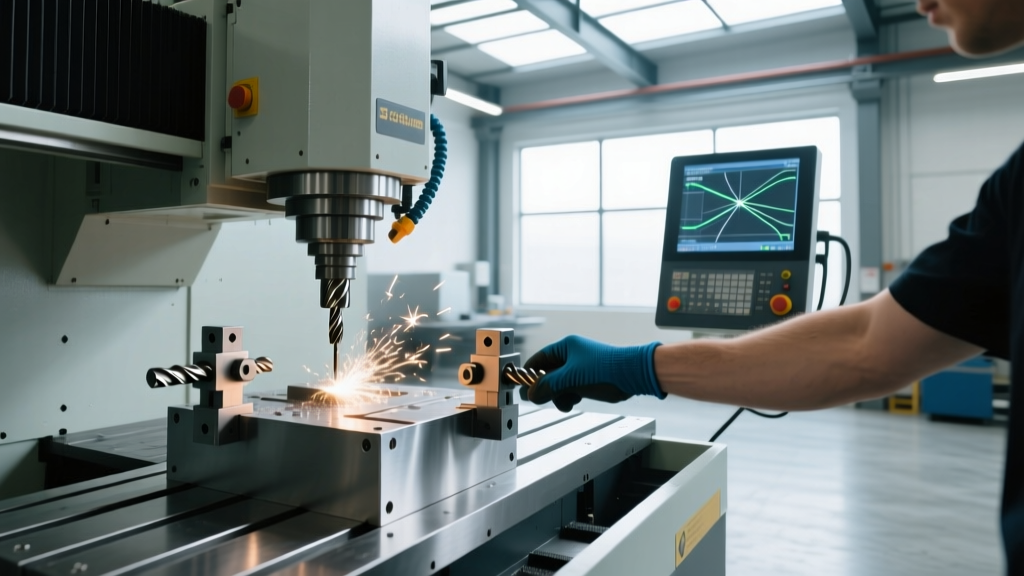
The fundamental divergence in CNC machine operation between industrial vertical machining centers (VMCs) and consumer-grade desktop routers lies in the physics of dynamic rigidity, closed-loop kinematics, and real-time G-code interpolation. While both systems utilize Cartesian coordinates to move a cutting tool through three or more axes, the mechanical execution of those movements dictates their respective capabilities, tolerances, and operational lifespans.
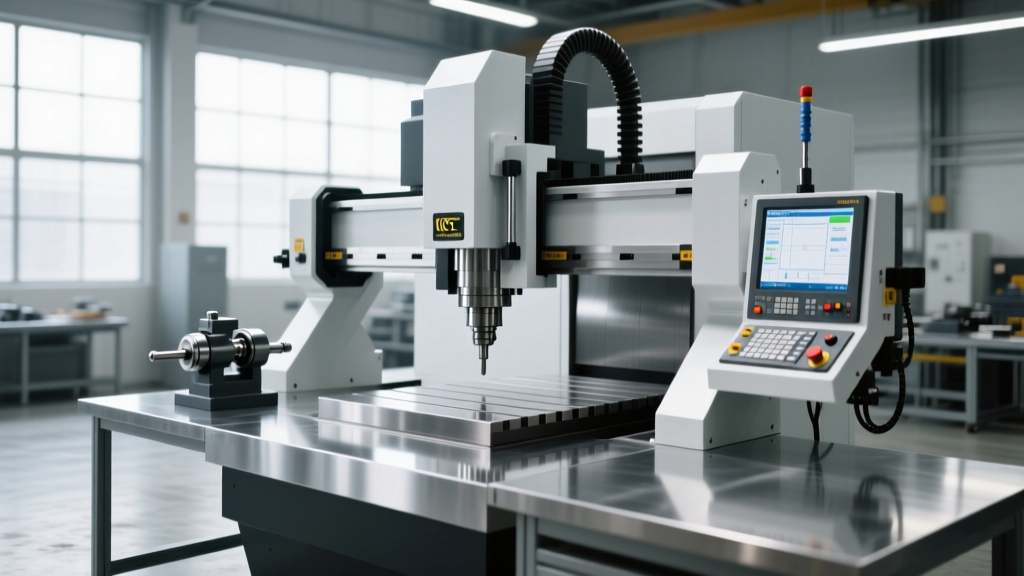
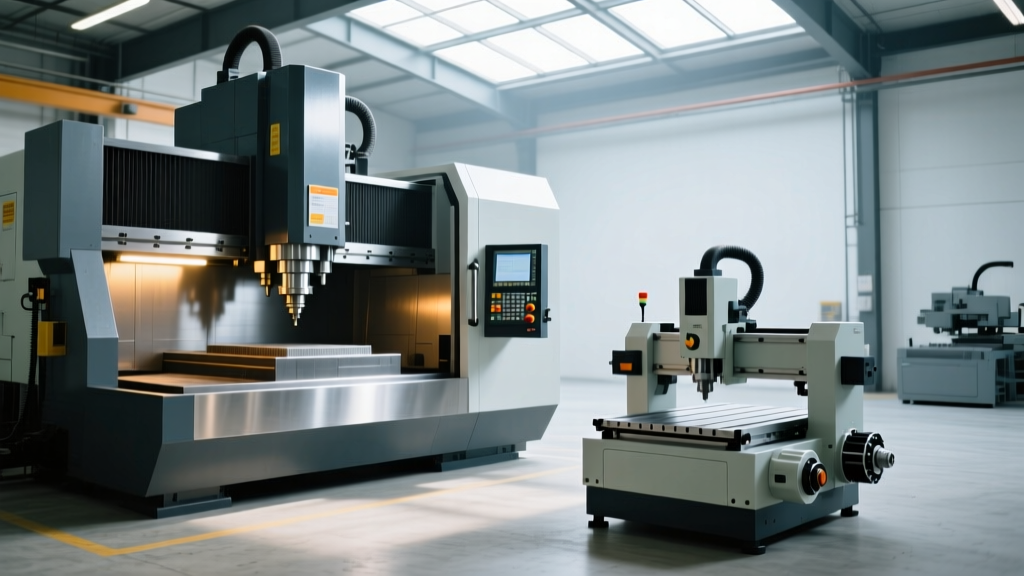
To understand these differences at a granular level, we must dissect the core subsystems that govern CNC machine operation: structural mass, drive mechanics, spindle tool retention, and controller logic. This technical breakdown contrasts a benchmark industrial VMC, such as the Haas VF-2, with a leading consumer-grade platform like the Carbide 3D Shapeoko 5.
Structural Rigidity and Harmonic Dampening
Industrial CNC machine operation relies on massive structural damping to absorb high-frequency vibrations generated during aggressive material removal. Industrial VMCs utilize heavily ribbed Meehanite cast iron or polymer concrete bases. Cast iron possesses a high internal damping capacity, absorbing vibrational energy and preventing harmonic resonance from transferring to the cutting tool.
Conversely, consumer CNC machines are constructed from extruded aluminum profiles (typically 6061-T6) and cold-rolled steel plates. While aluminum offers an excellent strength-to-weight ratio, it lacks the internal dampening characteristics of cast iron. During heavy cutting operations, aluminum frames can experience micro-deflections and harmonic ringing, which manifests as chatter marks on the workpiece surface and accelerates tool wear.
Engineering Insight: According to ISO 230-1 standards for machine tool testing, geometric accuracy is measured under static conditions, but operational accuracy is dictated by dynamic stiffness. A 5,000 lb cast-iron VMC will maintain sub-0.0005-inch tolerances under heavy radial loads, whereas a 150 lb aluminum router will experience elastic deformation exceeding 0.005 inches under identical cutting forces.
Drive Systems: Closed-Loop Servos vs. Open-Loop Steppers
The most critical distinction in CNC machine operation is the drive system. Industrial machines utilize AC synchronous servo motors paired with high-resolution absolute encoders (often 17-bit to 20-bit, providing over 130,000 to 1,000,000 pulses per revolution). This creates a closed-loop system. If the cutting tool encounters a hard spot in the material and the motor lags behind the commanded position by even a fraction of a micron, the encoder detects the error, and the servo drive instantly injects additional current to correct the positional deviation.
⚠️ Operational Warning: Open-Loop Stepper Stalling
Consumer machines predominantly use NEMA 23 or NEMA 34 stepper motors in an open-loop configuration. Stepper drivers send electrical pulses to the motor coils to move in discrete steps (typically 1.8 degrees per full step). The controller assumes the motor has moved. If the cutting force exceeds the motor's holding torque (usually around 1.2 to 3.0 Nm for NEMA 23), the motor will stall or skip steps. Because there is no positional feedback, the controller continues executing the G-code, resulting in a completely ruined part with no error message displayed on the screen.
Transmission Mechanics: Ball Screws vs. Belts
Industrial CNC machine operation translates rotary motor motion into linear axis movement using precision-ground C3 or C5 grade ball screws. These screws feature recirculating ball bearings that eliminate static friction and provide near-zero backlash. Furthermore, industrial ball screws are often pre-tensioned and internally cooled with chilled oil to prevent thermal expansion during high-speed rapids.
Consumer machines typically rely on steel-reinforced polyurethane timing belts (e.g., 9mm or 15mm wide GT2 or HTD profiles) or standard ACME lead screws with Delrin anti-backlash nuts. Belts introduce elastic stretch under load, while lead screws suffer from sliding friction and thermal growth, limiting rapid traverse rates to roughly 2 to 5 meters per minute, compared to the 25 to 35 meters per minute achievable on industrial ball screw systems.
Spindle Technology and Tool Retention Mechanisms
The spindle is the heart of CNC machine operation, and the method by which it holds the cutting tool dictates the machine's ability to handle lateral cutting forces.
- Industrial Tool Retention (BT40 / CAT40): Industrial VMCs use a tapered tool holder (7:24 taper ratio) secured by a high-tension retention knob and an internal pneumatic or hydraulic drawbar. This pulls the tool holder deep into the spindle taper, creating massive surface area contact and friction. This rigidity allows for heavy side-milling and deep cavity roughing without tool pull-out.
- Consumer Tool Retention (ER11 / ER20 Collets): Consumer routers use ER collets tightened via a mechanical nut. While ER collets provide excellent concentricity for round shank tools, they lack the axial pull-in force and radial rigidity of a BT40 taper. Attempting to run a 1-inch diameter face mill in an ER11 collet will result in severe tool deflection and collet slippage.
Technical Specification Comparison Matrix
| Specification | Industrial VMC (e.g., Haas VF-2) | Consumer Router (e.g., Shapeoko 5 Pro) |
|---|---|---|
| Base Price (Approx.) | $65,000 - $75,000+ | $2,100 - $2,500 |
| Machine Mass | 6,800 lbs (3,084 kg) | 115 lbs (52 kg) |
| Spindle Power | 22.4 kW (30 HP) Vector Drive | 1.2 kW - 2.2 kW VFD / Router |
| Tool Holder Interface | BT40 / CAT40 Taper | ER-11 Collet (Max 7mm shank) |
| Drive System | Closed-Loop AC Servos (Absolute Encoders) | Open-Loop NEMA 23 Steppers |
| Linear Transmission | Precision Ground Ball Screws (C3/C5) | Steel-Reinforced Timing Belts / Lead Screws |
| Rapid Traverse Rate | 30.5 m/min (1,200 IPM) | 4.5 m/min (180 IPM) |
| Positional Tolerance | ±0.0002 in (±0.005 mm) | ±0.005 in (±0.127 mm) |
Control Systems: Look-Ahead and Nano-Interpolation
CNC machine operation is only as precise as the mathematical interpolation performed by the controller. Industrial controllers, such as the Fanuc 0i-F Plus or Haas NGC, process thousands of G-code blocks per second. They utilize advanced look-ahead algorithms to analyze the geometric trajectory hundreds of moves in advance. This allows the controller to smoothly decelerate before sharp corners and maintain constant surface feed rates during complex 3D contouring, utilizing nano-interpolation to smooth out microscopic segment transitions.
Consumer machines typically run on open-source or lightweight controllers like GRBL, Mach3, or LinuxCNC. While highly capable for 2.5D profiling, GRBL's look-ahead buffer is generally limited to 16 to 24 blocks. When executing complex 3D toolpaths composed of thousands of microscopic line segments (G1 moves), the consumer controller struggles to calculate velocity changes in real-time. This results in the machine pausing micro-seconds at each node, causing dwell marks on the material surface and severely bottlenecking the maximum achievable feed rate.
Decision Framework: When to Upgrade to Industrial CNC Operation
Evaluating the transition from a consumer-grade router to an industrial VMC requires analyzing three operational bottlenecks:
- Material Hardness: If your operation requires machining materials harder than 6061 Aluminum (e.g., 7075-T6, Ti-6Al-4V, or 304 Stainless Steel), consumer belt-driven frames and ER collets will fail to maintain tolerances and destroy tooling. Industrial mass and BT40 rigidity are mandatory.
- Thermal Duty Cycle: Consumer routers are rated for intermittent use (2-4 hours). Continuous 24/7 operation will overheat stepper drivers, stretch timing belts, and wear out lead screw nuts. Industrial VMCs are engineered for 100% duty cycles with liquid-cooled spindle cartridges and enclosed way-covers.
- Tolerance Stack-Up: If your assembly requires press-fit bores or mating surfaces with geometric dimensioning and tolerancing (GD&T) flatness callouts tighter than 0.001 inches, the elastic deflection of a consumer machine will yield unacceptable scrap rates.
Thermal Stability and Precision Retention
The final major differentiator in CNC machine operation is thermal management. As industrial ball screws and spindles operate at high speeds, friction generates immense heat. Industrial VMCs employ active thermal compensation systems. Chilled oil is pumped through the core of the ball screws and the spindle cartridge to maintain a constant ambient temperature, preventing the metal from expanding and altering the tool tip position relative to the workpiece.
Consumer machines lack active cooling. As the stepper motors heat up, their holding torque drops significantly (torque degradation curves show a 30% to 50% loss at elevated RPMs). Furthermore, the friction in dry lead screws causes localized thermal expansion, meaning a consumer machine calibrated perfectly at 8:00 AM will exhibit dimensional inaccuracies by 2:00 PM due to uncompensated thermal growth. Understanding these deep technical specifications is essential for manufacturing engineers to select the correct platform for their specific operational demands.