CNC Roll Grinding Machine Specs: Industrial vs Consumer CNC
Compare industrial CNC roll grinding machine specs with consumer CNCs. Explore hydrostatic bearings, crowning kinematics, and heavy-duty tolerances.
The Physics of Scale: Why Mass Dictates Grinding Precision
The gap between an industrial CNC roll grinding machine and a consumer-grade desktop CNC is not merely a matter of size; it is a fundamental divergence in physics, kinematics, and thermal management. Industrial roll grinders—manufactured by specialists like Herkules and Waldrich Siegen—are engineered to remove microscopic layers of hardened steel from workpieces weighing up to 250 tons. Consumer-grade CNCs, such as benchtop mills or desktop routers, rely on lightweight castings and ball screws designed for prototyping aluminum or plastics. When applied to heavy-duty cylindrical grinding, the structural limitations of consumer machines result in catastrophic regenerative chatter, thermal drift, and immediate spindle failure.
⚠️ Engineering Warning: Attempting to retrofit a consumer-grade CNC router with a high-speed grinding spindle for heavy roll maintenance will inevitably destroy the machine's linear guides. The radial cutting forces generated by a vitrified CBN or aluminum oxide grinding wheel exceed the static load ratings of standard profile linear rails by a factor of 10 to 50.Core Technical Specifications: Industrial vs. Consumer Platforms
To understand the operational boundaries of these machines, we must compare the raw technical specifications of a heavy-duty industrial roll grinder against a high-end consumer/prosumer CNC mill. The data below reflects current 2026 market standards for steel and paper mill maintenance equipment versus advanced desktop machining.
| Specification | Industrial CNC Roll Grinder (e.g., Herkules Monolith) | Consumer/Prosumer CNC (e.g., Tormach 1500MX) |
|---|---|---|
| Machine Mass | 80,000 kg – 250,000 kg | 1,200 kg – 1,800 kg |
| Max Workpiece Weight | Up to 250 Tons | ~50 kg (on table) |
| Guideway Technology | Hydrostatic / Hydrodynamic Oil Film | Profile Linear Rails (Ball/Roller) |
| Z-Axis Resolution | 0.0001 mm (0.1 µm) | 0.005 mm (5.0 µm) |
| Achievable Surface Finish | Ra 0.05 µm (Mirror Finish) | Ra 1.6 µm (Milled, not ground) |
| Control System | Siemens Sinumerik One (Grind Cycles) | LinuxCNC / Mach4 / Grbl |
| Approximate Capital Cost | $3.5M – $12M+ | $8,000 – $25,000 |
How an Industrial CNC Roll Grinding Machine Actually Works
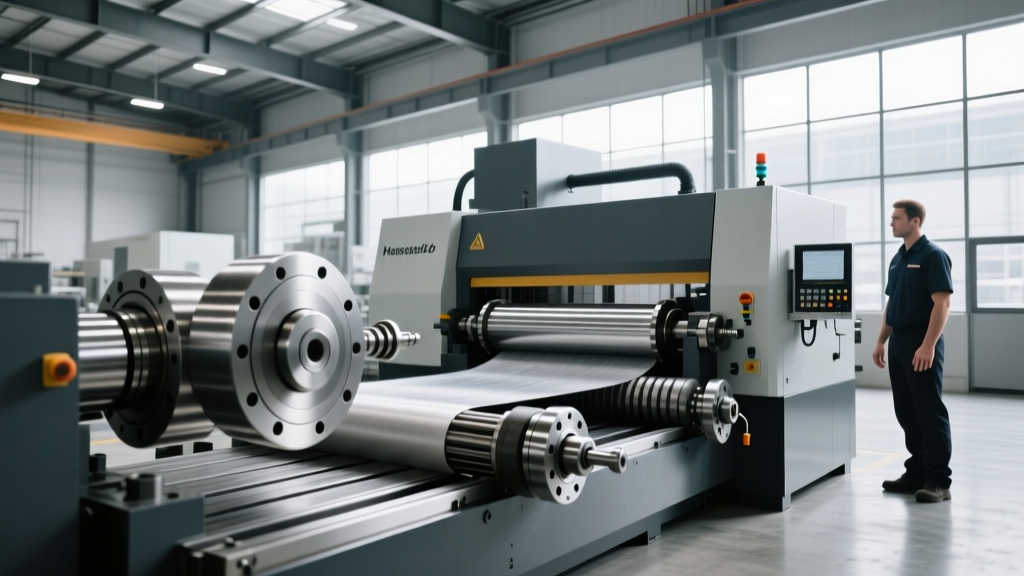
The operation of a CNC roll grinding machine is defined by its ability to manage extreme rotational inertia while executing complex, multi-axis synchronous movements. Unlike standard milling, where the tool rotates and the workpiece is stationary or moves linearly, roll grinding reverses this kinematic: the workpiece (the roll) rotates on massive headstocks, while the grinding wheel traverses along the X-axis and feeds radially via the Z-axis.
Dynamic CNC Crowning and Nip Deflection Compensation
The most critical function of a CNC roll grinder is generating a 'crown'—a precise, convex microscopic profile along the length of the roll. In paper mills and steel rolling stands, rolls are subjected to immense 'nip pressure' (the crushing force between two mating rolls). If a roll is ground perfectly cylindrical, this pressure will cause it to deflect in the center, resulting in thicker material in the middle of the sheet and thinner edges.
To counteract this, the CNC system dynamically interpolates the Z-axis (wheelhead infeed) while the X-axis (carriage) traverses. Using specialized grinding macros within the Siemens Sinumerik control, the machine continuously varies the Z-depth by fractions of a micron over a traverse length of up to 12 meters. This Continuous Variable Crown (CVC) capability requires the Z-axis to respond to positional changes in the X-axis with zero latency and zero stick-slip, a physical impossibility on consumer CNCs utilizing standard ball screws and linear bearings.
Hydrostatic Guideways vs. Linear Rails
Consumer CNCs rely on recirculating ball or roller linear guides. Under the heavy, interrupted cutting forces of grinding, these mechanical contacts suffer from 'stick-slip' friction at low speeds and lack the damping required to absorb high-frequency vibrations. Industrial roll grinders utilize hydrostatic guideways. High-pressure oil (typically maintained at 100 to 200 bar) is pumped into precision-machined pockets on the sliding surfaces, creating a rigid fluid film typically 15 to 25 microns thick.
- Infinite Stiffness at Zero Speed: Because the carriage floats on oil, there is no static friction to overcome, eliminating stick-slip entirely.
- Unmatched Damping: The oil film acts as a massive shock absorber, dissipating the vibrational energy that causes regenerative chatter marks on the roll surface.
- Zero Wear: With no metal-to-metal contact, the guideways do not degrade over decades of continuous heavy-duty operation.
Failure Modes: Pushing Consumer CNCs Beyond Limits
When manufacturers attempt to use under-specification CNC equipment for cylindrical grinding, specific, predictable failure modes occur. Understanding these edge cases highlights why industrial specs are non-negotiable for mission-critical rolls.
Common Failure Modes in Light-Duty Grinding
- Thermal Ball Screw Growth: Grinding generates immense localized heat. In consumer CNCs, this heat transfers into the Z-axis ball screw, causing thermal expansion. A 5°C temperature rise in a 500mm steel ball screw can result in over 0.005 mm (5 microns) of Z-axis drift, instantly ruining the roll's tolerance.
- Spindle Bearing Collapse: Desktop CNC spindles utilize precision angular contact bearings preloaded for light milling. The continuous, high-lateral force of a grinding wheel will brinell the bearing races within hours, leading to catastrophic spindle seizure.
- Wheel Loading and Glazing: Without the high-torque, low-RPM stability of an industrial wheelhead drive, the abrasive grains of the grinding wheel fail to fracture properly. The wheel 'loads' with swarf, generating excessive friction, burning the workpiece, and potentially causing the wheel to explode due to thermal shock.
Thermal Management and In-Process Gauging
Achieving a surface finish of Ra 0.1 µm or better on a 10-ton steel roll requires absolute thermal stability. Industrial CNC roll grinding machines feature closed-loop chilled oil systems that regulate the temperature of the hydrostatic supply, the spindle bearings, and the workpiece center drives to within ±0.1°C of the ambient shop temperature. Furthermore, modern industrial grinders are equipped with in-process gauging systems. These are CNC-integrated linear variable differential transformers (LVDTs) that physically touch the rotating roll during the grinding pass, feeding real-time diameter data back to the control loop to adjust the Z-axis on the fly, compensating for wheel wear and thermal expansion simultaneously.
Frequently Asked Questions (FAQ)
Can a consumer CNC be used to grind small, lightweight shafts?
For non-critical, low-tolerance shafts (e.g., DIY robotics or basic prototyping where ±0.05mm is acceptable), a heavily modified prosumer CNC with a dedicated high-frequency spindle and flood coolant can perform light cylindrical grinding. However, it cannot achieve the surface finishes or geometric tolerances required for hydraulic cylinders, precision bearings, or industrial rollers.
Why do industrial roll grinders use hydrodynamic bearings for the workpiece headstocks?
While the carriage uses hydrostatic (externally pressurized) bearings, the massive headstocks supporting the roll often use hydrodynamic (wedge-film) bearings. As the heavy roll spins, it naturally draws oil into a wedge, creating immense load-bearing capacity that scales with the weight of the workpiece and its rotational speed, safely supporting loads exceeding 100 tons without metal contact.
What is the typical ROI timeline for an industrial CNC roll grinder?
For steel mills and paper manufacturers, bringing roll grinding in-house with a $5M+ CNC machine typically yields an ROI within 24 to 36 months. This is achieved by eliminating the logistics costs of shipping 50-ton rolls to off-site toll grinding facilities, reducing mill downtime by 40%, and extending roll service life through superior CNC crowning profiles.