CNC Machine Data Collection for Entry-Level Hobbyist Routers
Compare cnc machine data collection methods for entry-level hobbyist routers. Analyze costs, sensors, and software for Shapeoko and Onefinity.
The Telemetry Gap in Sub-$3,000 CNC Routers
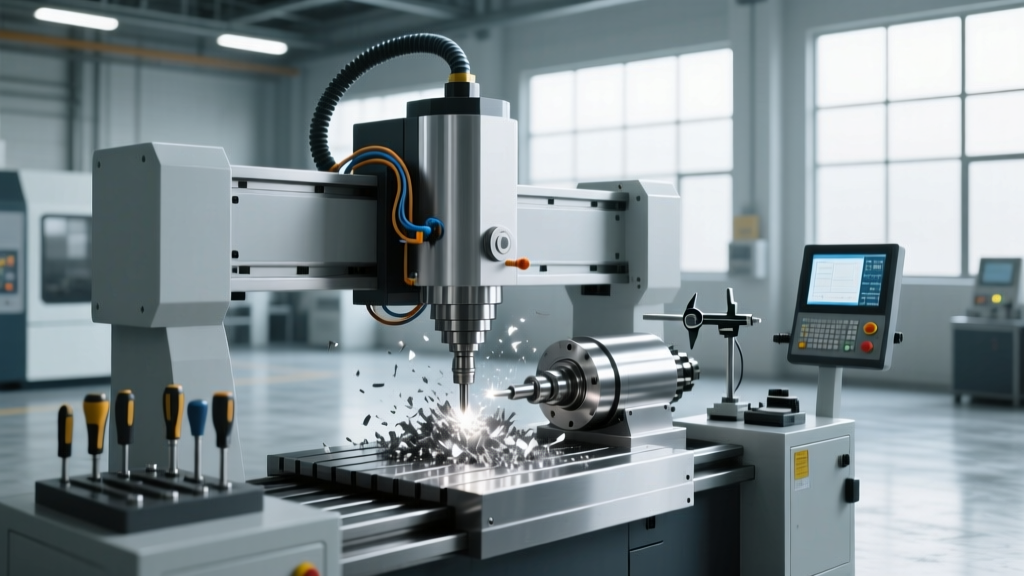
When makers and micro-job-shops invest in entry-level CNC machines like the Shapeoko 5 Pro ($2,399) or the Onefinity Woodworker ($2,099), the focus is almost entirely on mechanical rigidity, spindle power, and work area. What is routinely ignored is telemetry. Industrial VMCs from Haas or DMG MORI come pre-wired with MTConnect or OPC-UA adapters, streaming real-time spindle load, axis torque, and thermal data to the cloud. Hobbyist routers, by contrast, output nothing but G-code execution signals. This lack of native cnc machine data collection forces makers to rely on guesswork for tool wear, chatter detection, and cycle optimization.
The Entry-Level Telemetry Gap: A dull 0.25-inch carbide endmill cutting 6061 aluminum will eventually snap, ruining the workpiece and potentially damaging the Z-axis lead screw. Without spindle load monitoring, the machine cannot detect the 20% amperage spike that precedes tool failure. Implementing custom data collection is not just about logging hours; it is about predictive maintenance on a budget.Comparing 4 Alternatives for Hobbyist Data Collection
Because budget CNC controllers (like the Carbide Motion board or standard GRBL Mega 2560 shields) lack dedicated sensor inputs, makers must build or buy parallel data pipelines. Below is a comparison matrix of the four most viable alternatives for cnc machine data collection on entry-level rigs.
| Method | Hardware Cost | Setup Time | Data Granularity | Best Application |
|---|---|---|---|---|
| Controller Software Logging | $0 | 10 mins | Low (Cycle time, macros) | Basic job costing & scheduling |
| Non-Invasive Current Sensors | $42 | 2 hours | High (Real-time RMS amps) | Tool wear & spindle overload detection |
| ADXL345 Accelerometers | $15 | 3 hours | Extreme (High-freq FFT) | Regenerative chatter prevention |
| Commercial IoT Gateways | $300+ | 1 hour | Medium (Aggregated state) | Multi-machine micro-job-shops |
Method 1: Controller Software Logging (The Zero-Cost Baseline)
The most accessible form of cnc machine data collection requires no hardware modifications. Software controllers like Universal G-Code Sender (UGS) and Carbide Motion parse G-code and can log execution metrics. By enabling verbose logging in UGS, you can capture exact cycle times, rapid traverse distances, and G-code line execution rates.
Pushing GRBL Macros for Deeper Data
Standard GRBL firmware does not stream real-time positional data at high frequencies, but you can exploit macro variables. By embedding custom M-codes or utilizing the `$#` parameter query commands via a Python script connected to the controller's serial port (115200 baud), you can poll the machine's exact X, Y, and Z coordinates every 100 milliseconds. While this does not tell you how hard the machine is working, it allows you to build a digital twin of the toolpath execution, identifying exactly where in the G-code file the machine spends the most time, which is critical for optimizing feed rates in high-density toolpath areas.
Method 2: Non-Invasive Spindle Current Monitoring (The DIY Sweet Spot)
For makers running trim routers like the DeWalt DWP611 or Makita RT0701C, or entry-level VFDs, monitoring electrical current is the most reliable proxy for cutting forces. When a tool dulls or the depth of cut is too aggressive, the spindle motor draws more current to maintain RPM.
The $42 ESP32 Sensor Build
You do not need to splice into high-voltage lines to achieve this. The safest and most effective approach uses a YHDC SCT-013-030 non-invasive split-core current transformer. This sensor clamps around the live wire of the spindle's power cord and outputs a 0-1V analog signal proportional to a 0-30A draw.
- Microcontroller: ESP32-WROOM-32 ($6) for built-in Wi-Fi and 12-bit ADC.
- Sensor: SCT-013-030 ($18). Do not use the SCT-013-000, as it requires a burden resistor and op-amp circuit; the -030 has a built-in voltage output.
- Bias Circuit: Two 10k-ohm resistors and a 10uF capacitor to create a 1.65V DC offset, allowing the ESP32 to read the AC wave's negative cycles ($2).
- Software: The EmonLib C++ library calculates the RMS current and pushes the data via MQTT to a local Mosquitto broker, which feeds into InfluxDB and Grafana.
Interpreting the Amperage Data
A sharp 0.25-inch 3-flute carbide endmill cutting 0.125-inch deep into 6061 aluminum at 18,000 RPM and 40 IPM will typically cause the DeWalt DWP611 to draw roughly 4.5 amps. As the tool's cutting edges wear, friction increases. When the Grafana dashboard shows the RMS current creeping past 6.5 amps, it is a mathematically reliable indicator that the tool requires replacement or that the feed rate must be reduced to prevent chatter.
Method 3: ADXL345 Accelerometers for Chatter Detection
Regenerative chatter is the enemy of surface finish and tool life. It occurs when the vibration of the current tool pass perfectly aligns with the subsequent pass, amplifying the harmonic frequency. While industrial machines use expensive acoustic emission sensors, hobbyists can adapt the ADXL345 digital accelerometer—a component popularized by the Klipper 3D printer firmware—for high-fidelity cnc machine data collection.
Mounting and Sampling Rates
The ADXL345 must be rigidly mounted directly to the Z-axis carriage or the spindle housing using a machined aluminum bracket; zip-ties or double-sided tape will dampen the high-frequency harmonics. The sensor communicates via SPI to a Raspberry Pi running a custom Python script utilizing the SciPy library.
The ADXL345 supports a maximum sampling rate of 3200Hz. To accurately capture chatter in a spindle running at 24,000 RPM (400Hz), the tooth-passing frequency for a 3-flute cutter is 1200Hz. According to the Nyquist-Shannon sampling theorem, a 3200Hz sampling rate is sufficient to capture the fundamental frequency and its immediate sub-harmonics, which are the primary indicators of regenerative chatter.
By running a Fast Fourier Transform (FFT) on the Z-axis acceleration data in real-time, the Python script can identify the dominant vibration frequency. If the dominant frequency shifts away from the calculated tooth-passing frequency and locks onto a structural resonance of the machine frame (often between 80Hz and 150Hz on hobbyist routers), the script can trigger an emergency stop via the GRBL serial interface before the tool breaks.
Method 4: Commercial IoT Gateways (The Overkill Option)
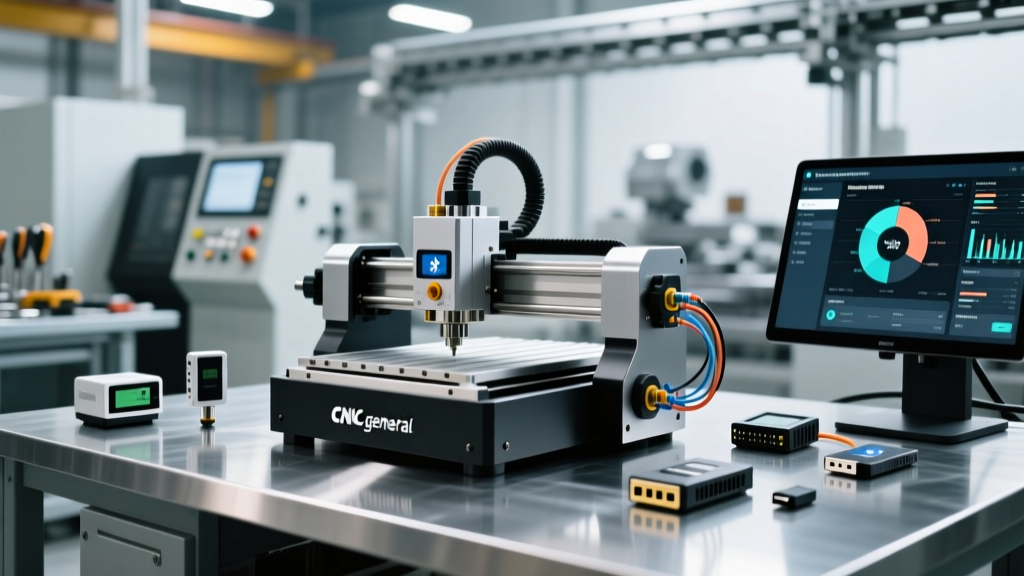
For makers transitioning from a garage hobby to a 5-machine micro-job-shop, DIY sensors become a maintenance liability. Commercial IoT gateways designed for legacy and entry-level machines offer plug-and-play cnc machine data collection. Devices like the FreeThings Edge Gateway or basic MTConnect adapters connect to the CNC's RS-232 or USB port, translating GRBL/Mach3 status codes into standardized JSON payloads.
While these systems cost upwards of $300 for the hardware plus $30 to $100 monthly for cloud dashboard subscriptions, they provide OEE (Overall Equipment Effectiveness) tracking, automated cycle-time reporting, and spindle utilization heat maps without requiring a single line of C++ or Python. However, for a single-machine hobbyist, the ROI is virtually non-existent compared to the $42 ESP32 current monitor.
Decision Framework: Which Setup Should You Build?
Selecting the right data collection architecture depends entirely on your operational bottlenecks. Use this framework to decide your next hardware investment:
- If your primary issue is job costing and quoting accuracy: Stick to Method 1. Write a Python script to parse Carbide Motion or UGS log files, extracting total spindle-on time versus rapid traverse time to calculate true machine hourly costs.
- If you are breaking endmills in aluminum and brass: Build the Method 2 ESP32 Current Monitor. The real-time amperage threshold alerts will save you hundreds of dollars in shattered carbide and ruined stock.
- If your surface finishes are poor and you hear high-pitched ringing: Implement the Method 3 ADXL345 Chatter Detector. The FFT data will allow you to build a custom 'Sweet Spot' RPM chart for your specific machine frame.
- If you manage 3+ machines and need to bill clients for exact cycle times: Invest in Method 4. The time saved on manual logging will offset the SaaS subscription costs within the first month.
Authoritative References & Further Reading
Implementing robust telemetry on budget hardware bridges the gap between hobbyist making and professional manufacturing. For deeper technical standards and machine-specific documentation, consult the following resources:
- MTConnect Institute: Review the open-source XML schemas for machine tool communication at mtconnect.org. While aimed at industrial VMCs, the data models for spindle load and axis position are directly applicable to custom database schemas for hobbyist rigs.
- NIST Smart Manufacturing: The National Institute of Standards and Technology provides extensive frameworks on edge computing and sensor integration for small-to-medium manufacturers. Explore their research at nist.gov/smart-manufacturing.
- Carbide 3D Documentation: For specific GRBL parameter queries and serial port communication protocols used in the Shapeoko series, refer to the official Carbide 3D Docs.