Granite CNC Machine Vibration Damping vs Cast Iron Alternatives
Compare granite CNC machine bases against cast iron and epoxy alternatives for vibration damping. Discover top noise reduction solutions for precision.
Executive Briefing
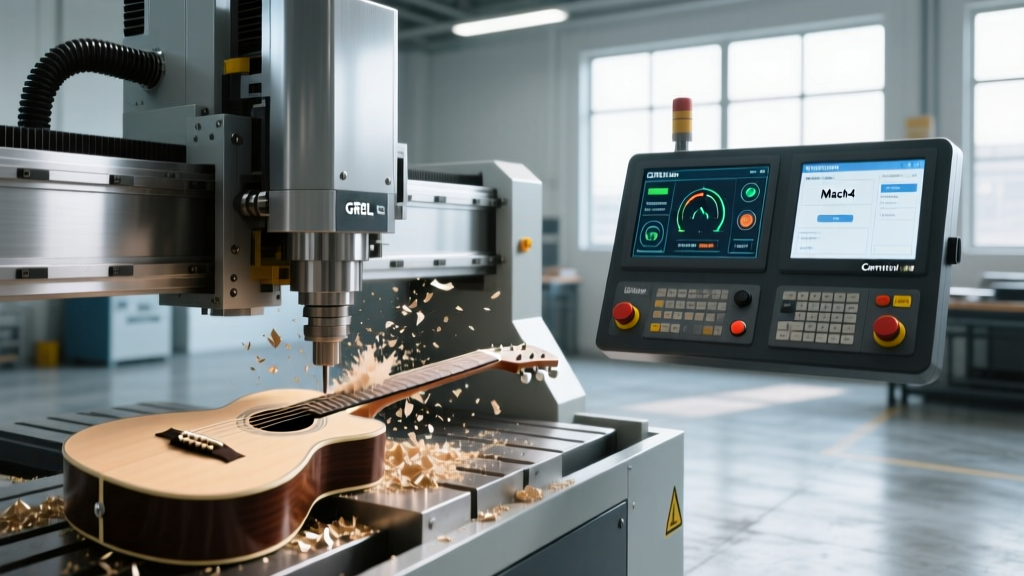
Regenerative chatter and structural resonance limit machining tolerances, accelerate tool wear, and generate hazardous noise levels. While traditional cast iron bases dominate the market, the granite CNC machine architecture—utilizing natural or epoxy granite—offers superior passive vibration damping. This analysis compares granite base structures against cast iron, steel weldments, and active damping alternatives to determine the optimal noise and vibration reduction strategy for high-precision manufacturing in 2026.
The Physics of CNC Vibration and Noise Generation
Vibration in CNC machining primarily manifests as regenerative chatter, a self-excited oscillation occurring when the cutting tool interacts with the wavy surface left by previous tooth passes. This phenomenon typically excites structural modes between 50 Hz and 500 Hz. The resulting acoustic energy often pushes ambient shop noise past the OSHA permissible exposure limit of 85 dBA over an 8-hour time-weighted average, with heavy stone or metal milling frequently exceeding 105 dBA at the operator console.
According to ISO 230-1 standards for machine tool testing, geometric accuracy under operational loads is directly compromised by low-frequency structural deflections and high-frequency spindle chatter. Mitigating these forces requires either increasing the dynamic stiffness of the machine base or maximizing its internal damping capacity.
Granite CNC Machine Bases: Natural vs. Epoxy Polymer
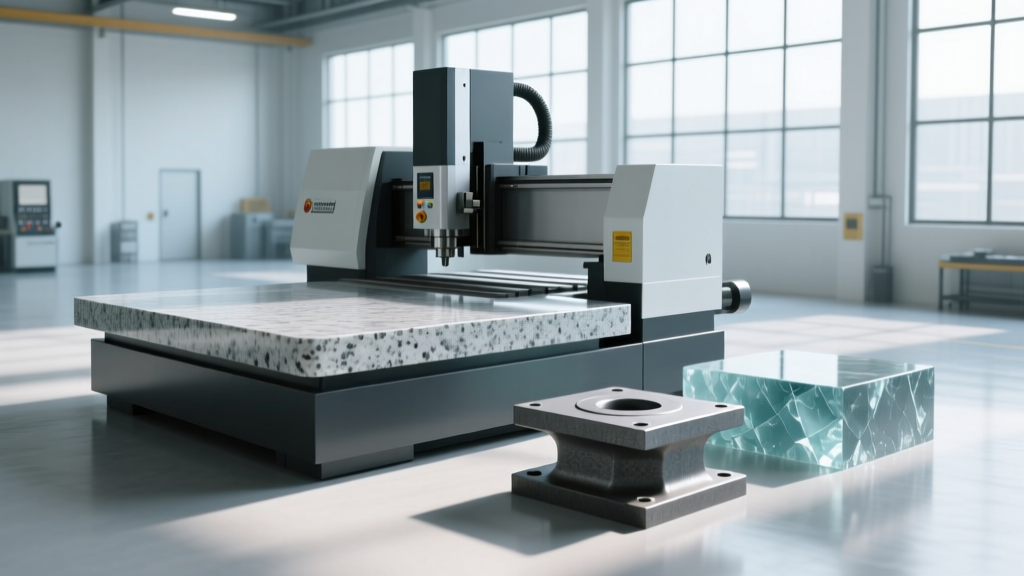
The term 'granite CNC machine' generally refers to equipment built on either quarried natural granite or cast epoxy granite (polymer concrete). Both materials are engineered to solve the inherent damping deficiencies of metallic structures.
Natural Granite Structures
Natural granite provides exceptional thermal stability and a high modulus of elasticity. Its crystalline structure dissipates vibrational energy through internal micro-friction. However, natural granite is limited by size constraints, brittleness under point loads, and the high cost of precision lapping for linear guideway mounting surfaces.
Epoxy Granite (Polymer Concrete)
Epoxy granite combines crushed granite aggregate with an epoxy resin binder. Cast at room temperature into custom molds, it allows for complex geometries, integrated fluid channels, and threaded inserts. The polymer matrix acts as a viscoelastic damper, absorbing vibrational energy far more effectively than the rigid crystalline bonds in natural stone or metal.
Material Damping Capacity Ratios
Measured via logarithmic decrement of free vibration decay (Relative to Cast Iron = 1.0):
- Steel Weldment: 0.3x (Poor damping, high stiffness)
- Cast Iron: 1.0x (Baseline standard)
- Natural Granite: 3.0x to 5.0x (High thermal stability, moderate damping)
- Epoxy Granite: 10.0x to 30.0x (Exceptional damping, lower stiffness)
Material Alternatives: Damping and Stiffness Matrix
When selecting a base material for a new CNC build or evaluating a retrofit, engineers must balance damping capacity against static stiffness and thermal mass. The following matrix compares the primary structural materials used in modern CNC manufacturing.
| Material | Relative Damping | Static Stiffness | Thermal Stability | Estimated Base Cost (5-Axis Scale) |
|---|---|---|---|---|
| Steel Weldment | Very Low | High | Poor (High expansion) | $8,000 - $15,000 |
| Cast Iron (Meehanite) | Moderate | High | Good | $25,000 - $45,000 |
| Natural Granite | High | Very High | Excellent | $40,000 - $70,000 |
| Epoxy Granite | Very High | Moderate | Excellent | $20,000 - $35,000 |
As highlighted by NIST Advanced Manufacturing research on precision machine tools, epoxy granite's lower static stiffness requires thicker cross-sections and strategic ribbing to match the rigidity of cast iron. However, the 10x to 30x improvement in damping drastically reduces the amplitude of chatter, allowing for higher material removal rates (MRR) without sacrificing surface finish.
Alternative Vibration Damping Technologies
If procuring a dedicated granite CNC machine is outside the capital expenditure budget, or if existing cast-iron machinery requires vibration mitigation, several alternative damping technologies can be deployed.
1. Elastomeric Isolation Mounts (Passive)
Installing high-deflection elastomeric pads (such as Fabreeka or Mason Industries mounts) between the machine leveling feet and the concrete foundation isolates the CNC from ground-borne vibrations (e.g., nearby stamping presses or forklift traffic). Limitation: These mounts do not dampen internally generated regenerative chatter; they only prevent external vibration transmission.
2. Tuned Mass Dampers (TMD)
TMDs are secondary mass-spring systems attached to the machine column or spindle head. They are tuned to the exact resonant frequency of the primary structure. When the machine begins to chatter, the TMD oscillates out of phase, canceling the vibrational energy. Cost: $4,000 to $12,000 per axis. Limitation: Highly effective for a specific, narrow frequency band, but ineffective if the chatter frequency shifts due to tool wear or varying workpiece masses.
3. Active Damping Systems
Active systems use piezoelectric sensors to detect vibration in real-time and electromagnetic actuators to inject counter-forces within milliseconds. Cost: $35,000 to $80,000+ for full integration. Limitation: Requires complex control loop tuning and significant power infrastructure.
Noise Reduction: Acoustic Enclosures vs. Base Damping
Vibration damping and noise reduction are correlated but distinct engineering challenges. A granite CNC machine base eliminates structural resonance (which causes tool chatter and poor surface finishes), but it does not entirely eliminate airborne acoustic noise generated by the cutting zone, coolant pumps, and spindle motors.
'Reducing structural vibration improves part geometry and tool life, but achieving OSHA compliance for operator noise exposure requires addressing airborne acoustic pathways through mass-loaded barriers and acoustic absorption.' - Industrial Hygiene Engineering Guidelines
Acoustic Enclosure Alternatives
- Full Machine Enclosures: Constructed from 1/4-inch polycarbonate with mass-loaded vinyl (MLV) interlayers. Reduces airborne noise by 15 to 25 dBA. Cost: $12,000 - $25,000.
- Spindle/Toolpath Dampening: Using variable pitch end mills and trochoidal milling toolpaths breaks up the harmonic frequencies of the cutting edges, reducing high-frequency acoustic emissions at the source without physical barriers.
- Acoustic Baffles: Hanging suspended polyurethane foam wedges above the machining cell. Reduces reverberation time (RT60) in the shop but offers minimal direct dB reduction at the operator's ear.
2026 Decision Framework: Selecting Your Damping Strategy
Use the following operational parameters to determine whether a granite CNC machine base or an alternative damping solution is required for your facility.
- If machining aerospace composites, optical glass, or hardened tool steels: The extreme sensitivity to micro-chatter necessitates an epoxy granite or natural granite base. The 30x damping coefficient of epoxy granite is non-negotiable for achieving sub-micron surface finishes.
- If performing heavy roughing on large castings (e.g., engine blocks): Static stiffness is more critical than high-frequency damping. A heavily ribbed Meehanite cast iron base is superior, as epoxy granite may deflect under massive static cutting forces.
- If operating in a shared facility with heavy forging or stamping equipment: Ground-borne vibration is the primary enemy. Retrofit your existing cast iron CNC with active pneumatic isolation mounts rather than replacing the machine base.
- If failing OSHA noise audits (>85 dBA TWA): Base material changes will not solve airborne noise. Invest immediately in a sealed acoustic enclosure with integrated HEPA filtration and automated door actuators.
Cost and ROI Analysis: Granite vs. Cast Iron Retrofits
Upgrading to a 5-axis granite CNC machine architecture represents a significant capital investment, typically ranging from $180,000 to $350,000 for mid-format stone and precision metal mills. By comparison, a standard cast iron equivalent costs between $120,000 and $220,000.
However, the ROI on the granite base is realized through tooling savings and cycle time reductions. The superior damping allows for 20% to 40% higher feed rates and deeper axial depths of cut without triggering chatter. In high-volume production environments, the extended life of carbide end mills and indexable inserts—often increasing by a factor of 2.5x due to the elimination of harmonic micro-fractures on the cutting edges—can recoup the $60,000 base premium within 14 to 18 months.
For job shops with mixed materials and lower volumes, the capital is better allocated toward a standard cast iron machine ($150,000) supplemented by a $6,000 set of tuned mass dampers and a $15,000 acoustic enclosure, yielding a highly capable, OSHA-compliant cell for $171,000 total.