CNC Welding Machine Workholding: Industry Case Studies
Explore how aerospace and heavy equipment manufacturers optimize workholding for CNC welding machines to eliminate thermal distortion and boost throughput.
The Hidden Bottleneck in Automated Welding: Thermal Distortion
When manufacturers deploy a cnc welding machine to automate production, the robotic arm and power source rarely dictate the ultimate cycle time or quality limit. The true bottleneck is workholding. Thermal expansion during the weld cycle introduces residual stresses that can warp a part by several millimeters once the clamps are released. In 2026, leading fabricators are abandoning static, custom-welded fixtures in favor of dynamic, thermally conductive modular workholding systems.
According to research published in the American Welding Society (AWS) Welding Journal, improper fixturing accounts for up to 34% of post-weld rework in automated cells. This article examines two distinct industrial case studies demonstrating how advanced fixturing methodologies solve complex distortion and setup challenges in CNC welding environments.
Case Study 1: Aerospace Ti-6Al-4V Structural Rib Welding
The Challenge: An aerospace tier-1 supplier utilized a 6-axis CNC GTAW (TIG) welding machine to join 2.5mm thick Ti-6Al-4V titanium structural ribs. Titanium's high coefficient of thermal expansion and low thermal conductivity resulted in severe angular distortion. Initial runs yielded an average deflection of 3.2mm at the rib tips, requiring costly post-weld stress relieving and manual straightening.
The Fixturing Solution: Thermal Sinking and Hydraulic Clamping
The engineering team replaced their traditional 1045 carbon steel fixtures with a custom base machined from Ampcoloy 940, a high-strength copper alloy with thermal conductivity roughly eight times greater than steel. This acted as a massive heat sink, pulling thermal energy away from the weld zone rapidly.
For actuation, they integrated Roemheld hydraulic swing clamps operating at 250 bar. Unlike manual toggle clamps, the hydraulic system provided a consistent, programmable clamping force of 14.5 kN per node. Crucially, the CNC welding machine's PLC was programmed to dynamically reduce clamping pressure by 20% during the cooling phase, allowing the metal to contract uniformly without inducing locked-in tensile stresses.
Data Highlight: Aerospace Fixture ROI
- Initial Deflection: 3.2mm (Out of tolerance)
- Post-Fixture Deflection: 0.08mm (Within 0.1mm aerospace spec)
- Fixture Investment: $28,500 (Ampcoloy base + Roemheld hydraulics)
- Payback Period: 4.5 months (Eliminated $6,200/month in post-weld straightening labor)
Case Study 2: Heavy Equipment AR400 Chassis GMAW
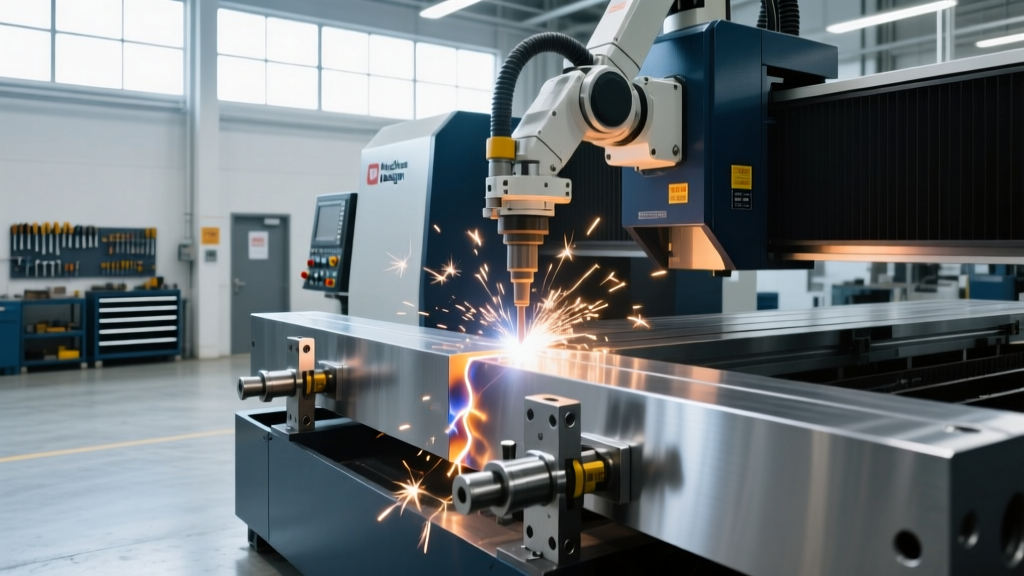
The Challenge: A heavy machinery OEM used a gantry-style CNC welding machine for high-deposition GMAW (MIG) on 25mm AR400 abrasion-resistant steel chassis components. The high heat input (350 amps) generated massive amounts of spatter, which fused to their custom-welded steel fixture beds. Operators spent 45 minutes per shift chipping spatter off the fixtures, and part changeovers took over an hour due to the rigid, dedicated nature of the tooling.
The Fixturing Solution: Modular 3D Tables and Anti-Spatter Coatings
The facility transitioned to a Siegmund 3D modular fixturing system featuring a nitrided steel tabletop with 28mm precision boreholes. Nitriding increases surface hardness to over 60 HRC, providing a baseline resistance to spatter adhesion. To further protect the workholding, all modular clamping arms and stop pins were treated with a chromium nitride (CrN) PVD anti-spatter coating.
Instead of dedicated fixtures, operators used standardized pneumatic toggle clamps. The CNC welding machine was equipped with a tool-changer style end-effector that could automatically swap between the welding torch and a pneumatic fixture actuation tool, allowing the machine to autonomously reconfigure the modular clamps for different chassis variants.
'The shift from dedicated welded fixtures to precision modular workholding didn't just reduce our setup time from 65 minutes to 12 minutes; it fundamentally changed our production flow. The CNC welding machine now handles batch sizes of one profitably.' — Director of Manufacturing, Heavy Equipment OEM
Workholding Actuation Matrix for CNC Welding
Selecting the right clamping actuation is critical when programming a CNC welding machine. The table below contrasts the primary methods used in modern automated cells.
| Actuation Method | Typical Clamping Force | Thermal Stability | Best Application | Cost per Node (2026) |
|---|---|---|---|---|
| Manual Toggle | 2 - 5 kN | Low (Operator dependent) | Prototyping, low-volume job shops | $85 - $150 |
| Pneumatic | 5 - 15 kN | Medium | Sheet metal, high-cycle thin gauge | $350 - $600 |
| Hydraulic | 15 - 50+ kN | High (Programmable pressure) | Thick plate, aerospace, high distortion | $800 - $1,400 |
| Magnetic | Variable (Electro-permanent) | High (Uniform surface hold) | Flat ferrous plates, shipbuilding | $12,000+ (System) |
Troubleshooting Decision Tree: Fixturing Failure Modes
Even with advanced tooling, CNC welding machine operators encounter fixturing-related defects. Use this diagnostic framework to isolate the root cause.
Symptom: Part Springs Back After Unclamping
- Cause A: Clamping force exceeded the yield strength of the base metal at elevated temperatures, causing plastic deformation under the clamp.
- Fix: Reduce hydraulic pressure or increase the footprint of the clamping pad to distribute the load.
- Cause B: Insufficient heat sinking causing localized thermal expansion that the fixture physically restrains, locking in stress.
- Fix: Introduce copper chill bars directly adjacent to the weld seam.
Symptom: Arc Instability and Porosity
- Cause A: Grounding clamp attached to a painted or rusty section of the modular fixture table, causing erratic current return.
- Fix: Machine a dedicated, bare-metal grounding pad on the fixture bed and use a magnetic ground clamp with a braided copper cable.
- Cause B: Shielding gas disruption caused by pneumatic clamp hoses positioned too close to the weld pool.
- Fix: Reroute actuation lines below the fixture table surface; maintain a minimum 150mm clearance from the torch path.
The 2026 Frontier: IoT-Enabled Smart Fixtures
The latest evolution in CNC welding machine workholding involves embedding intelligence directly into the fixture bed. According to the National Institute of Standards and Technology (NIST) Advanced Manufacturing Portal, smart manufacturing relies heavily on real-time process monitoring.
Modern modular fixture bases are now being machined with internal channels to house fiber Bragg grating (FBG) strain gauges and thermocouples. These sensors monitor the exact micro-strain and temperature gradients occurring within the fixture during the weld cycle. If the sensor detects that thermal expansion is exceeding the predictive model's threshold, the CNC welding machine's adaptive control system instantly alters the travel speed or pauses to allow for localized cooling, preventing the distortion before it permanently sets into the part.
Expert Tip: Calculating Thermal Yield Drop
When designing hydraulic workholding for a CNC welding machine, never calculate clamping force based on room-temperature yield strength. For example, 304 stainless steel loses approximately 40% of its yield strength at 600°C. If your fixture applies 20 kN of force, and the heat-affected zone (HAZ) reaches this temperature under the clamp pad, the part will yield and deform. Always use high-temperature alloy backing plates or reduce clamping pressure dynamically via proportional hydraulic valves as the torch approaches the clamping node.
Strategic Takeaways for Manufacturing Engineers
Optimizing workholding for a CNC welding machine is not a secondary consideration; it is the primary determinant of automated welding success. Aerospace applications demand high-conductivity materials and programmable hydraulic pressure to manage extreme thermal gradients. Conversely, heavy equipment manufacturing benefits from hardened, modular systems that prioritize rapid changeovers and spatter resistance. By matching the fixture's thermal and mechanical properties to the specific metallurgical behavior of the workpiece, manufacturers can unlock the true, unattended potential of their CNC welding cells.