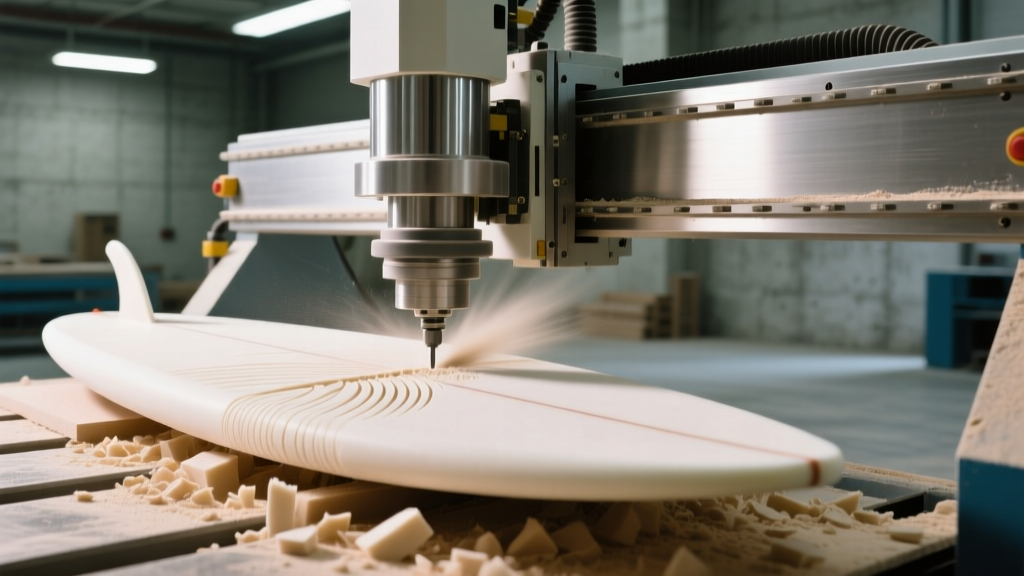
Troubleshooting CNC Machine Surfboard Shapers for Composite Cuts
Fix delamination, tear-out, and dimensional errors on your CNC machine surfboard shaper. Expert troubleshooting for EPS foam and composite cutting.
Industrial surfboard manufacturing relies heavily on 5-axis and large-format 3-axis CNC routers to profile EPS/EPU blanks and trim composite reinforcements. Transitioning a single spindle from routing 1.5 lb/ft³ EPS foam to cutting abrasive carbon fiber, Innegra, or S-glass deck patches accelerates tool wear and introduces severe Z-axis drift. When configuring a CNC machine surfboard production cell, operators frequently encounter edge fraying, asymmetric rail profiling, and vacuum hold-down failures. This guide details the mechanical and tooling failures specific to composite cutting over foam substrates and provides exact recalibration protocols.
⚠️ Critical Safety Warning: Machining carbon fiber composite patches over EPS foam generates highly conductive, abrasive dust. If your dust collection system lacks proper grounding, static buildup can discharge into the CNC controller, causing fatal logic board faults. Always verify ground continuity to the spindle housing and consult OSHA combustible dust guidelines before initiating composite cutting operations.Tackling Delamination and Edge Fraying on Composite Patches
Cutting 3K carbon fiber or S-glass patches on a contoured foam blank requires compressing the composite material against a yielding substrate. Standard up-cut bits pull the composite away from the foam, causing immediate delamination, while down-cut bits push the abrasive fibers into the EPS, leaving a bruised, compressed halo.
The Compression Bit Solution
To achieve a clean shear on both the composite and the underlying foam, you must use a diamond-coated compression router bit (e.g., Harvey Tool 87414 series or equivalent 1/4-inch shank diamond compression tooling). The down-cut section at the tip of the bit pushes the carbon fiber flush against the foam, while the up-cut section above the shear line evacuates the EPS foam chips.
- Spindle Speed: 18,000 RPM (Do not exceed 20,000 RPM, or the epoxy resin in the composite patch will melt and glaze the diamond coating).
- Feed Rate: 90 to 110 IPM. Feeding slower than 80 IPM causes friction burning; feeding faster than 120 IPM risks snapping the 1/4-inch shank.
- Depth of Cut: Maximum 0.060 inches per pass. Most surfboard deck patches are 0.030 to 0.040 inches thick, requiring only a single finishing pass.
- Climb vs. Conventional: Always use climb milling for the final composite pass to ensure the cutting edge shears the fiber cleanly against the foam backing.
Diagnostic Matrix: Surfboard CNC Tooling Wear
Tooling life varies drastically when a surfboard CNC transitions between roughing EPS foam and finishing composite stringers or patches. The table below outlines expected lifespans and failure indicators for modern surfboard manufacturing.
| Tool Type | Application | Expected Life | Primary Failure Mode |
|---|---|---|---|
| Solid Carbide O-Flute (e.g., Onsrud 48-712) | EPS/EPU Foam Roughing | 300+ linear feet | Resin buildup causing chatter |
| Diamond-Coated Compression | Carbon/Fiberglass Patches | 40-60 linear feet | Diamond coating delamination |
| Single Flute V-Bit (60°) | Fin Box Routing / Stringers | 150+ linear feet | Tip fracture on wood stringers |
| Ball Nose (2-Flute Carbide) | 3D Rail Contouring | 80-100 linear feet | Flute edge dulling (loss of gloss) |
Z-Axis Drift and Rail Asymmetry in 5-Axis Profiling
Surfboard rails require deep, sweeping 5-axis contouring. If the left rail measures 2mm thicker than the right, the issue is rarely the CAM software (such as Shape3D); it is almost always mechanical backlash or spindle runout exacerbated by the lateral forces of cutting composite-reinforced rails.
Step-by-Step Spindle Runout Verification
When cutting carbon fiber rail patches, lateral pressure on the spindle is immense. A runout exceeding 0.0005 inches will cause the bit to deflect, resulting in asymmetric rail profiles and premature bearing failure in spindles like the HSD ES929.
- Secure the Indicator: Mount a 0.0001-inch resolution dial indicator to the machine's Z-axis carriage, positioning the plunger against the tool shank just below the collet nut.
- Manual Rotation: Disengage the spindle brake and rotate the shaft by hand. Record the total indicator reading (TIR).
- Analyze TIR: If TIR exceeds 0.0005 inches, the collet is likely fouled with carbon dust or the angular contact bearings are pre-loaded incorrectly.
- Collet Maintenance: Remove the ER32 collet. Clean the internal taper with isopropyl alcohol and a lint-free swab. Carbon fiber dust acts as a lapping compound, permanently scoring the collet bore if left uncleaned.
- Bearing Preload Check: If the collet is pristine but runout persists, the spindle bearings require re-greasing with high-speed ceramic bearing grease (e.g., Kluber Isoflex NBU 15). This requires sending the spindle to a certified rebuild facility, typically costing between $1,200 and $1,800.
Vacuum Hold-Down Failures on Contoured Blanks
Holding a rocker-profiled surfboard blank flat during composite trimming is notoriously difficult. Standard flat-table vacuum pods fail because the EPS blank only makes contact at the nose and tail, creating a massive vacuum leak that allows the board to shift during high-speed composite routing.
💡 Pro Tip: Custom EVA GasketingReplace standard rubber O-ring cord on your vacuum pods with 40-durometer EVA foam gasketing. When the vacuum engages, the EVA foam compresses and conforms to the exact rocker profile of the surfboard blank, creating an airtight seal even on deep concaves. Ensure your vacuum pump can pull a minimum of 25 inches of mercury (Hg) to overcome the lateral cutting forces of composite materials.
Troubleshooting Vacuum Loss Mid-Cut
If the machine throws a 'Vacuum Pressure Low' alarm mid-cycle while cutting a fiberglass deck patch, check the following:
- Spoilboard Permeability: MDF spoilboards absorb moisture and lose porosity over time. If your vacuum gauge reads below 20" Hg, skim-cut 0.050 inches off the top of the MDF spoilboard using a 3-inch diameter surfacing bit to expose fresh, porous material.
- Zone Valving: Ensure only the zones directly beneath the surfboard blank are open. Open zones in empty space will bleed off critical vacuum pressure.
- Filter Blockage: EPS foam dust combined with epoxy resin from composite patches creates a sticky residue that clogs inline vacuum filters. Clean the primary canister filter after every 10 board cycles.
Controller Faults from Carbon Dust Ingress
Modern 5-axis CNC routers, such as those manufactured by Thermwood, utilize highly sensitive servo drives and limit switches. Carbon fiber dust is electrically conductive. When it infiltrates the electrical cabinet or settles on exposed limit switches, it creates micro-shorts that manifest as random 'Following Error' or 'Limit Switch Triggered' alarms.
"We see dozens of dead servo drives every year in surfboard factories. The operators machine carbon fiber Innegra patches without sealing the electrical cabinet. The conductive carbon dust gets sucked into the cooling fans, settles on the drive logic boards, and shorts the 24V DC control lines. A $50 positive-pressure cabinet blower saves you a $3,000 servo replacement."
— Lead Service Technician, Industrial CNC Repair
Preventative Electrical Maintenance Protocol
To protect your CNC machine surfboard setup from conductive dust ingress, implement the following weekly maintenance routine:
- Positive Pressure Verification: Ensure the electrical cabinet blower is functioning and creating positive air pressure inside the enclosure. This forces air out of the seams, preventing carbon dust from being drawn in.
- Switch Sealing: Inspect the bellows boots on all X, Y, and Z-axis proximity switches. If the rubber is cracked or torn, replace them immediately. Apply a thin layer of dielectric grease to the switch connectors to repel moisture and conductive dust.
- Cabinet Filter Replacement: Replace the HVAC intake filters on the electrical cabinet every 40 hours of machining time. Do not use compressed air to blow out the cabinet, as this will force conductive dust deeper into the relay sockets.
By strictly adhering to these tooling parameters, mechanical tolerances, and dust management protocols, surfboard manufacturers can eliminate the most common composite cutting defects and maintain the tight dimensional accuracy required for high-performance hydrodynamics.