Essential CNC Machine Information for Small Workshop Setups
Discover essential CNC machine information for small workshops. Compare footprints, power needs, and costs of Tormach, Haas, and Syil models for 2026.
Integrating Subtractive Manufacturing into Confined Spaces
Integrating subtractive manufacturing into a sub-1,000-square-foot facility requires navigating severe spatial, electrical, and acoustic constraints. Gathering accurate CNC machine information before signing a purchase order is the difference between a highly profitable micro-job shop and a garage full of rusting iron. Small workshop environments—ranging from 2-car residential garages to 800-square-foot industrial flex-spaces—demand equipment that balances rigidity with a compact footprint and residential-compatible utility requirements.
⚠️ Hidden Infrastructure Warning: The base price of a small-format CNC mill is typically only 40% of the total deployment cost. A $28,000 machine frequently requires an additional $12,000 to $15,000 in phase converters, 100-PSI air compressors, 220V electrical drops, and specialized chip management systems before it cuts its first chip.Gathering Accurate CNC Machine Information: Footprint vs. Work Envelope
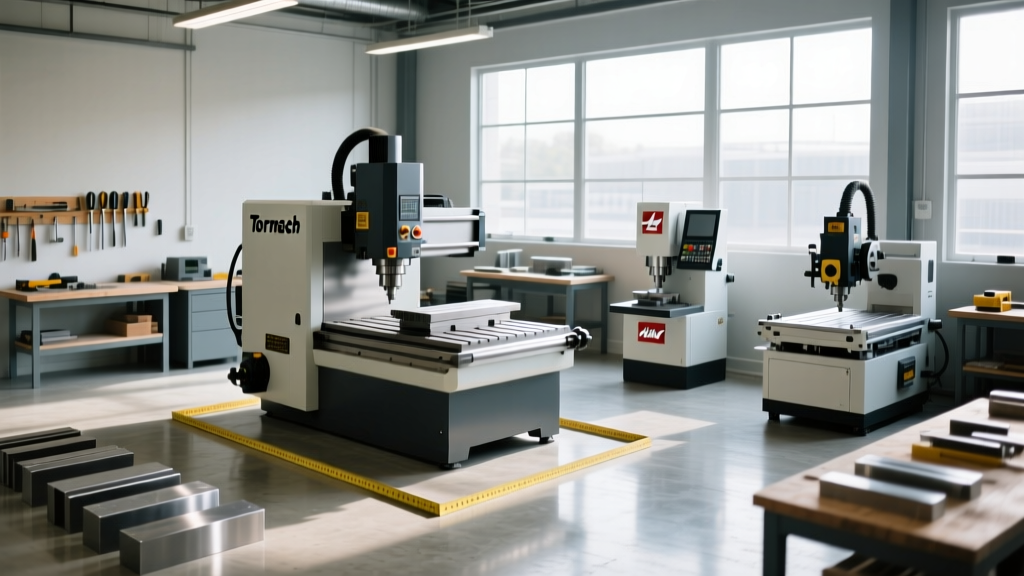
When researching CNC machine information from major OEMs, manufacturers list the physical footprint (the floor space the cast iron occupies) and the work envelope (the maximum X-Y-Z travel). In a small shop, you must calculate the "operational footprint," which includes door swing clearance, chip conveyor ejection zones, and maintenance access panels.
For example, a machine with a 40-inch physical width might require 65 inches of lateral clearance to fully open the operator doors and allow a technician to access the way lube reservoirs. Below is a 2026 comparison matrix of three dominant small-shop platforms.
| Machine Model | Physical Footprint | Work Envelope (X-Y-Z) | Spindle Taper | 2026 Base Pricing |
|---|---|---|---|---|
| Tormach PCNC 440 | 26" x 36" | 10" x 6.25" x 10" | TTS (Tormach) | $6,250 |
| Syil X7 Pro | 43" x 35" | 27.5" x 15.7" x 11.8" | BT30 | $14,500 |
| Haas Mini Mill | 65" x 46" | 16" x 12" x 10" | CAT40 | $28,900 |
The Power Dilemma: Single-Phase vs. Three-Phase Infrastructure
Industrial CNC mills rely on three-phase power for spindle motors and coolant pumps. Most small workshops, particularly residential garages and light commercial flex-spaces, only have single-phase 220V/240V power available. Understanding this electrical bottleneck is a critical piece of CNC machine information that brokers often gloss over.
Calculating the True Cost of Phase Conversion
If you purchase a Haas Mini Mill (which requires 3-phase power) for a single-phase shop, you must install a phase converter. You have two primary options:
- Rotary Phase Converters (RPC): Cost between $1,200 and $2,500. They use an idler motor to generate a third leg of power. Drawback: They introduce voltage imbalance, which can degrade the lifespan of sensitive CNC servo drives if not perfectly tuned. They also generate significant heat and noise.
- Digital Solid-State Converters (e.g., Phase Perfect): Cost between $3,500 and $5,500. These use solid-state electronics to generate a perfectly balanced third leg. Benefit: Zero voltage fluctuation, silent operation, and complete protection for the machine's proprietary control boards.
Case Study: Transitioning a 400-Sq-Ft Garage to a Precision Job Shop
In late 2025, a precision prototyping firm in Austin, Texas, retrofitted a standard 400-square-foot residential garage into a low-volume CNC job shop. Their primary constraint was acoustic dampening and vibration isolation, as the shop shared a property line with a residential neighbor.
They selected the Syil X7 Pro due to its BT30 spindle (capable of 10,000 RPM for aluminum prototyping) and relatively compact 43-inch width. However, placing a 2,200-lb cast-iron machine directly on a 4-inch residential concrete slab resulted in severe harmonic vibration during heavy roughing passes, triggering the machine's servo fault alarms.
"We learned the hard way that residential slabs lack the mass and rebar density of industrial floors. We had to pour an isolated 4x4-foot, 12-inch-deep concrete pad reinforced with #5 rebar, separated from the main slab by a 1/2-inch expansion joint, before the machine could hold 0.0005-inch tolerances."
— M. Torres, Lead Machinist
To manage acoustics, they constructed an interior "room-in-room" enclosure using mass-loaded vinyl (MLV) and acoustic foam, reducing exterior spindle noise from 85 dB to a compliant 55 dB. This required sacrificing 18 inches of floor space on all sides, highlighting the need to overestimate spatial requirements when gathering CNC machine information for confined areas.
Chip Management and Coolant in Confined Spaces
Flood coolant systems generate massive volumes of fluid and airborne mist. In a small shop without industrial HVAC and floor drains, flood coolant will inevitably migrate, causing concrete degradation, drywall mold, and severe slip hazards. Compliance with OSHA machine guarding and workplace safety standards requires strict containment of these fluids.
Small-Shop Coolant Mitigation Strategies
- Minimum Quantity Lubrication (MQL): Ideal for aluminum and plastics. Systems like the Unist Coolubricator apply a microscopic mist of biodegradable oil directly to the cutting edge. This eliminates the need for a 30-gallon sump, floor skimmers, and rancidity management, though it is unsuitable for heavy steel milling.
- Enclosed Splash Guards with High-Pressure Skimmers: If flood coolant is mandatory for cutting titanium or stainless steel, the machine must feature fully enclosed telescoping way covers and a sealed sump. Small shops should invest in a 1/2 HP centrifugal coolant pump with a paper-band filter to prevent tramp oil from accumulating in a small 15-gallon reservoir.
- Air Blast and Vacuum Integration: For dry machining brass or delrin, integrate a shop-vac directly into the machine's chip pan using a static-dissipative hose to prevent combustible dust accumulation.
Decision Framework: Which Machine Fits Your Shop?
Selecting the right equipment requires matching your shop's physical limitations to your production goals. Use this diagnostic framework to finalize your equipment choice:
Step 1: Audit Your Electrical Panel.
If you have less than 50 amps of spare capacity on a single-phase 240V line, you are restricted to machines with 2HP to 3HP spindles (e.g., Tormach PCNC 440 or Pocket NC). Upgrading to a 400-amp service costs $3,500–$6,000.
Step 2: Measure the "Doorway Bottleneck."
Standard residential exterior doors are 36 inches wide. Machines like the Haas Mini Mill (46 inches wide) require the removal of door frames, drywall cutting, or delivery via a forklift through a garage bay. If you lack a garage bay, your maximum machine width is 34 inches.
Step 3: Define Your Tooling Ecosystem.
If your shop already holds an inventory of CAT40 tooling, buying a TTS-only machine will force you to repurchase $3,000+ in toolholders. Conversely, if you are starting from scratch, a BT30 machine (like the Syil X7 or Brother Speedio) offers the best balance of high-RPM capability, compact tool changer footprint, and affordable tooling.
By rigorously analyzing operational footprints, electrical conversion costs, and fluid containment requirements, small workshop owners can deploy highly capable CNC mills that generate industrial-grade revenue without violating the physical boundaries of their facilities.