Cost of Automation CNC Machines and Robotics: Tolerance Specs
Analyze the cost of tolerance specs in automation cnc machines and robotics. Compare 2026 pricing, hidden HVAC costs, and integration matrices.
The True Cost of Micron-Level Tolerances in Automated Cells
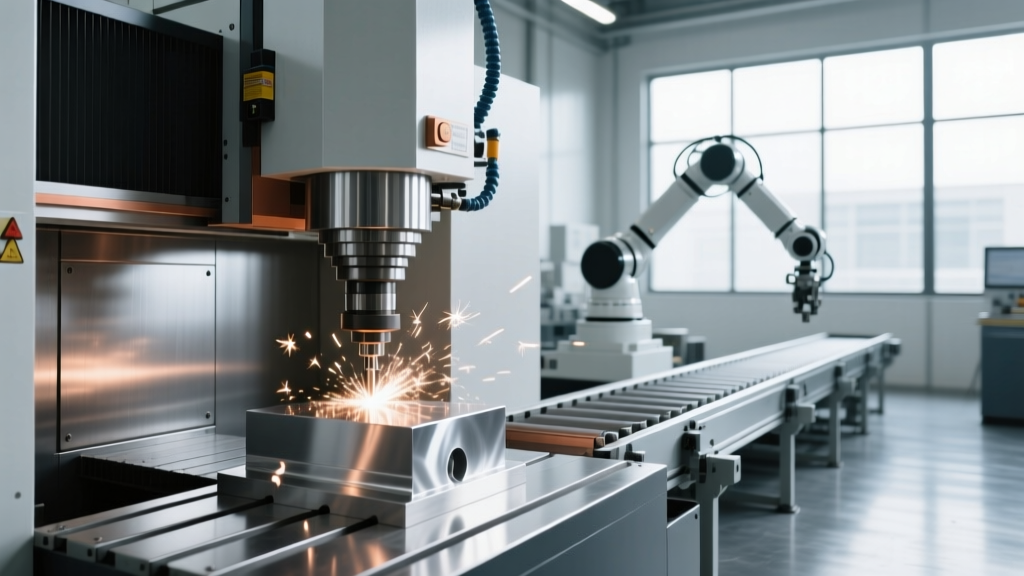
When engineering teams specify micron-level tolerances for automated manufacturing cells, capital expenditure scales exponentially rather than linearly. The integration of automation cnc machines and robotics introduces a complex kinematic chain where the final part accuracy is dictated by the weakest link in the system. A 5-axis CNC mill may boast a volumetric accuracy of ±0.005mm, but if the articulated robot loading the workpiece has a repeatability variance of ±0.05mm, the CNC's precision is functionally bottlenecked before the spindle even engages.
Budgeting for these systems requires a rigorous analysis of geometric dimensioning and tolerancing (GD&T) requirements against actual part function. Over-specifying tolerances on non-critical features is the leading cause of budget overruns in automated machining cells, driving up cycle times, scrap rates, and necessary environmental controls.
⚠️ The Over-Tolerancing Budget Trap: Specifying a ±0.0001" (±0.0025mm) tolerance on a non-mating structural flange in an automated cell increases the per-part cost by an estimated 35-50%. This stems from mandatory in-process probing, reduced feed rates, and the requirement for ultra-precision spindle bearings that degrade faster under heavy automated roughing cycles.Capital Expenditure Matrix: Accuracy Specs vs. Automation Integration
The following matrix outlines the 2026 market pricing for fully integrated automated CNC cells, categorized by their target positional accuracy as defined by ISO 230-1:2012 testing conditions. Costs include the machine tool, robotic tending unit, safety fencing, and basic PLC integration.
| Cell Tier | CNC & Robot Configuration | Positional Accuracy | Repeatability | 2026 Est. Cell Cost |
|---|---|---|---|---|
| Standard Production | Haas VF-2SS + FANUC M-20iD/25 | ±0.0002" (±0.005mm) | ±0.0001" (±0.0025mm) | $210,000 - $260,000 |
| High-Precision Aerospace | DMG MORI DMU 50 3rd Gen + KUKA KR QUANTEC | ±0.00008" (±0.002mm) | ±0.00004" (±0.001mm) | $550,000 - $680,000 |
| Ultra-Precision Medical | Kern Micro HD + EROWA Robot Compact 80 | ±0.00004" (±0.001mm) | ±0.00002" (±0.0005mm) | $1.3M - $1.6M |
Hidden Operational Costs of Tight Tolerances
The purchase price of the hardware is only the baseline. Maintaining sub-10-micron accuracy in an automated environment requires strict environmental and metrological investments that frequently catch budget planners off guard.
- Thermal Stabilization (HVAC): Machine castings expand and contract with ambient temperature shifts. To maintain ISO 230-1 geometric accuracy, the facility must maintain 68°F ± 1°F (20°C ± 0.5°C). A dedicated precision HVAC system for a 5,000 sq. ft. cell area costs approximately $45,000 to install and $2,800 monthly to operate.
- Automated Metrology: If the CNC holds ±0.002mm, the measurement device must resolve to at least ±0.0006mm (following the 10:1 rule of thumb, or 4:1 per ASME Y14.5-2018 guidelines). Integrating a Zeiss CONTURA CMM with robotic loading adds $165,000 to the cell budget.
- Advanced Tooling & Workholding: Standard ER collets introduce runout that destroys tight tolerances. Budgeting must include HAIMER shrink-fit holders ($120-$180 each) and EROWA or System 3R pneumatic pallet systems ($35,000-$60,000) to ensure the robot loads the workpiece into the exact same coordinate space every cycle.
The Kinematic Bottleneck: Robot Repeatability vs. CNC Accuracy
A critical failure mode in automated cell budgeting is confusing CNC accuracy with robot repeatability. An articulated 6-axis robot like the FANUC M-20iD/25 is exceptionally repeatable (±0.02mm), meaning it will return to the exact same point in space consistently. However, its absolute accuracy—its ability to hit a programmed coordinate relative to the machine bed—can be off by ±0.1mm or more due to gear backlash and link deflection.
If a robot loads a raw billet directly into a CNC vise relying on absolute robot coordinates, the CNC's work offset (G54) will shift slightly every cycle. To bypass this, high-precision cells use kinematic coupling pallet systems. The robot only needs to place the pallet roughly; the pallet system's mechanical wedges pull the workpiece into a hard-stop position with ±0.002mm repeatability, effectively isolating the CNC from the robot's accuracy flaws.
Matching Tolerance to Application: A Decision Framework
Use this framework to determine the necessary automation tier based on the part's functional requirements. This prevents over-capitalization on ultra-precision machinery when standard automated cells suffice.
Standard Tier (±0.001" / ±0.025mm)
Best for: Structural brackets, automotive engine blocks, general enclosures.
Robotics: Standard articulated arm with soft-jaw grippers. Direct vise loading.
Budget Impact: Lowest. Standard tooling, no mandatory climate control.
High-Precision Tier (±0.0002" / ±0.005mm)
Best for: Aerospace turbine blades, hydraulic valve bodies, injection molds.
Robotics: Vision-guided robotics or kinematic pallet systems (EROWA).
Budget Impact: Moderate. Requires thermal compensation software, shrink-fit tooling, and in-process probing.
Strategic Budgeting for Automation CNC Machines and Robotics
When allocating capital for tight-tolerance automated cells, financial planners should adopt the 50/30/20 hardware distribution rule. Dedicate 50% of the budget to the CNC machine tool and spindle technology, 30% to the robotics, pallet systems, and workholding, and 20% to metrology, tooling presets, and environmental controls. According to data tracked by NIST Advanced Manufacturing initiatives, facilities that underfund the 30% workholding/robotics allocation experience a 22% higher scrap rate during the first six months of automated lights-out production due to localized clamping distortion and loading misalignments.
Frequently Asked Questions
How does thermal growth affect automated CNC tolerances overnight?
During lights-out operation, friction from spindle bearings and axis ballscrews generates heat. Without active thermal compensation or a chiller unit, a standard 3-axis mill can experience Z-axis growth of up to 0.003" (0.075mm) over an 8-hour shift. High-precision cells mitigate this using real-time Renishaw OMP600 spindle probes to update work offsets dynamically between parts.
Is a SCARA robot better than an articulated robot for CNC tending?
For high-speed, low-tolerance applications (like loading small turned parts into a secondary operation), SCARA robots offer faster cycle times and higher Z-axis rigidity. However, they lack the 6-axis dexterity required to tilt and load complex 5-axis aerospace components into angled vise setups. SCARA units are also limited to a smaller horizontal reach, typically under 1,200mm.
What is the cost of adding in-process probing to an automated cell?
Integrating a Renishaw OMP400 or Blum TC60 spindle probe system costs between $8,500 and $12,500 for the hardware and software licenses. While this adds to the initial capital expenditure, it reduces post-process CMM inspection time by up to 40% and allows the CNC to automatically scrap or re-machine a part before the robot unloads it, preventing bad parts from entering the downstream automated assembly line.