12 Axis CNC Machine Guide: Buying Mill-Turn Centers for Complex Parts
Discover how to evaluate and select a 12 axis CNC machine for mill-turn operations. Compare specs, pricing, and top brands for complex part production.
Defining the 12-Axis Mill-Turn Kinematic Layout
When procurement teams evaluate a 12 axis CNC machine, a common point of confusion is the assumption that the control system is interpolating 12 axes simultaneously. In reality, modern multitasking mill-turn centers utilize 12 controllable kinematic axes, typically with a maximum of 5 simultaneous interpolated axes (RTCP - Rotary Tool Center Point). The remaining axes are dedicated to positioning, part transfer, or synchronized secondary operations.
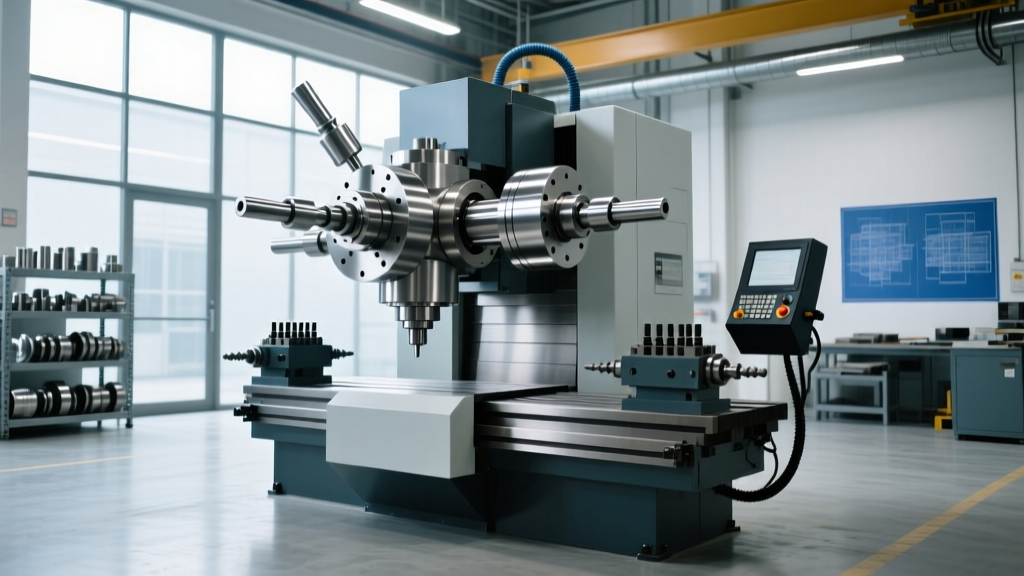
The '12-Axis' Breakdown:A standard high-end 12-axis configuration (such as the Okuma Multus or Mazak Integrex series) maps out as follows:
• Main Spindle: X1, Z1, C1 (3 axes)
• Sub-Spindle: X2, Z2, C2 (3 axes)
• Upper Turret/Milling Head: X3, Y3, Z3, B-axis (4 axes)
• Lower Turret: X4, Z4 (2 axes)
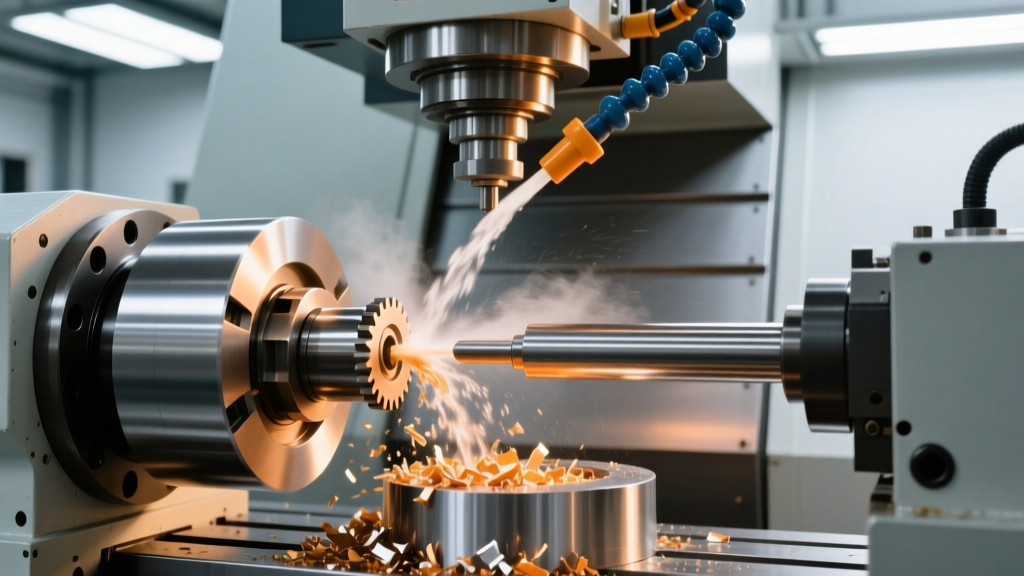
Total: 12 controllable axes. The B-axis provides 5-axis simultaneous contouring, while the C1/C2 spindles synchronize for operations like gear hobbing or seamless part handoffs.
Understanding this kinematic reality is critical for selecting the right machine. If your parts require heavy, simultaneous 5-axis contouring on both the main and sub-spindles concurrently, a 12-axis mill-turn center might actually introduce unnecessary cycle-time bottlenecks compared to a dedicated 5-axis vertical machining center paired with a turning center. However, for complex aerospace fittings, medical implants, and hydraulic manifolds requiring 'done-in-one' setups, the 12-axis configuration is unmatched.
Configuration Matrix: 5-Axis vs. 9-Axis vs. 12-Axis
Not every shop requires the full 12-axis footprint. Upgrading from a 9-axis to a 12-axis machine typically adds $120,000 to $180,000 to the base capital expenditure. Use the matrix below to align your part geometry with the correct kinematic tier.
| Machine Tier | Kinematic Layout | Ideal Part Family | Avg. Base Price (2026) |
|---|---|---|---|
| 5-Axis Mill-Turn | Main Spindle (X,Z,C) + B-Axis Head (X,Y,Z,B) | Valves, simple aerospace structural parts, single-chuck work. | $350,000 - $450,000 |
| 9-Axis Mill-Turn | Main + Sub Spindle (X,Z,C) + Upper B-Axis Head (X,Y,Z,B) | Shafts requiring back-working, automotive drivetrain components. | $550,000 - $700,000 |
| 12-Axis Mill-Turn | Main + Sub Spindle + Upper B-Head + Lower Turret (X,Z) | Complex hydraulic manifolds, landing gear components, orthopedic implants requiring simultaneous roughing and finishing. | $750,000 - $1.2M+ |
Top OEM Platforms and Capital Expenditure Realities
The market for high-end multitasking machines is dominated by three primary OEMs, each with distinct control architectures and mechanical philosophies. According to industry data on Mazak's multitasking platforms and Okuma's Multus series, the choice often comes down to control familiarity and thermal stability requirements.
1. Mazak Integrex i-800 / i-600 Series
Mazak remains the volume leader in the multitasking space. The Integrex series utilizes the MAZATROL SmoothAi CNC, which excels in conversational programming for shops that lack dedicated offline CAM programmers.
Pros: Exceptional ergonomics, vast dealer network, SmoothAi thermal shielding.
Cons: Complex G-code post-processing can be restrictive if you rely heavily on third-party CAM systems.
Target Price: $850,000 (equipped with 1,000 PSI coolant and bar feeder interface).
2. Okuma Multus U5000 / U6000
Okuma’s OSP-P500 control is built on a single-source architecture (the control, drives, and encoders are all built by Okuma). This provides superior thermal compensation via their Thermo-Friendly Concept. For shops running 24/7 lights-out operations where thermal growth on the Y-axis could scrap a $10,000 titanium forging, the Multus is the benchmark.
Target Price: $950,000 - $1.1M.
3. DMG MORI NTX 3000
DMG MORI targets the high-precision medical and aerospace sectors. The NTX series features a highly compact B-axis head (compactMaster) that allows for deep cavity milling without turret interference. The CELOS control interface is heavily integrated with Industry 4.0 monitoring tools.
Target Price: $1.1M - $1.3M+.
The Hidden CapEx: Tooling, CAM, and High-Pressure Coolant
Buying guides often focus solely on the machine base price, leading to severe budget overruns. Equipping a 12 axis CNC machine for production requires significant peripheral investment.
- Quick-Change Tooling (Coromant Capto): A 12-axis machine with an upper B-head and two turrets requires a massive tooling inventory. Standardizing on Sandvik Coromant Capto C6 or C8 interfaces is mandatory for rigidity. Budget $15,000 to $25,000 just for the initial master toolholders and reduction sleeves. As Sandvik Coromant's multi-task machining guidelines note, using standard VDI turrets on a 12-axis machine severely limits the torque transfer required for heavy B-axis milling.
- Multitasking CAM Software: Standard 3-axis CAM packages cannot calculate collision avoidance for a lower turret and a B-axis head operating in the same envelope. You must license dedicated Mill-Turn software like Hexagon ESPRIT or Mastercam Mill-Turn. Expect to pay $18,000 to $25,000 for the software seat, plus $5,000 to $8,000 for a verified, machine-specific post-processor.
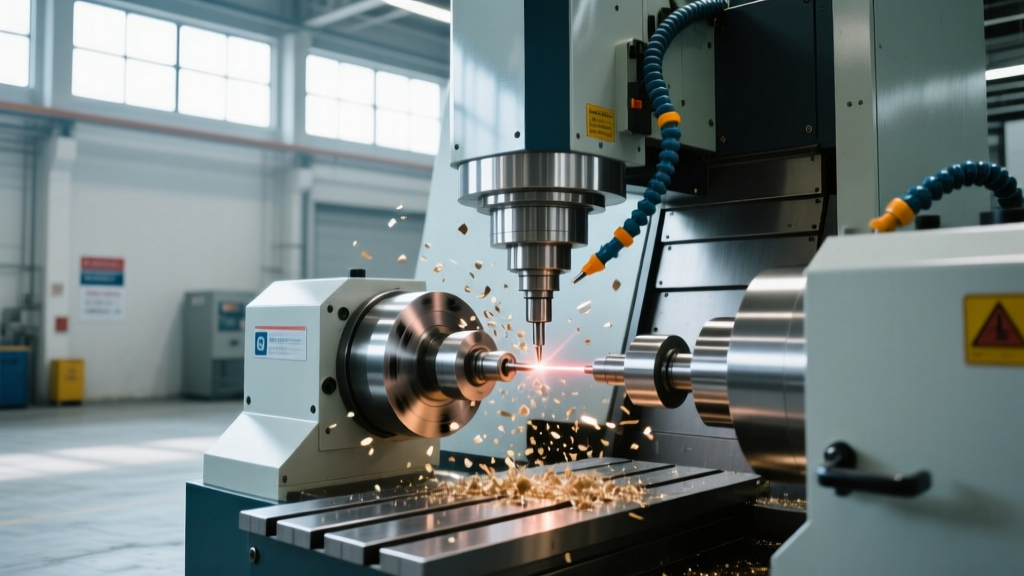
- High-Pressure Coolant (HPC): When turning Inconel or Titanium on the main spindle while simultaneously milling on the B-axis, standard 300 PSI coolant will fail to break the chip. You must spec a 1,000 to 1,500 PSI HPC pump system with targeted nozzle capabilities (like Sandvik CoroTurn HP). Add $25,000 to the machine build for this option.
Failure Modes and Operational Edge Cases
Operating a 12-axis machine introduces unique mechanical and programming risks that do not exist on standard VMCs or lathes.
Turret-to-Spindle Collision Risks
The most common catastrophic failure on a 12-axis machine is the lower turret colliding with the main spindle or the part during a rapid traverse. Because the lower turret operates on the X4/Z4 axes independently of the upper head, CAM simulation must account for the exact physical envelope of the toolholders. Edge Case: If a long boring bar is left in the lower turret and the main spindle indexes to a new C-axis position, the bar can swing into the upper B-axis head. Always utilize machine simulation software (like VERICUT) rather than relying solely on the CAM system's internal kinematic model.
Thermal Drift on the Y-Axis
The Y-axis on a mill-turn center is often achieved by offsetting the X-axis cross-slide or using a dedicated Y-axis saddle. Under heavy, continuous milling loads, the Y-axis ball screw expands. On a 12-axis machine, this thermal growth manifests as Z-axis positional errors on the milling head. If your shop lacks climate control (maintained at 68°F / 20°C ± 2°), you must invest in a machine with active ball-screw cooling or real-time thermal compensation algorithms (like Okuma's Thermo-Friendly Concept) to hold tolerances tighter than 0.0005 inches.
Procurement Decision Framework
Before issuing a PO for a 12 axis CNC machine, run your production requirements through this checklist:
- Setup Reduction Metric: Are you currently spending more than 4 hours setting up parts across multiple machines (Lathe -> VMC -> Manual Deburr)? If yes, the 'done-in-one' capability justifies the CapEx.
- Workholding Limitations: Do your parts require complex soft-jaw milling or custom fixtures that introduce runout? A 12-axis machine allows you to machine the soft jaws in-situ on the sub-spindle, guaranteeing perfect concentricity.
- Automation Readiness: Will this machine be fed by a bar feeder, a gantry loader, or a robotic tending cell? 12-axis machines with sub-spindles require specialized part-catchers or robotic handoff routines. Ensure the OEM provides native API integration for your specific robot brand (e.g., FANUC or KUKA).
- Programming Bandwidth: Do you have a programmer capable of managing 12-axis synchronization codes (like G-code spindle sync or Mazatrol unit-to-unit handoffs)? If not, budget for 40 hours of OEM applications training post-installation.
Selecting a 12-axis multitasking center is an exercise in balancing kinematic flexibility against programming complexity and capital outlay. By accurately mapping your part families to the machine's physical envelope and budgeting for the hidden costs of Capto tooling and Mill-Turn CAM, you can transform a multi-machine bottleneck into a single-setup, high-margin production cell.