CNC Cutting Machine Comparison: Laser vs Plasma vs Waterjet
Compare fiber laser, high-definition plasma, and abrasive waterjet CNC cutting machines. Analyze pricing, cut speeds, tolerances, and HAZ.
When specifying a new cutting machine, CNC integration is the baseline expectation, but the underlying cutting physics—photonic, electrical, or kinetic—dictates your facility's operational ceiling. Selecting between a high-power fiber laser, high-definition plasma, and abrasive waterjet is rarely a simple matter of comparing price tags. It requires a rigorous analysis of material thickness, edge metallurgy, heat-affected zones (HAZ), and long-term consumable burn rates.
This analysis breaks down the three dominant CNC cutting technologies using 2026 market data, specific OEM system capabilities, and real-world operational costs to provide a definitive selection framework for manufacturing engineers and shop owners.
Rapid Decision Matrix: Which Physics Fit Your Shop?
- Choose Fiber Laser IF: Your primary volume is 14-gauge to 3/8-inch mild steel, stainless, or aluminum, and you require oxide-free edges with ±0.001-inch tolerances for immediate press-brake bending.
- Choose HD Plasma IF: You process heavy plate (1/2-inch to 2-inch mild steel), prioritize raw cutting speed over edge squareness, and need a lower capital entry point for structural steel fabrication.
- Choose Abrasive Waterjet IF: You machine heat-sensitive alloys (Inconel, titanium, hardened tool steel), require zero HAZ, or cut extreme thicknesses (up to 8 inches) where thermal processes fail.
Fiber Laser Cutting: Photonic Speed and Precision
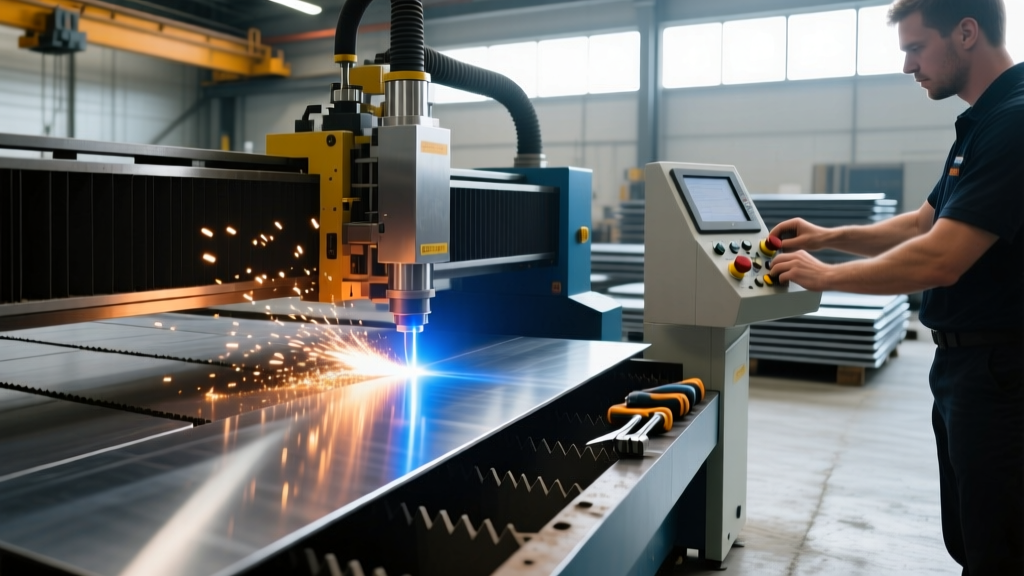
Fiber lasers dominate the sheet metal and light-plate fabrication sector. By utilizing a solid-state laser beam delivered through a fiber optic cable, these systems achieve immense power density. A modern 12kW fiber laser, such as the Mazak Optiplex Nexus 3015, represents the current industrial benchmark for high-volume processing.
Performance and Metallurgical Impact
When cutting 1/2-inch (12mm) mild steel using nitrogen as an assist gas, a 12kW system achieves cut speeds approaching 240 inches per minute (IPM). The high energy density vaporizes the material, while the high-pressure nitrogen (typically 300-400 psi) ejects the molten slag. Because nitrogen is an inert gas, the resulting cut edge is completely oxide-free. This is a critical metallurgical advantage: oxide-free edges eliminate the need for secondary grinding before welding and prevent coating adhesion failures during powder coating.
However, fiber lasers struggle with highly reflective materials like copper and brass at lower power settings, though modern 12kW+ systems with specialized anti-reflection optics have largely mitigated this historical limitation. The HAZ on a fiber laser cut is exceptionally narrow—typically less than 0.010 inches—preserving the base metal's structural integrity near the cut line.
Capital and Integration Costs
Entry-level 6kW import machines can be sourced for under $150,000, but a fully integrated, production-grade 12kW system with automated sheet loading, nozzle changers, and fume extraction commands between $550,000 and $750,000. For comprehensive system specifications and automation integrations, manufacturers detail their current lineups on the Mazak laser cutting technology portal.
High-Definition Plasma: The Heavy-Duty Thermal Alternative
For shops processing heavy structural plate, high-definition (HD) plasma remains the most cost-effective thermal cutting process. Unlike traditional air plasma, HD systems utilize a highly constricted arc and specialized gas mixtures (typically oxygen for mild steel, H35 for stainless) to achieve near-laser edge quality on thicker materials.
The Hypertherm XPR300 Benchmark
The Hypertherm XPR300 (300-amp system) is the industry standard for HD plasma. When cutting 1/2-inch mild steel with oxygen, the XPR300 achieves speeds of roughly 130 IPM. While slower than a 12kW laser on this specific thickness, plasma maintains a distinct speed advantage as material thickness increases past 1 inch, where laser cut speeds drop exponentially and assist gas costs become prohibitive.
A critical feature of modern HD plasma is advanced hole-cutting algorithms, such as Hypertherm's True Hole technology. By precisely manipulating the torch lead-in, lead-out, and arc voltage, these systems can cut bolt-ready holes with a diameter-to-thickness ratio of 1:1, eliminating the severe bevel and dross traditionally associated with plasma hole cutting.
Edge Bevel and Consumable Realities
The primary trade-off with plasma is edge squareness. Even with HD technology, expect a 2 to 3-degree bevel on the cut edge due to the divergent nature of the plasma arc. Furthermore, plasma consumables (electrodes, nozzles, and swirl rings) degrade with every pierce. A standard 300A oxygen consumable set costs roughly $25 and is rated for approximately 200 to 250 pierces. Shops running high-pierce nesting patterns must factor in significant consumable downtime and costs. Full technical parameters on arc constrictions and gas flows are available via the Hypertherm plasma technology resources.
Abrasive Waterjet: Kinetic Energy for Exotic Alloys
Waterjet cutting relies on kinetic energy rather than thermal energy. A high-pressure pump forces water through a jewel orifice, creating a supersonic stream that entrains abrasive garnet to erode the material. This process is entirely cold, meaning there is absolutely zero HAZ, no micro-cracking, and no alteration to the material's temper or hardness.
Pump Pressures and Taper Compensation
Modern systems like the OMAX 60120 paired with a 50-horsepower, 60,000 psi direct-drive pump can cut 1/2-inch mild steel at approximately 12 to 15 IPM. While drastically slower than thermal alternatives, the waterjet's ability to cut 4-inch thick titanium or 6-inch Inconel blocks makes it irreplaceable in aerospace and defense manufacturing.
A historical flaw of waterjet cutting is the 'stream lag' or taper effect, where the top of the cut is wider than the bottom. Advanced 5-axis cutting heads, such as the OMAX Tilt-A-Jet, mechanically tilt the nozzle up to 9 degrees to compensate for this taper, holding tight part tolerances of ±0.003 inches without requiring secondary machining. Detailed breakdowns of kinetic cutting mechanics and taper elimination can be reviewed on the OMAX waterjet technology page.
Head-to-Head Specification Matrix
The following table compares the three technologies when processing 1/2-inch (12mm) mild steel, the most common benchmark material in heavy fabrication.
| Feature / Metric | 12kW Fiber Laser | 300A HD Plasma | 60kpsi Waterjet |
|---|---|---|---|
| Cut Speed (1/2" MS) | ~240 IPM | ~130 IPM | ~14 IPM |
| Positional Tolerance | ±0.001" | ±0.020" | ±0.003" |
| Edge Bevel | < 0.5 degrees | 2 - 3 degrees | 0 degrees (w/ 5-axis) |
| Heat Affected Zone | Minimal (< 0.010") | Moderate (0.050"+) | Zero (Cold Cut) |
| Max Practical Thickness | 1" (Mild Steel) | 2" (Mild Steel) | 8"+ (Any Material) |
| Estimated System Cost | $550k - $750k | $90k - $140k | $250k - $350k |
Operational Cost Analysis: Beyond the Capital Expense
Evaluating a CNC cutting machine requires looking past the initial capital expenditure to understand the true cost-per-part. The operational expenditures (OPEX) vary wildly between these three technologies.
Assist Gases and Abrasives
Fiber lasers cutting with nitrogen require massive volumes of assist gas. A 12kW laser cutting 1/2-inch steel at 400 psi can consume over 3,000 cubic feet of nitrogen per hour. Shops running these systems must install bulk liquid nitrogen tanks with vaporizers; relying on high-pressure cylinders will bankrupt the cutting operation within weeks. Conversely, when the laser switches to oxygen assist for thicker plates, the gas cost drops to pennies per hour, but the edge becomes heavily oxidized.
Waterjet OPEX is dominated by abrasive garnet. A standard 60,000 psi cutting head consumes approximately 0.8 to 1.2 pounds of garnet per minute. At an average bulk price of $0.50 per pound, the abrasive cost alone hovers around $30 to $40 per hour of continuous cutting. Additionally, the disposal of spent garnet mixed with metal sludge requires specialized waste management, adding hidden environmental compliance costs.
Power Consumption and Maintenance
Plasma systems are highly efficient regarding utility draw but suffer from high wear-part costs. The XPR300 power supply draws roughly 65 kW during full 300A output. However, the cost of replacing torch consumables, combined with the wear on the CNC table's slats (which degrade rapidly from intense plasma heat and slag accumulation), results in a higher ongoing maintenance burden compared to the relatively clean environment of a fiber laser enclosure.
Expert Warning on Material Handling: Do not underestimate the cost of material loading. A 12kW laser cuts so quickly that the bottleneck shifts from the cutting head to the loading/unloading process. If you invest in a high-speed laser, you must pair it with automated shuttle tables or tower storage systems, which can add $100,000 to the final project cost.Final Selection Framework
There is no universal 'best' cutting machine; there is only the correct tool for your specific material profile and downstream manufacturing requirements.
- Deploy Fiber Lasers for high-volume sheet metal enclosures, electrical cabinets, and precision brackets where edge quality eliminates secondary deburring and where press-brake tolerances demand perfectly square, oxide-free bends.
- Deploy HD Plasma for structural steel beam coping, heavy baseplate fabrication, and shipbuilding applications where a 2-degree edge bevel is acceptable and raw throughput on 1-inch+ plate is the primary metric for profitability.
- Deploy Waterjets as a job-shop 'Swiss Army knife' for cutting thick tool steel blanks, aerospace turbine components, and layered materials where thermal distortion would instantly scrap a $5,000 workpiece.
By aligning the cutting physics with your shop's specific thickness distribution and metallurgical requirements, you can accurately forecast ROI and avoid the costly mistake of applying thermal processes to heat-sensitive applications or kinetic processes to high-volume sheet metal production.