What Does a CNC Machine Operator Do for On-Machine Troubleshooting?
Discover what a CNC machine operator does during troubleshooting, from diagnosing Fanuc alarms and fixing G-code offsets to resolving tool chatter.
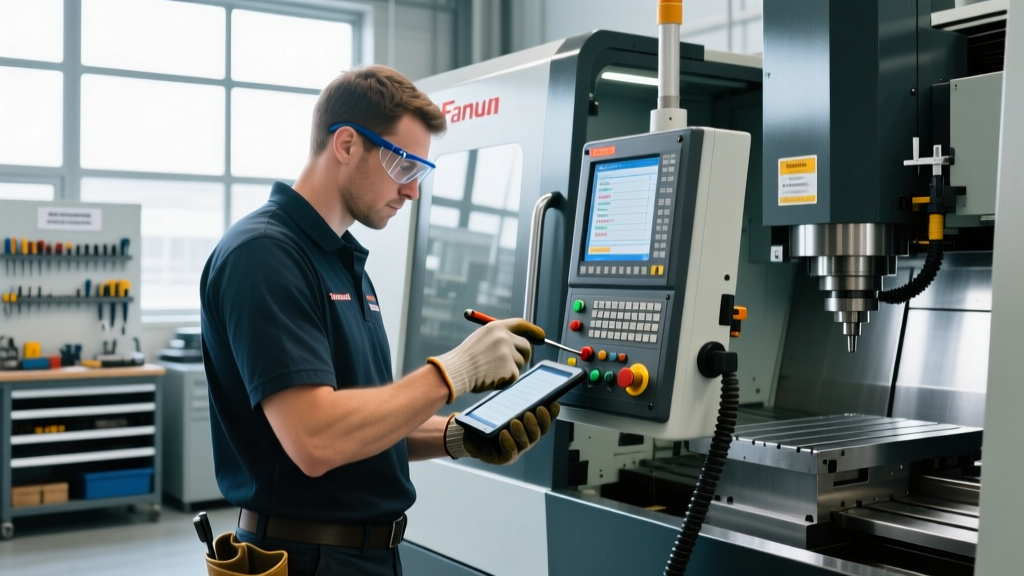
When industry outsiders ask what does a CNC machine operator do, the common misconception is that the role merely involves loading raw material and pressing a green cycle-start button. In reality, modern manufacturing environments require operators to act as Tier 1 diagnostic technicians. When a machine faults, a part goes out of tolerance, or surface finishes degrade, the CNC operator is the first line of defense. Understanding the troubleshooting and minor repair responsibilities of this role is critical for workforce development and shop floor efficiency.
The Diagnostic Workflow: Responding to Control Alarms
Modern CNC controls, such as the Haas NGC or Fanuc 31i-B5, generate hundreds of specific alarm codes. A skilled operator does not simply hit 'reset' when an alarm triggers. Instead, they follow a structured diagnostic workflow to identify the root cause without risking machine damage or scrap parts.
⚠️ Safety Protocol Override: Before opening any cabinet or clearing a physical jam in the chip conveyor, operators must adhere to Lockout/Tagout (LOTO) procedures. The OSHA Metalworking guidelines strictly mandate that kinetic and electrical energy sources be isolated before manual mechanical interventions.Step-by-Step Alarm Troubleshooting
- Read and Record the Alarm: Note the exact code (e.g., Fanuc Alarm 411 - Servo Error: Move Error). Write down the machine coordinates at the time of the fault.
- Visual Inspection: Check for physical obstructions, broken tooling, or excessive chip buildup around the axis way covers.
- Check Load Meters: Switch the control display to the servo load page. If the X or Y axis shows a persistent load above 40% while idle, the way lube system may have failed, or the gibb adjustment is too tight.
- Verify Toolpath Boundaries: Use the control's graphical toolpath verification to ensure the G-code isn't commanding a rapid move (G00) into a fixture or the machine table.
Troubleshooting Tool Wear and Surface Finish Defects
Tooling failure is rarely instantaneous; it provides visual and auditory warnings. Operators must continuously monitor cutting conditions and adjust offsets or speeds/feeds on the fly to maintain part quality. Recognizing the difference between flank wear, crater wear, and built-up edge (BUE) dictates the operator's next move.
| Symptom on Part / Tool | Root Cause Analysis | Operator Intervention |
|---|---|---|
| High-frequency chatter marks | Harmonic resonance; tool overhang exceeds 4x diameter ratio. | Reduce spindle RPM by 10-15% to exit the resonant frequency zone; reduce radial depth of cut (RDOC). |
| Built-Up Edge (BUE) on carbide | Cutting temperature too low; material welding to the rake face (common in 6061-T6 aluminum). | Increase Surface Feet per Minute (SFM) by 20%; verify through-tool coolant pressure is above 300 PSI. |
| Dimensional taper on turned OD | Tool deflection under heavy radial load; tailstock misalignment. | Take a lighter finish pass (0.005''); check tailstock center alignment with a test bar. |
| Flank wear exceeding 0.015'' | Normal abrasive wear; cutting speed too high for the substrate. | Index the insert; reduce SFM by 10% for the next batch to extend tool life. |
G-Code Debugging and Offset Management
A critical answer to what does a CNC machine operator do when a part fails final inspection is: they debug the offsets and edit localized G-code. Operators rarely rewrite entire CAM programs, but they frequently modify cutter compensation, work coordinates, and macro variables.
Fixing Overcut and Undercut Conditions
When a milled pocket measures 0.003'' undersized, the operator must determine if the error stems from tool deflection, thermal expansion, or incorrect cutter compensation. Instead of altering the CAM-generated G-code, the operator manipulates the G41 (left compensation) or G42 (right compensation) wear offset.
- Scenario: A 0.500'' endmill machines a slot that measures 0.497'' wide.
- Diagnosis: The tool is deflecting away from the cut due to a high chip load, or the tool diameter is slightly undersized from regrinding.
- Fix: The operator navigates to the Offset/Geometry page, finds the active tool, and adds
-0.003to the wear register. This forces the control to drive the tool 0.0015'' closer to the wall on each side of the slot during the next cycle.
The Golden Rule of Offsets: Never adjust the Geometry offset to fix a worn tool. Geometry is reserved for the physical baseline measurements of the tool. Always use the Wear offset register to chase tolerances and compensate for tool degradation.
Mechanical and Coolant System Interventions
CNC operators are responsible for the daily health of the machine's peripheral systems. Neglecting these systems leads to catastrophic mechanical failures that require expensive maintenance team interventions.
Coolant Concentration and Tramp Oil Management
Water-soluble synthetic coolants must be maintained at a specific concentration to prevent rust, bacterial growth, and tool corrosion. Operators use a handheld refractometer daily to measure the Brix scale.
- Target Range: 8% to 10% concentration for most aerospace aluminum and steel applications.
- Corrective Action: If the refractometer reads 5%, the operator adds concentrated coolant, not just water. If tramp oil (way lube leaking into the sump) is visible, the operator deploys a skimmer or manually removes the oil to prevent the coolant from turning rancid and producing hydrogen sulfide gas.
Way Lube and Chip Conveyor Maintenance
Operators monitor the way lube reservoir levels and verify that the automatic lubrication pump cycles at the intervals specified by the machine builder (typically every 15 to 30 minutes of cutting time). Additionally, clearing chip auger jams is a standard operator duty. If the chip conveyor stalls, the operator must reverse the conveyor belt to dislodge the stringy aluminum or steel birds-nests before burning out the conveyor's torque limiter.
Escalation Framework: When to Call Maintenance
While operators handle Tier 1 troubleshooting, knowing when to stop and escalate to Tier 2 (the maintenance department) is a vital skill. Pushing a machine with underlying mechanical faults ruins spindle bearings and ball screws. Operators are trained to escalate immediately under the following conditions:
🛑 Immediate Escalation Triggers
- Spindle Growl: Any audible grinding or growling noise from the spindle cartridge at high RPMs indicates bearing failure. Stop the machine immediately.
- Backlash Errors: If reversing the X or Y axis results in a physical delay of more than 0.0005'' before the table moves (verified with a dial indicator), the ball screw thrust bearings are worn or the coupling is loose.
- Servo Motor Overheating: If the servo motor casing is too hot to touch after a standard cycle, the motor windings may be failing, or the axis gibs are overtightened.
- Hydraulic Pressure Drops: If the main hydraulic pump fails to maintain 1,500+ PSI for chuck clamping, the part may slip during heavy roughing, creating a severe safety hazard.
Career Progression Through Troubleshooting Mastery
The transition from a basic machine tender to a highly compensated CNC machinist or setup technician is entirely dependent on troubleshooting proficiency. According to the National Institute for Metalworking Skills (NIMS), operators who achieve advanced credentials in troubleshooting and precision measurement earn significantly higher wages and take on programming responsibilities.
By mastering alarm diagnostics, tool wear analysis, G-code offset manipulation, and mechanical escalation protocols, CNC operators prove their value on the shop floor. They transform from passive observers of automated processes into active problem-solvers who protect machine assets, ensure part quality, and keep production schedules on track.
For those looking to formalize these skills, pursuing certifications through organizations like the Society of Manufacturing Engineers (SME) provides structured pathways to validate advanced troubleshooting competencies and accelerate career growth in modern manufacturing.