Why the Modern CNC Machine Operator Vacancy Demands Tech Skills
Discover how AI, cobots, and IoT telemetry are transforming the modern CNC machine operator vacancy, required skills, and salary premiums in 2026.
The phrase 'cnc machine operator vacancy' used to imply a straightforward role: load raw material blanks, hit the green cycle start button, deburr the finished parts, and manually log production counts. In 2026, advanced machine shops posting a CNC machine operator vacancy are actually seeking hybrid technologists. The integration of collaborative robotics, Internet of Things (IoT) telemetry, and artificial intelligence on the shop floor has fundamentally rewritten the job description, the required skill matrix, and the compensation structure for machinists.
Market Insight: Shops utilizing MTConnect and cobots report a 34% higher starting salary for operators who can interpret machine telemetry and program robotic waypoints compared to traditional manual loaders. The modern vacancy is less about physical labor and more about data-driven process optimization.The 4 Technologies Rewriting CNC Job Descriptions
When reviewing a modern cnc machine operator vacancy at a Tier 1 or Tier 2 aerospace or medical manufacturing facility, you will increasingly see requirements that border on systems engineering. Here are the four core technologies driving this shift.
1. Collaborative Robots (Cobots) and Automated Tending
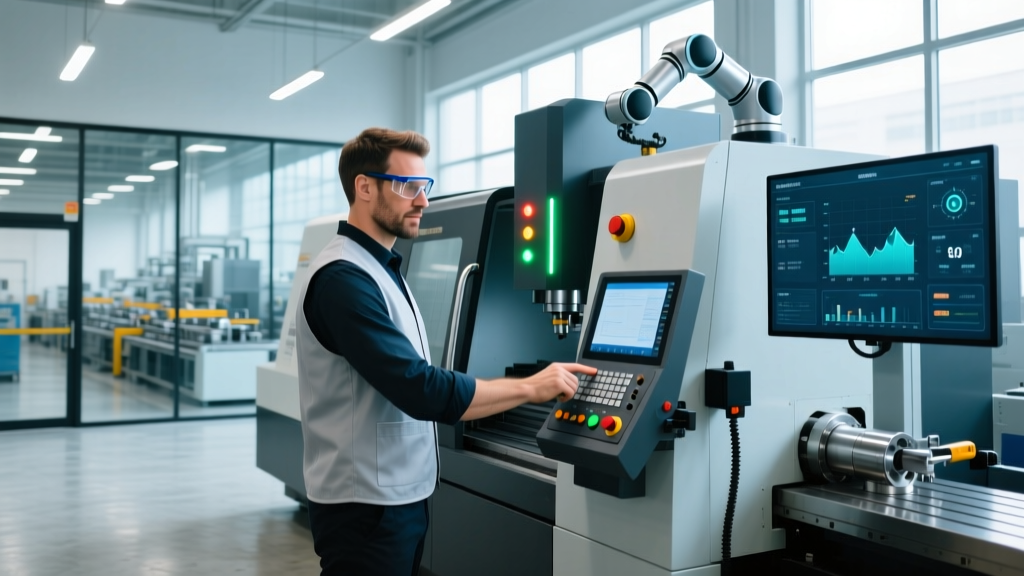
Machine tending is no longer limited to hard-automation gantry loaders. Shops are deploying collaborative robots like the FANUC CRX-10iA/L or the Universal Robots UR10e directly next to Haas VF-2SS or Mazak VCN-530C machining centers. The modern operator is expected to swap out end-of-arm tooling (EOAT) and adjust drag-and-drop waypoints via a teach pendant when part geometries change. Furthermore, operators must understand dual-gripper setups—where the cobot holds a raw blank in one gripper and the finished part in the other—to minimize machine idle time during load/unload cycles. A candidate who can troubleshoot a cobot's torque limit fault or recalibrate a Schunk pneumatic gripper holds a massive advantage in the hiring process.
2. IoT Telemetry and Predictive Maintenance
The MTConnect Institute standard has become the backbone of smart manufacturing data extraction. Today's CNC vacancies require operators to read spindle load dashboards and interpret real-time telemetry. Instead of running a carbide endmill until it catastrophically fails and scraps a $4,000 titanium aerospace structural component, the tech-enabled operator monitors the spindle load graph. A sustained 12% deviation in amperage draw indicates micro-chipping on the cutting edge. The operator's new job is to intervene based on data trends, swapping the insert during a planned pause rather than reacting to a broken tool alarm. Understanding how to navigate MTConnect adapter data or use shop-floor monitoring software like Freeform Pro or MachineMetrics is now a baseline requirement for high-mix, low-volume environments.
3. AI-Assisted Toolpath and Chatter Suppression
Next-generation CNC controllers, such as the Mazak SmoothAi and Siemens Sinumerik One, feature embedded acoustic sensors and AI-driven chatter suppression algorithms. When a shop posts a cnc machine operator vacancy for a cell running these machines, they need an operator who can 'train' the AI. During the first-article run, the operator must intentionally push the machine to the edge of stability, allowing the controller's acoustic sensors to map the chatter frequency. The operator then sets the AI boundaries, enabling the machine to automatically micro-adjust feed rates and spindle speeds in real-time during unmanned overnight shifts to maintain surface finish tolerances of 16 Ra or better.
4. Digital Twin Verification and Macro Editing
With the rise of 5-axis simultaneous machining, the cost of a spindle crash is catastrophic. Operators are now expected to run digital twin verifications using software like CGTech VERICUT directly at the machine control or on a localized shop-floor terminal. Additionally, vacancies frequently demand the ability to edit Renishaw probing macros. If a customized O9000-series macro fails to account for thermal expansion in a 17-4 PH stainless steel part, the operator must possess the G-code literacy to adjust the probe compensation variables on the fly.
Comparison Matrix: Traditional vs. Smart Manufacturing Vacancies
To understand how the cnc machine operator vacancy has evolved, compare the expectations and compensation of a traditional job shop versus a smart manufacturing facility.
| Skill / Requirement | Traditional Vacancy | Smart Mfg. Vacancy (2026) | Salary Premium |
|---|---|---|---|
| Machine Loading | Manual loading, vise clamping | Cobot EOAT setup, pneumatic fixture troubleshooting | + $6,000 / yr |
| Tool Management | Visual inspection, time-based changes | Spindle load telemetry analysis, predictive swapping | + $8,500 / yr |
| Quality Control | Manual micrometers, CMM handoff | In-machine Renishaw probing, macro variable editing | + $7,000 / yr |
| Process Verification | Dry runs, single-block execution | VERICUT digital twin simulation, AI chatter mapping | + $9,000 / yr |
How to Upskill and Capture the Premium Salary
If you are applying for a tech-forward cnc machine operator vacancy, generic machining experience is no longer sufficient. You must demonstrate verifiable proficiency in smart manufacturing protocols. Here is the exact roadmap to upskill and command the top-tier salary brackets.
- Acquire NIMS Smart Manufacturing Credentials: The National Institute for Metalworking Skills (NIMS) offers specialized credentials that go beyond basic G-code. Target the 'CNC Milling: Programming, Setup & Operations' certification, but pair it with their Smart Manufacturing credentials, which cover networked machine tools and data collection.
- Master MTConnect Data Interpretation: You do not need to be a software engineer, but you must know how to read an MTConnect XML stream or use a dashboard to identify OEE (Overall Equipment Effectiveness) bottlenecks. Learn to correlate spindle load spikes with specific toolpath movements in Mastercam or Fusion 360.
- Learn Cobot Basics: Complete the free or low-level certification courses offered by Universal Robots (UR Academy) or FANUC. Understanding payload limits, reach radius, and singularity avoidance will allow you to confidently answer technical interview questions regarding automated machine tending.
- Develop Macro-Programming Literacy: Learn how to write and edit custom macro B code. Being able to program a routine that automatically updates the tool wear offset based on a post-process gauge measurement is a highly sought-after skill in high-precision medical machining.
Real-World Salary Impact of Tech Proficiency
According to baseline data from the U.S. Bureau of Labor Statistics, the median pay for machinists hovers around the mid-$50,000s. However, this aggregate data masks the severe bifurcation in the 2026 labor market. A traditional manual operator in a low-tech job shop may cap out at $58,000 annually. Conversely, a 'CNC Technologist' or 'Smart Cell Operator' managing a pallet pool system with integrated cobots and IoT monitoring routinely commands between $78,000 and $92,000, with lead technologists in aerospace hubs exceeding $105,000.
Employers are willing to pay this premium because a tech-enabled operator prevents catastrophic crashes, reduces scrap rates by leveraging predictive tooling data, and maximizes spindle uptime during lights-out manufacturing shifts. When you next evaluate a cnc machine operator vacancy, look past the base hourly rate. Scrutinize the job description for mentions of MTConnect, 5-axis digital twins, and automated tending. If those keywords are present, you are looking at a future-proof career path that rewards technical agility over brute-force manual labor.
Interview Tip: When interviewing for a smart manufacturing vacancy, ask the hiring manager about their machine monitoring infrastructure. Asking 'Are you currently utilizing MTConnect or OPC-UA to track spindle utilization, and how do operators interact with that data?' immediately positions you as a high-level candidate who understands the business economics of modern machining.