Safety Standards: What to Know Before Buying a Used CNC Lathe Machine
Discover what to know before buying a used CNC lathe machine regarding OSHA compliance, safety interlocks, and hidden retrofit costs.
The Hidden Liability in the Used CNC Lathe Market
When shop owners evaluate the secondary equipment market, the focus is almost exclusively on mechanical integrity: spindle runout, ballbar testing, way wear, and control hours. However, understanding exactly what to know before buying a used CNC lathe machine extends far beyond mechanical precision. Safety compliance is the most frequently overlooked variable in used machinery acquisitions, and it carries severe financial and legal liabilities.
A used lathe that bypasses modern safeguarding standards doesn't just pose a physical risk to operators; it exposes the purchasing company to catastrophic OSHA fines, voided liability insurance, and catastrophic worker compensation claims. Under OSHA's National Emphasis Program (NEP) on amputations, turning machines are heavily scrutinized. According to OSHA's Machine Guarding guidelines, failure to properly guard the point of operation or rotating components like chucks and lead screws can result in willful violation fines exceeding $156,000 per incident as of 2026.
⚠️ Insurance & Liability Warning: Many commercial liability policies contain a 'compliance clause.' If an operator is injured on a used CNC lathe and an investigation reveals the machine's safety interlocks were bypassed or failed to meet ANSI B11.0 standards at the time of installation, the insurer may deny the claim entirely, leaving the business fully liable for medical and legal costs.Core Safety Standards Governing CNC Lathes
To accurately assess a used lathe, buyers must audit the machine against three primary regulatory frameworks. Machines built before 2015 often fall short of current enforcement expectations without targeted retrofits.
- ANSI B11.0 (Safeguarding): Dictates the physical guarding requirements for the chuck, tailstock, and chip conveyor.
- ISO 13849-1 (Control System Safety): Requires safety-related parts of control systems (like E-stops and door interlocks) to meet specific Performance Levels (PL d or PL e for lathes), meaning a standard PLC output is no longer legally sufficient for stopping a chuck.
- NFPA 79 (Electrical Standard for Industrial Machinery): Governs the electrical cabinet, wiring, and ground-fault protection, particularly critical in wet environments where coolant ingress is common.
Decoding the Control Panel: E-Stop and Interlock Architecture
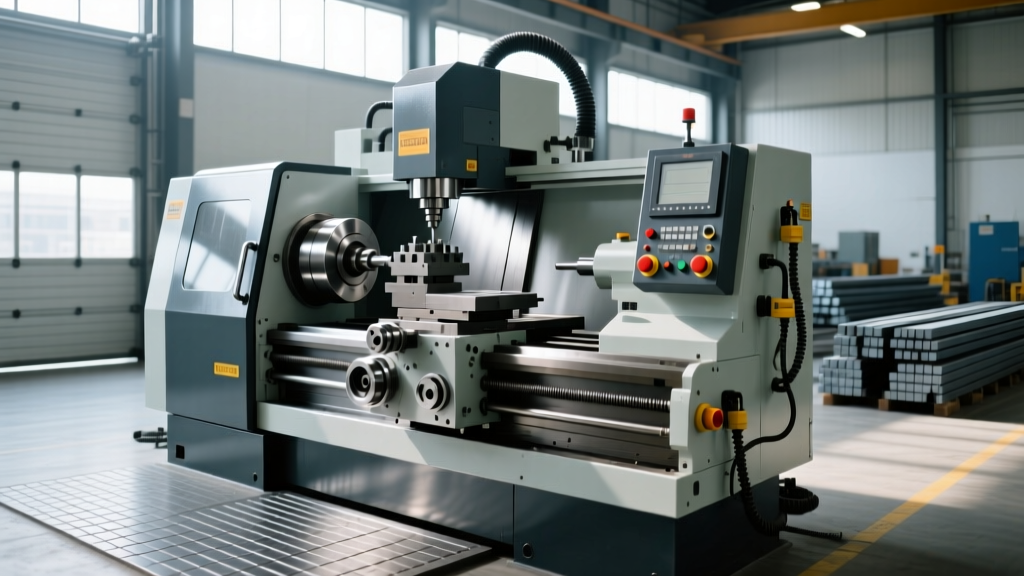
The most critical inspection point on a used CNC lathe is the electrical cabinet. Open the panel and trace the Emergency Stop and door interlock wiring. On older machines (e.g., early 2010s Mori Seiki NL series or older Okuma Lathes), the E-stop circuit often routes directly through a standard relay or the main CNC PLC.
Under ISO 13849-1, this is a Category 1 or B architecture, which is largely non-compliant for modern heavy-turning applications. You need to see dedicated safety relays—such as the Allen-Bradley Guardmaster 440R series or Pilz PNOZ X3—that utilize dual-channel, cross-fault monitored circuits. If the machine uses a single-channel microswitch on the sliding door, it must be retrofitted with an RFID-coded, tamper-proof switch like the Euchner CTM or Schmersal AZM40 to prevent operators from defeating the interlock with a zip-tie or spare magnet.
5-Point Physical Safety Inspection Checklist
Use this framework when walking the floor to inspect a prospective used lathe purchase. These physical deficiencies are common in the secondary market and serve as prime negotiation leverage.
| Inspection Point | Common Failure Mode | Required Retrofit Action | Est. Cost (2026) |
|---|---|---|---|
| Chuck Guarding | Polycarbonate shield is yellowed, crazed, or cracked from synthetic coolant exposure. | Replace with coolant-resistant PETG or coated polycarbonate shield. | $400 - $900 |
| Sliding Door Interlocks | Mechanical limit switch defeated or bypassed via jumper wire in the cabinet. | Install RFID-coded safety switch (e.g., Euchner CTM) wired to a safety relay. | $850 - $1,400 |
| Chip Conveyor Auger | Top access panels removed by previous owner for easier jam clearing. | Fabricate and install hinged, interlocked steel mesh guarding per ANSI B11.0. | $1,200 - $2,500 |
| Lead Screw / Way Covers | Z-axis way covers torn, exposing the rotating ballscrew to the operator. | Replace telescopic steel way covers or install heavy-duty bellows. | $1,500 - $3,200 |
| Tailstock Quill Guard | Missing or broken anti-rotation guard on hydraulic tailstocks. | Source OEM replacement or fabricate custom sheet-metal wrap guard. | $300 - $750 |
NFPA 79 and the Coolant Ingress Hazard
While mechanical guarding prevents amputations, electrical faults cause fires and fatal shocks. The NFPA 79 standard strictly outlines the requirements for industrial machinery electrical equipment. In used CNC lathes, the primary enemy is high-pressure coolant.
Inspect the way covers and the chip conveyor basin. If the previous owner ran high-pressure coolant (e.g., 1,000+ PSI for Inconel or titanium turning) without upgrading the way cover wipers, coolant inevitably migrates into the Z-axis servo motor housing and the electrical cabinet's lower wire trough. Look for signs of white corrosion (aluminum oxide) on the servo drives or rust on the 24V DC power supply terminals. A machine with compromised electrical insulation requires a full cabinet teardown, terminal block replacement, and megger testing of the servo motors—a $4,000+ undertaking before the machine can be legally energized.
Real-World Scenario: Upgrading a 2014 Haas ST-20
Consider a shop purchasing a used 2014 Haas ST-20 for $68,000. The machine cuts well, but the door interlock is a standard mechanical plunger switch that operators frequently tape down to load parts while the spindle spins down. Furthermore, the chip conveyor lacks a top guard.
The Compliance Retrofit Plan:
- Interlock Upgrade: Remove the mechanical plunger. Install a Banner Engineering EZ-SCREEN light curtain at the loading zone for setup mode, and an RFID door switch for auto mode. Wire both through an Allen-Bradley Guardmaster 440R relay. Cost: $2,100.
- Spindle Orientation Lock: Program the Haas M-code (M19) to trigger a physical spindle brake or zero-speed monitor relay, ensuring the chuck cannot be opened until rotation is strictly 0 RPM. Cost: $450 (parts/labor).
- Conveyor Guarding: Weld a 14-gauge steel mesh hinge guard over the auger intake. Cost: $800.
Total safety retrofit cost: $3,350. The buyer should negotiate this exact figure off the $68,000 asking price prior to signing the bill of sale.
Negotiating Price Based on Safety Deficiencies
Sellers of used CNC equipment rarely price machines based on safety compliance; they price them based on age, hours, and cosmetic condition. This creates a distinct arbitrage opportunity for informed buyers. Do not accept a seller's claim that 'the machine ran fine in our shop.' If an OSHA inspector walked into their shop, they would likely face citations.
'When acquiring secondary market machinery, the bill of sale does not transfer regulatory compliance. The moment the machine is plugged in on your floor, you assume 100% of the liability for its safeguarding architecture. Price your retrofits before you negotiate the final purchase order.' — Industrial Safety Compliance Board, 2025 Manufacturing Risk Report
The Pre-Purchase Safety Audit Framework
Before wiring a deposit, execute this three-step audit:
- Request the Electrical Schematics: If the seller cannot provide the original PDF schematics, walk away. Without schematics, tracing the safety relay logic to ensure ISO 13849-1 compliance is nearly impossible, and any electrical repair becomes a guessing game.
- Perform the 'Defeat' Test: With the machine powered on and the spindle rotating at 500 RPM in MDI mode, attempt to open the main door. If the spindle does not immediately trigger a Category 0 or Category 1 stop (depending on the braking architecture), the interlock is non-compliant.
- Check the Light Curtains: If the machine is equipped with a vertical light curtain for bar feeder integration, use the provided test piece (usually a 14mm or 30mm diameter rod) to verify the resolution. If the machine continues to cycle when the beam is broken, the muting logic is dangerously flawed.
Ultimately, buying a used CNC lathe is an exercise in risk management. By prioritizing safety standards and accurately pricing the necessary compliance retrofits, buyers can secure high-performance turning centers without inheriting catastrophic regulatory and physical liabilities.