How Much Do CNC Machines Cost? Hidden Repair & Downtime Fees
Discover how much CNC machines cost when factoring in troubleshooting, spindle repairs, and downtime. A 2026 guide to hidden TCO and repair matrices.
The Sticker Price vs. The Troubleshooting Reality
When shop owners ask, "how much do cnc machines cost," they are typically looking at the manufacturer's invoice. A mid-range vertical machining center (VMC) like a Haas VF-2SS might command $95,000, while a 5-axis mill-turn center like a Mazak INTEGREX i-200S easily exceeds $450,000. However, the invoice price is merely the entry fee. The true cost of ownership (TCO) is dictated by the troubleshooting and repair ledger over the machine's 10-to-15-year lifecycle.
Machine tool economics have shifted dramatically by 2026. Supply chain stabilization has lowered baseline hardware costs, but the shortage of skilled CNC maintenance technicians has driven repair labor rates up by 22% since 2022. Understanding how much CNC machines cost to maintain, troubleshoot, and repair is the only way to accurately forecast profitability and avoid catastrophic cash-flow interruptions.
⚠️ The "Budget Import" Spindle TrapPurchasing a $25,000 direct-import VMC to save capital often backfires during the first major failure. When a proprietary, non-standard 10,000 RPM spindle seizes on a budget machine, local technicians cannot source replacement ceramic bearings or match the drawbar retention force specifications. You are left with a $6,000 repair bill, six weeks of ocean-freight downtime, and a machine that loses 0.003" of Z-axis accuracy under load. Always verify local spindle rebuild support before purchasing off-brand iron.
Tier-by-Tier Breakdown: How Much Do CNC Machines Cost to Fix?
Repair costs scale non-linearly with machine complexity. A servo drive failure on a 3-axis router is an inconvenience; the same failure on a 5-axis aerospace mill is a multi-day crisis.
Entry-Level & Production Routers ($15,000 – $60,000)
Machines in this tier (e.g., ShopBot, Avid CNC, entry-level Biesse) rely on stepper motors, rack-and-pinion drives, and basic linear rails.
- Common Failures: Stepper motor burnout from excessive rapid traverse loads, linear guide block seizure due to MDF dust ingestion, and VFD (Variable Frequency Drive) overheating.
- Repair Costs: Replacing a NEMA 34 stepper motor and driver costs between $250 and $450. Upgrading to sealed THK linear rails to prevent dust ingestion runs $1,800 per axis in parts and labor.
Mid-Range Production VMCs & Lathes ($75,000 – $180,000)
This is the workhorse tier (Haas, Doosan/DN Solutions, Brother). These machines utilize Fanuc, Mitsubishi, or Yaskawa servo systems and direct-drive or belt-driven BT40/BT50 spindles.
- Common Failures: Spindle bearing wear (indicated by a high-pitch whine above 6,000 RPM), telescopic way cover punctures from stringy chips, and servo amplifier alarm faults (e.g., Fanuc Alarm 414 - X Axis Detect Error).
- Repair Costs: A standard 10,000 RPM BT40 spindle rebuild costs $6,500 to $9,500 in 2026. Replacing a Fanuc alpha-i series servo amplifier costs $2,200 to $3,500 for the part alone. Way cover replacements average $600 per axis.
High-End 5-Axis & Mill-Turn Centers ($250,000+)
Advanced machines (DMG MORI, Grob, Mazak) feature integrated trunnion tables, HSK-63A/100A spindles, and high-pressure coolant systems (up to 1,000 PSI).
- Common Failures: Trunnion table rotary union leaks, high-pressure coolant pump cavitation, and absolute encoder battery failures causing axis datum loss.
- Repair Costs: Rebuilding a 20,000 RPM HSK spindle cartridge requires specialized cleanroom facilities and costs $18,000 to $28,000. Replacing a 1,000 PSI Cat pump and flushing the system to remove metal particulates averages $4,500.
2026 CNC Troubleshooting & Repair Cost Matrix
The table below outlines the real-world costs of common CNC failures, factoring in OEM parts, specialized labor, and the hidden cost of spindle downtime (calculated at an average shop rate of $125/hour).
| Component / Failure | Symptom / Alarm | Avg. Part Cost | Labor & Calibration | Total Downtime Cost |
|---|---|---|---|---|
| BT40 Spindle Rebuild | Vibration > 2.5 mm/s at 8k RPM | $4,500 - $6,000 | $2,500 (12 hrs) | $8,500 - $10,500 |
| X-Axis Ball Screw (40mm) | Backlash > 0.0004", Alarm 411 | $1,800 - $2,400 | $2,200 (Laser Cal) | $4,500 - $5,200 |
| Servo Amplifier (Yaskawa) | A.E2 Alarm (Overload) | $2,100 - $2,800 | $450 (2 hrs) | $2,600 - $3,300 |
| High-Pressure Coolant Pump | Low flow alarm, tool burn | $2,800 - $3,500 | $900 (4 hrs + flush) | $4,000 - $4,800 |
| Tool Changer Arm (Cam Box) | Arm stalls, ATC Alarm 2044 | $1,200 - $1,800 | $1,500 (8 hrs) | $2,900 - $3,500 |
The Troubleshooter’s Decision Matrix: Repair vs. Replace
Knowing how much CNC machines cost to fix is only half the battle. Maintenance managers must decide when to authorize a major repair and when to scrap or trade in the asset. Use this decision framework:
The 50% / 15K Rule
Step 1: Check Spindle Hours. If the machine has fewer than 15,000 verified spindle hours, repair the component. The cast iron and structural geometry still have immense residual life.
Step 2: Calculate the 50% Threshold. If the machine is over 15,000 hours, pull the current depreciated market value (or the cost of an equivalent used model). If the quoted repair exceeds 50% of that value, do not repair.
Step 3: Evaluate Control Obsolescence. A machine running a Fanuc 0i-C or older Siemens 840D (non-Sinumerik One) faces severe memory and PCB sourcing issues. If the mainboard fails, the cost to retrofit a modern CNC controller (e.g., via Centroid or Mach4 integrators) starts at $18,000. Factor this into your replace decision.
Mitigating Hidden Costs Through Preventative Troubleshooting
The most effective way to manage how much CNC machines cost over their lifespan is to shift from reactive troubleshooting to predictive maintenance. Ignoring fluid dynamics and lubrication specs is the leading cause of catastrophic mechanical failure.
- Way Lubrication Specifics: Never use generic hydraulic fluid in a one-shot lube system. You must use a tackified way oil like Mobil Vactra Oil Heavy Medium (#2). The tackifier prevents the oil from slinging off the ways during rapid traverses, preventing metal-on-metal wear that destroys linear guide blocks.
- Coolant Filtration: Standard paper band filters allow 20-to-30-micron particulates to recirculate. This acts as lapping compound on your spindle bearings and ball screws. Upgrading to a 10-micron bag filter or centrifugal separator costs $2,500 upfront but extends coolant life by 400% and prevents premature screw wear.
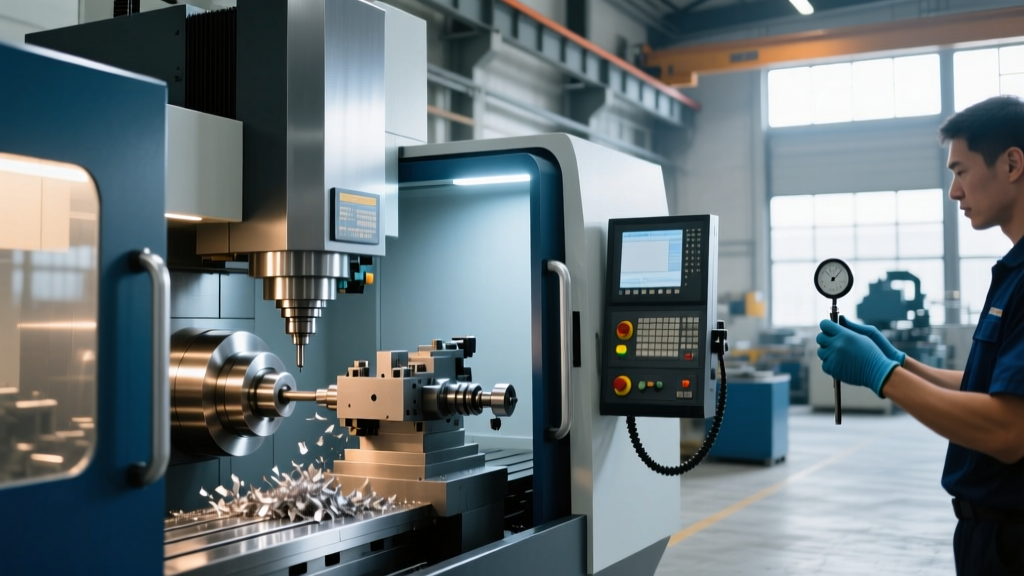
- Backlash Mapping: Troubleshoot axis geometry quarterly. Mount a 0.0001" resolution dial indicator on the spindle and push the axis against a fixed stop. If reversal error exceeds 0.0002", adjust the servo backlash parameters in the control immediately to prevent scrapped aerospace tolerances.
"The cost of a CNC machine is amortized over its uptime, not its purchase date. A $150,000 machine that runs 6,000 hours a year with 98% availability costs $4.25 per hour to own. A $75,000 machine that breaks down twice a month and requires proprietary overseas parts costs upwards of $11.00 per hour when factoring in missed deliveries and expedited shipping fees."
— Director of Maintenance, Tier-1 Aerospace Supplier
Sourcing Parts: OEM vs. Aftermarket
When troubleshooting a fault, sourcing the right part dictates your repair budget. According to industry lifecycle data tracked by organizations like The Association For Manufacturing Technology (AMT), mixing OEM and aftermarket parts strategically is the hallmark of a mature maintenance department.
Always Buy OEM: Spindle cartridges, servo amplifiers, main CPU boards, and absolute encoders. The proprietary handshake protocols between a Fanuc drive and a Fanuc motor cannot be reliably replicated by third-party cloners. Furthermore, when performing electrical troubleshooting, strict adherence to OSHA's Lockout/Tagout (LOTO) standards is mandatory before opening any servo cabinet to prevent arc flash injuries.
Buy Aftermarket: Telescopic way covers, chip conveyor hinges, hydraulic hoses, and coolant pump impellers. A local fabrication shop can build a stainless steel way cover for $400 that matches the OEM $1,100 part perfectly. Similarly, sourcing replacement ball nuts from SME-vetted suppliers like THK or NSK directly, rather than through the machine tool builder's markup, can save 30% to 45% on mechanical drivetrain repairs.
Total Cost of Ownership Summary
Answering "how much do cnc machines cost" requires looking past the initial capital expenditure. Budget an additional 8% to 12% of the machine's purchase price annually for maintenance, troubleshooting, and unexpected component failures. By enforcing strict way-lubrication protocols, utilizing 10-micron coolant filtration, and applying the 50% / 15K repair matrix, shops can artificially extend the MTBF (Mean Time Between Failures) and drastically reduce the hidden costs of machine tool ownership.