How Much Does a CNC Machine Cost? 2026 Industry Case Studies & ROI
Discover how much a CNC machine costs in 2026 through real industry case studies. We break down TCO, ROI, and pricing for job shops, aerospace, and medical.
The Real Answer to "How Much Does a CNC Machine Cost?"
When manufacturing engineers and shop owners ask, "how much does a CNC machine cost," the only honest answer is that the base sticker price is largely irrelevant to your bottom line. A 3-axis vertical machining center (VMC) might list for $95,000, while a 5-axis simultaneous mill can exceed $450,000. However, the true cost of ownership—encompassing rigging, facility preparation, workholding, CAM software, and cutting tools—frequently adds 25% to 40% to the initial capital expenditure.
To provide actionable clarity for 2026 capital equipment planning, we have analyzed three distinct industry applications. These case studies break down the exact landed costs, hidden expenses, and realistic return on investment (ROI) timelines for modern CNC acquisitions.
Case Study 1: The Precision Job Shop (3-Axis VMC)
Application: General Machining, Prototyping, and Aluminum/Steel Production
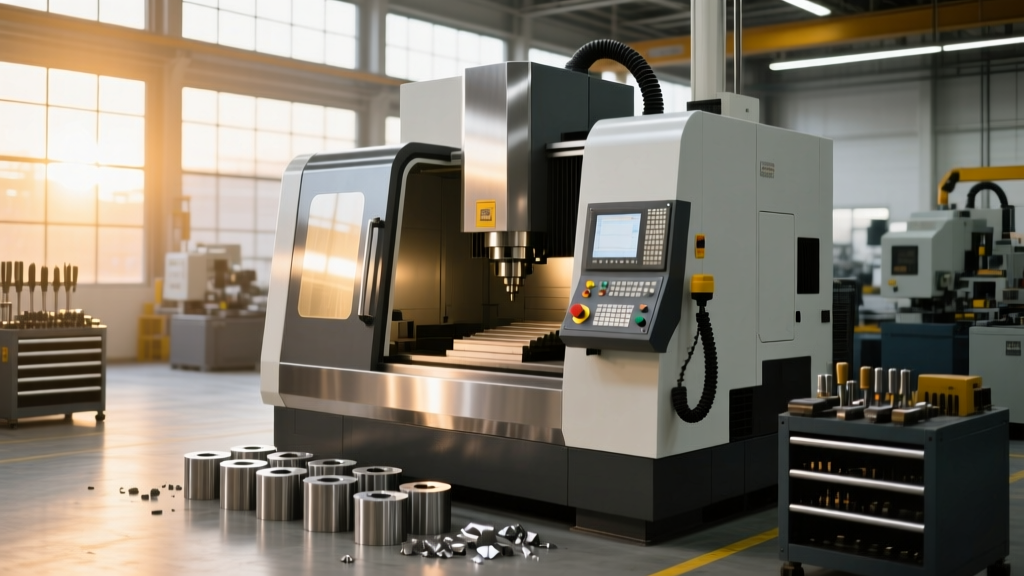
For a mid-sized job shop transitioning from manual mills to CNC to increase throughput on 6061-T6 aluminum and 1018 steel fixtures, the Haas VF-2SS (Super Speed) remains the industry benchmark. The 12,000 RPM inline direct-drive spindle and 24+1 side-mount tool changer offer the optimal balance of speed and rigidity for general-purpose milling.
Cost Breakdown: Haas VF-2SS Landed Setup- Base Machine (with 15K RPM upgrade & probing): $128,500
- Workholding (3x Kurt DX6 Vises + Parallels): $6,200
- Initial Tooling (Sandvik Coromant & Kennametal endmills, drills, holders): $14,500
- Rigging, Forklift, and Leveling: $3,800
- 3-Phase Power Drop & Air Line Routing: $7,500
- Total Landed Cost: $160,500
ROI Analysis: By replacing two manual Bridgeport mills with one VF-2SS, the shop reduces cycle times on complex bracketry by 65%. Assuming a blended shop rate of $145/hour and 60% spindle utilization (roughly 1,250 billable hours annually), the machine generates $181,250 in gross margin per year. Factoring in operator labor, material, and maintenance, the net payback period is approximately 14 to 16 months.
Case Study 2: Aerospace & Defense (5-Axis Simultaneous)
Application: Titanium/Inconel Structural Components and Impellers
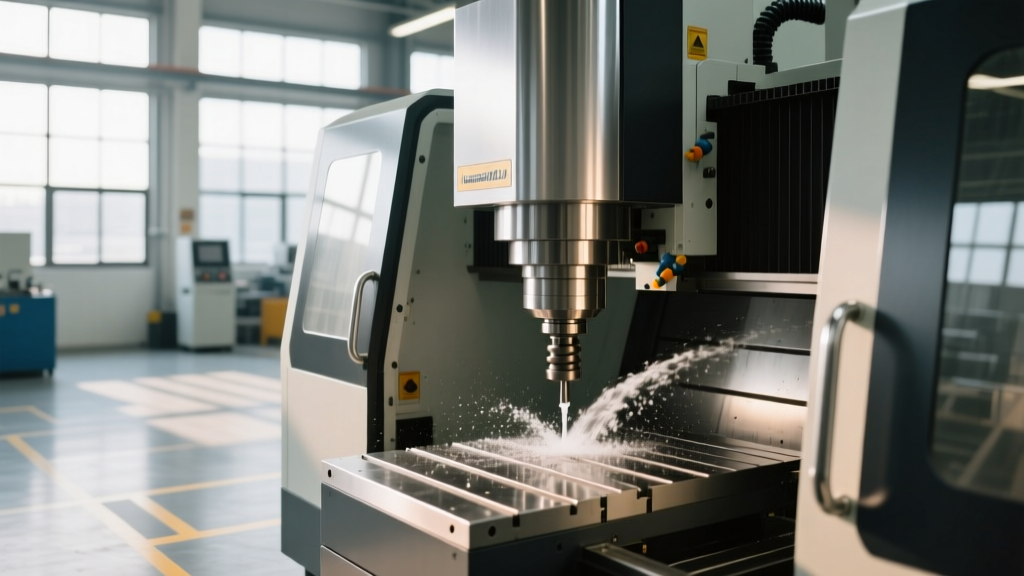
Machining aerospace alloys like Ti-6Al-4V and Inconel 718 requires immense static rigidity, advanced thermal compensation, and high-pressure coolant to break stringy chips. The Makino D500 5-axis VMC is engineered specifically for these demanding tolerances, featuring a direct-drive torque motor table and advanced geometric error correction.
Cost Breakdown: Makino D500 Aerospace Cell- Base Machine (with 1000 PSI Coolant & Chiller): $415,000
- Advanced Workholding (Schunk Zero-Point & Hydraulic Fixtures): $28,000
- Aerospace Tooling (Harvey Tool, OSG, custom form tools): $45,000
- 5-Axis CAM Software (hyperMILL Aerospace Bundle + Post): $22,000
- Foundation Prep (Epoxy grout pad & vibration isolation): $18,500
- Total Landed Cost: $528,500
ROI Analysis: The primary financial driver here is not cycle time, but scrap reduction and setup elimination. A single scrapped Inconel turbine blisk forging can cost $12,000 in raw material alone. By utilizing 5-axis simultaneous machining and Renishaw on-machine probing, first-part inspection pass rates increase from 72% to 96%. According to data tracked by the US Manufacturing Technology Orders (USMCT) report, high-end 5-axis investments in the aerospace sector typically yield a full ROI within 11 to 13 months purely through scrap mitigation and reduced CMM (Coordinate Measuring Machine) queue times.
Case Study 3: High-Volume Medical (Swiss-Type Lathe)
Application: Orthopedic Bone Screws and Surgical Implants
Producing millions of tiny, high-tolerance medical components requires a Swiss-type automatic lathe. The Citizen Cincom L20XII features a main and sub-spindle, overlapping tool posts, and a B-axis for complex contouring, making it ideal for machining medical-grade stainless steel (316LVM) and titanium on a 24/7 lights-out basis.
| Expense Category | Estimated Cost (2026) | Critical Justification |
|---|---|---|
| Base Swiss Lathe | $295,000 | Includes high-precision B-axis and sub-spindle C-axis control. |
| Iemca Master 80 Bar Feeder | $48,000 | Required for 12-foot bar capacity to enable weekend lights-out runs. |
| High-Pressure Coolant & Oil Skimmer | $16,500 | Prevents built-up edge (BUE) on micro-drills under 1mm diameter. |
| Tooling & Guide Bushings | $22,000 | Carbide bushings and custom micro-turning inserts. |
| Total Landed Cost | $381,500 | Fully automated, production-ready cell. |
ROI Analysis: The ROI on Swiss lathes is driven by labor amortization. One operator can manage a cell of four Citizen machines running unattended. With a part cycle time of 45 seconds and a net profit of $1.10 per bone screw, a single machine generates over $180,000 in annual profit at 80% OEE (Overall Equipment Effectiveness). Payback is achieved in under 24 months, after which the machine acts as a high-margin cash cow.
The Hidden Costs That Destroy CNC Budgets
When calculating how much a CNC machine costs, buyers routinely overlook peripheral infrastructure. The NIST Manufacturing Extension Partnership (MEP) frequently highlights facility readiness as the primary cause of delayed equipment deployments. Factor these edge cases into your 2026 capital request:
⚠️ Critical Infrastructure Warnings
- Utility Transformer Upgrades: If your facility lacks sufficient amperage on a dedicated 480V 3-phase line, utility companies can take 8 to 14 weeks to install a new step-down transformer, costing $12,000–$25,000.
- Thermal Stabilization: 5-axis and Swiss machines require ambient temperature control (±2°F). Failing to install dedicated HVAC drops or machine-specific chillers will cause thermal growth, ruining GD&T callouts on tight-tolerance parts.
- Chip Conveyor Maintenance: Standard hinge-belt conveyors fail when machining stringy aerospace alloys. Upgrading to a scraper-style or filter-integrated conveyor at the time of purchase adds $6,000 but prevents $15,000 in annual downtime.
Decision Framework: Matching the Machine to the Margin
Do not buy a machine based on its base price; buy it based on the margin profile of your target industry.
- High-Mix / Low-Volume (Job Shops): Prioritize fast setup times, large tool magazines, and conversational CNC controls. Landed costs should remain under $180,000. Focus on 3-axis VMCs with quick-change workholding.
- Low-Mix / High-Complexity (Aerospace/Medical): Prioritize rigidity, thermal stability, and advanced CAM integration. Expect landed costs between $400,000 and $600,000. The machine must pay for itself through scrap reduction, not just speed.
- High-Volume / Commodity (Automotive/Fasteners): Prioritize automation readiness, bar feeders, and pallet changers. Landed costs hover around $350,000. ROI relies entirely on lights-out machining and labor reduction.
"The cheapest CNC machine is often the most expensive one on your floor. A $90,000 machine that requires constant manual intervention, scrap rework, and spindle rebuilds will consume more overhead in 24 months than a $300,000 machine that runs unattended with 99.8% first-pass yield."
Ultimately, answering the question of how much a CNC machine costs requires looking past the dealer's invoice. By mapping your specific material requirements, tolerance stacks, and production volumes to the case studies above, you can accurately forecast your true capital requirements and build a defensible ROI model for your next equipment purchase.