Inside a CNC Cheap Machine: Technical Specs & How It Works
Explore the technical specifications, drive systems, and operational limits of a CNC cheap machine to understand what budget hardware can actually cut.
The sub-$2,000 desktop routing market has expanded dramatically, but marketing claims often obscure the physical realities of budget hardware. When evaluating a CNC cheap machine, buyers must look past advertised work areas and focus on structural rigidity, drive mechanics, and open-loop control limitations. Understanding the exact technical specifications of these machines is the only way to predict their actual machining capabilities and avoid catastrophic tool breakage or ruined workpieces.
Structural Rigidity: Extrusions and V-Wheel Dynamics
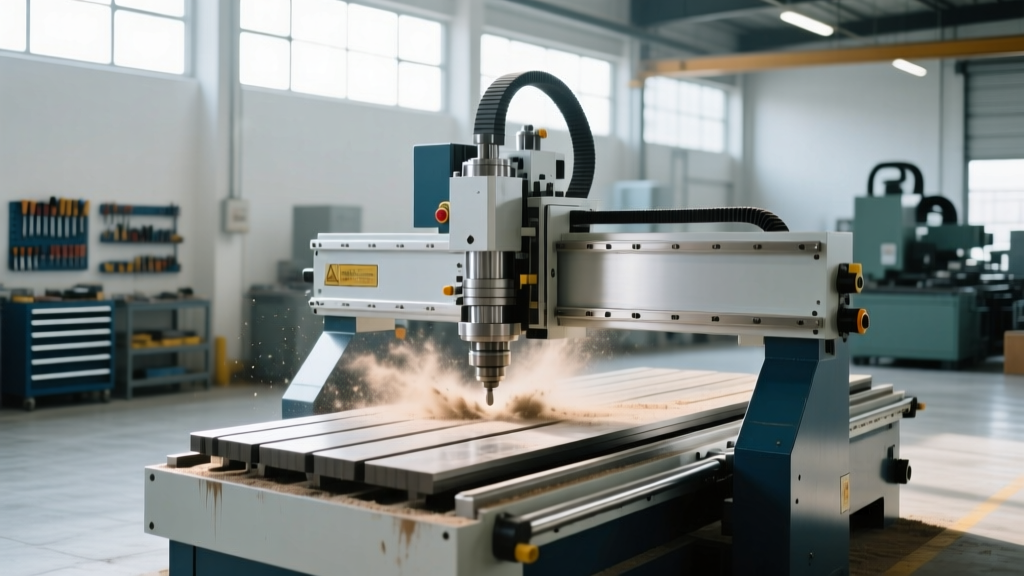
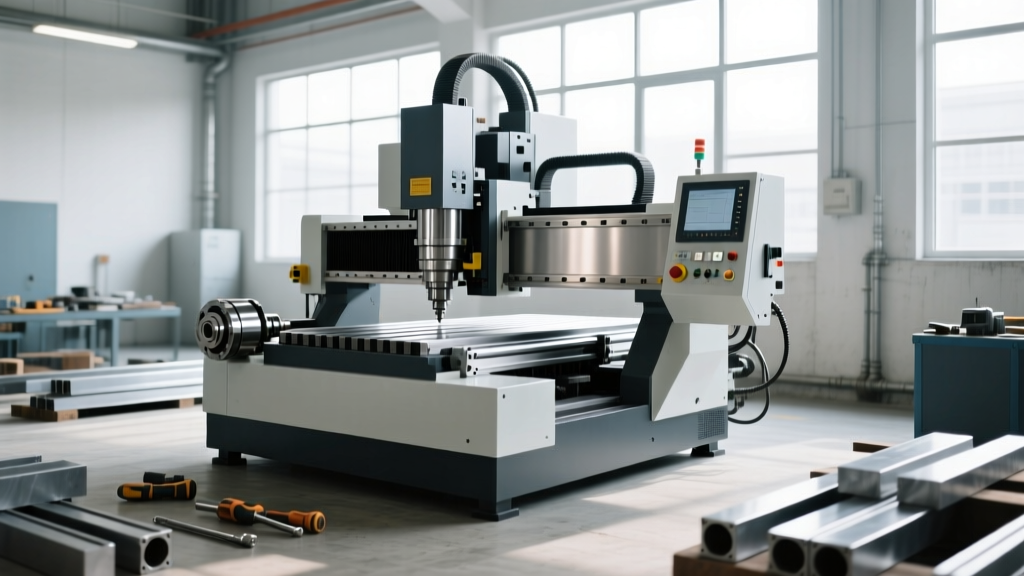
The foundation of any budget CNC router is its frame. Machines in the $300 to $1,200 range almost universally rely on aluminum extrusions (typically 2020, 2040, or 4080 profiles) rather than cast iron or welded steel. While extrusions offer excellent modularity, their moment of inertia limits rigidity under heavy cutting loads.
Motion along these extrusions is generally handled by POM (polyoxymethylene) V-wheels riding in the V-slots of the aluminum. According to the Shapeoko Mechanics Wiki, V-wheel systems require precise eccentric nut tensioning to eliminate gantry racking. However, POM wheels compress under high radial loads, introducing positional error.
Deflection Warning: Under a 50N lateral cutting force (common when roughing 6061 aluminum with a 1/4-inch endmill), a standard V-wheel gantry on a 2040 extrusion can deflect between 0.05mm and 0.15mm. This deflection causes chatter, poor surface finishes, and accelerated tool wear. Machines utilizing budget HGH15CA linear guide rails reduce this deflection to under 0.01mm, but add roughly $300 to the base price.Drive Systems: T8 Lead Screws vs. GT2 Belts
Budget CNC machines translate rotational motor force into linear axis movement using either ACME lead screws or timing belts. The technical trade-offs between these systems dictate the machine's speed, accuracy, and backlash characteristics.
T8 Lead Screws and Anti-Backlash Nuts
Most sub-$800 machines utilize T8 lead screws with an 8mm lead and 2mm pitch. These screws offer high mechanical advantage, allowing small NEMA 17 or NEMA 23 stepper motors to lift heavy Z-axes or push through dense materials without stalling. However, ACME screws operate at roughly 40% mechanical efficiency due to sliding friction.
To combat the inherent backlash in lead screw systems, manufacturers install dual-nut anti-backlash assemblies. These consist of two Delrin nuts separated by a compression spring, preloading the threads against opposite flanks of the screw. While effective for X and Y axes, Z-axis lead screws are prone to 'back-driving' if the motor loses holding torque during a power interruption, causing the spindle to crash into the workpiece.
GT2 Timing Belts for High-Speed Gantry Motion
Machines prioritizing speed over heavy cutting forces (such as those designed for wood and plastics) often use 9mm or 12mm wide GT2 fiberglass-reinforced timing belts. Belts eliminate backlash entirely and allow for rapid traverse rates exceeding 5,000 mm/min. The limitation is tensile stretch; under heavy cutting loads, the belt can stretch microscopically, causing lost steps and dimensional inaccuracies in the final part.
Stepper Motors and Open-Loop Control Physics
A defining characteristic of a CNC cheap machine is the use of open-loop stepper motors rather than closed-loop servos. The most common configurations are NEMA 17 (42mm frame) and NEMA 23 (57mm frame) bipolar steppers.
- NEMA 17 (e.g., Genmitsu 3018 series): Typically rated for 4.0 to 4.5 kg-cm of holding torque. Suitable for engraving, PCB milling, and light passes in softwoods or acrylics.
- NEMA 23 (e.g., FoxAlien Masuter, Shapeoko 3): Rated for 12.0 to 13.5 kg-cm of holding torque. Capable of moderate 3D profiling in aluminum and deep roughing in MDF.
Stepper motors suffer from a severe torque drop-off as RPM increases. According to torque curve data from OMC StepperOnline, a standard NEMA 23 motor may produce 12 kg-cm of torque at 200 RPM, but that torque drops to less than 4 kg-cm at 1,000 RPM. This physical limitation means budget machines cannot achieve the high feed rates required for efficient aluminum machining, regardless of the spindle speed.
2026 Firmware Upgrade: Legacy budget machines relied on 8-bit Arduino boards running GRBL 1.1, which struggled with complex arc interpolation and high step rates. Modern budget machines now utilize ESP32 microcontrollers running FluidNC. This 32-bit architecture handles advanced kinematics, supports TMC2209 UART stepper drivers for sensorless homing, and virtually eliminates the 'stuttering' that plagued older 8-bit controllers during high-speed G-code execution.Spindle Mechanics: DC Motors vs. VFD Brushless Systems
The spindle is the cutting heart of the CNC. Budget machines generally fall into two spindle categories, each with distinct technical limitations regarding runout, torque, and thermal management.
| Spindle Type | Typical Power | RPM Range | Collet System | Runout (TIR) | Best Application |
|---|---|---|---|---|---|
| 775 DC Motor | 120W - 200W | 3,000 - 12,000 | ER11 (1-7mm) | 0.03mm - 0.08mm | PCB isolation, wood engraving, acrylic |
| Brushless VFD (Water-Cooled) | 800W - 1.5kW | 8,000 - 24,000 | ER11 or ER16 | 0.01mm - 0.02mm | Aluminum 6061, brass, hardwoods, 3D profiling |
The ER11 Collet and Runout Problem
Almost all cheap CNC machines utilize the ER11 collet system. While ER11 is capable of holding tool shanks up to 7mm (or 1/4-inch with specialized collets), the cheap, mass-produced ER11 nuts and collets included with budget machines often exhibit Total Indicator Runout (TIR) of 0.05mm or more. In micro-machining or when using fragile 1/8-inch carbide endmills in aluminum, this runout causes uneven flute engagement. One flute takes the entire cutting load, leading to immediate tool fracture. Upgrading to a precision-ground ER11 collet set (e.g., from Techniks or Maritool) is a mandatory $80 investment for anyone attempting to machine metals on a budget router.
Firmware Kinematics: Configuring GRBL and FluidNC
Understanding how the machine's firmware interprets G-code is critical for pushing a cheap CNC to its limits without losing steps. The official GRBL v1.1 Configuration Wiki outlines the parameters that dictate motion planning.
Two settings are particularly vital for budget hardware:
- Junction Deviation ($11): This parameter determines how sharply the machine can corner without decelerating to a full stop. Setting this too high on a lightweight, V-wheel gantry will cause the machine to overshoot corners due to momentum, resulting in rounded edges and dimensional inaccuracy. A value of 0.010mm to 0.020mm is recommended for lightweight routers.
- Acceleration Limits ($120, $121, $122): Budget lead-screw machines cannot handle rapid acceleration. Pushing the X/Y acceleration beyond 500 mm/sec² will often exceed the stepper motor's pull-in torque, causing the motor to stall and lose positional synchronization. Belt-driven machines can typically handle 1,500 to 2,000 mm/sec².
Material Machinability Matrix for Budget Hardware
To provide actionable guidance, the following matrix outlines the realistic cutting parameters for a standard NEMA 23, lead-screw-driven CNC router (sub-$1,000 class) equipped with an 800W VFD spindle. These parameters prioritize tool life and machine preservation over maximum material removal rates.
| Material | Tooling Requirement | Max Depth of Cut (DOC) | Feed Rate | Spindle RPM |
|---|---|---|---|---|
| MDF / Plywood | 2-Flute Upcut Carbide (1/4') | 3.0mm per pass | 2,500 mm/min | 16,000 |
| Acrylic (Cast) | 1-Flute O-Flute Carbide (1/8') | 2.0mm per pass | 1,200 mm/min | 14,000 |
| Delrin / POM | 2-Flute Standard Carbide (1/8') | 1.5mm per pass | 1,000 mm/min | 12,000 |
| Aluminum 6061 | 3-Flute ZrN Coated (1/4') | 0.25mm (10% stepdown) | 600 mm/min | 18,000 |
When machining aluminum on a budget machine, the primary limitation is not the spindle power, but the Z-axis and gantry rigidity. Utilizing a 10% radial stepover with a 0.25mm axial depth of cut allows the machine to clear chips efficiently without generating the lateral forces that cause V-wheel deflection and stepper stall. Attempting to take 1mm deep passes in aluminum with a 50% stepover on a cheap router will almost certainly result in broken endmills and ruined workpieces.
Evaluating the True Cost of Budget CNC Ownership
Purchasing a CNC cheap machine is only the initial capital expenditure. The operational reality requires budgeting for precision upgrades. A $400 machine will inevitably require a $100 upgrade to precision collets, a $50 upgrade to shielded drag chains to prevent EMI interference with unshielded stepper cables, and potentially $150 for closed-loop stepper motors if the user intends to machine metals. By understanding the technical specifications—from the T8 lead screw efficiency to the ESP32 firmware kinematics—buyers can accurately map the capabilities of budget hardware to their specific manufacturing requirements without falling victim to inflated marketing claims.