Automated Packaging Machinery for Manufacturers: Blister Line Costs
Analyze the true cost of automated packaging machinery for manufacturers. Breakdown of pharma blister line CapEx, OpEx, and ROI for 2026 budgeting.
Capital Expenditure (CapEx) Tiers for Pharma Blister Lines
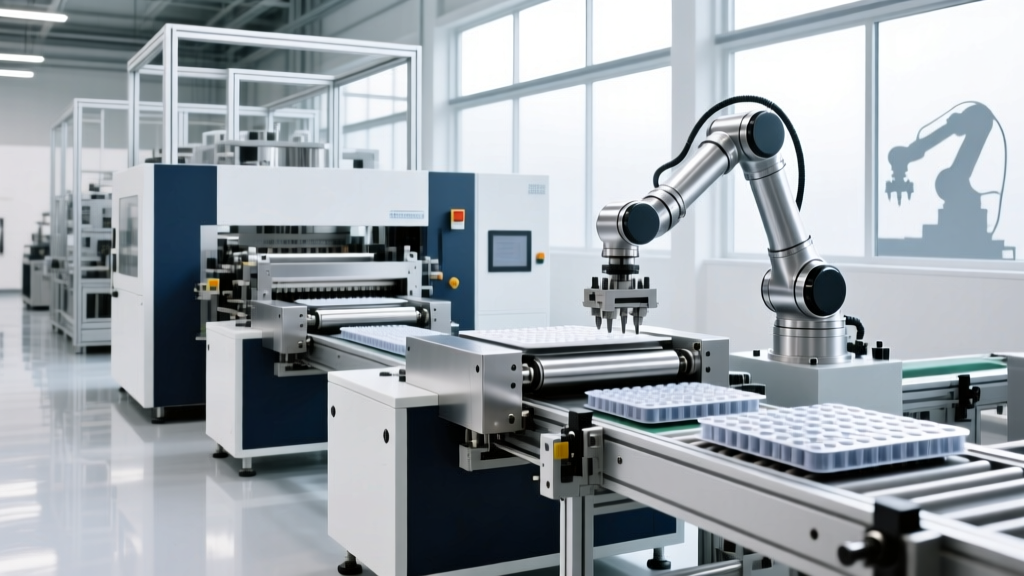
Procuring automated packaging machinery for manufacturers in the pharmaceutical sector requires navigating strict regulatory overhead alongside standard mechanical costs. Unlike food or consumer goods packaging, pharma blister lines must guarantee absolute seal integrity, precise lot-code traceability, and strict adherence to Good Manufacturing Practices (GMP). When budgeting for a new thermoform-fill-seal (TFS) blister line in 2026, capital expenditures vary drastically based on throughput requirements, forming technology, and integrated vision inspection systems.
Below is a breakdown of current market pricing for pharmaceutical-grade blister packaging equipment, categorized by production tier:
| Equipment Tier | Typical Models / Brands | Output Speed (Blisters/Min) | 2026 Est. CapEx Range | Primary Use Case |
|---|---|---|---|---|
| Entry-Level Flat-Plate | Hoong-A CAPS, Romaco Blisterline basic | 60 - 150 | $180,000 - $320,000 | Clinical trial batches, orphan drugs, low-volume OTC |
| Mid-Range Flat-Plate/Rotary | Romaco Promatic P 960, CAM CP 500 | 200 - 400 | $450,000 - $850,000 | Standard commercial solid oral dose (tablets/capsules) |
| High-Speed Continuous Rotary | Uhlmann UPS 1000, Marchesini MB 750 | 500 - 1,000+ | $1.2M - $2.8M+ | High-volume blockbuster APIs, multi-lane 24/7 production |
Note: CapEx figures above include the primary TFS machine and a standard inline cartoner. They exclude secondary end-of-line case packers, palletizers, and facility integration (HVAC, compressed air drops, and cleanroom partitioning).
The Hidden Cost: Validation and 21 CFR Part 11 Compliance
The most frequently underestimated line item in a pharmaceutical packaging budget is system validation. The FDA mandates rigorous documentation under 21 CFR Part 211 Subpart G to ensure packaging operations prevent contamination and mix-ups. Furthermore, any automated packaging machinery for manufacturers that utilizes a Human-Machine Interface (HMI) to record batch data, alarm logs, or recipe parameters must comply with 21 CFR Part 11 regarding electronic records and signatures.
⚠️ Compliance Warning: The 'Out-of-the-Box' FallacyDo not assume a machine's standard PLC software is Part 11 compliant by default. Upgrading a basic Siemens or Allen-Bradley HMI to a compliant system with audit trails, role-based access control, and secure electronic signatures typically adds $35,000 to $60,000 to the software integration budget. Failing to specify this during the User Requirement Specification (URS) phase will result in costly retrofits during the Site Acceptance Test (SAT).
A full validation lifecycle (IQ/OQ/PQ) executed by a third-party GMP consulting firm for a mid-range blister line costs between $55,000 and $90,000. This covers:
- Installation Qualification (IQ): Verifying utility connections, material certifications (e.g., 316L stainless steel product contact parts), and calibration of heating elements and servo motors.
- Operational Qualification (OQ): Testing alarm states, emergency stops, temperature uniformity across the sealing station, and Part 11 audit trail functionality.
- Performance Qualification (PQ): Running three consecutive commercial-scale batches with live product and placebo to prove the machine maintains a CpK (Process Capability Index) of >1.33 for seal integrity and blister depth.
Operational Expenditure (OpEx): Consumables and Changeovers
Once the equipment is commissioned, the ongoing OpEx is dictated by barrier material selection and format changeover frequency. Pharmaceutical packaging engineers must balance material costs against the moisture vapor transmission rate (MVTR) required to protect the specific Active Pharmaceutical Ingredient (API).
Forming Film Economics (Per 1,000 Blisters)
Material costs fluctuate based on polymer science and supply chain constraints. As of 2026, baseline pricing for pharma-grade forming webs (assuming a standard 0.25mm thickness and 120x80mm blister footprint) is as follows:
- Rigid PVC (Polyvinyl Chloride): ~$1.80 - $2.50. Used for standard, non-moisture-sensitive tablets. Lowest cost, but poor barrier properties.
- PVDC (Polyvinylidene Chloride) coated PVC: ~$5.50 - $7.00. The industry standard for moderate moisture protection. Offers 10x the moisture barrier of plain PVC.
- PP (Polypropylene) / PE blends: ~$3.00 - $4.50. Gaining traction as a sustainable, recyclable alternative to PVC, though sealing parameters require precise thermal control.
- Aclar® (PCTFE) Films: ~$65.00 - $95.00. Ultra-high barrier fluoropolymer. Reserved for highly hygroscopic APIs, biologics, or effervescent tablets where even trace moisture degrades the drug.
Format Changeover Tooling
In contract packaging organizations (CPOs) or facilities with high SKU counts, changeover costs destroy Overall Equipment Effectiveness (OEE). Every new pill shape or blister cavity layout requires a custom set of format parts: the forming die, the punching die, and the embossing/lot-code station.
A single set of custom-machined 316L stainless steel and PEEK (polyether ether ketone) tooling costs between $4,200 and $7,500. More critically, the lead time for these parts is currently 6 to 10 weeks. Budget planners must allocate capital for at least 3-5 spare tooling sets upfront to prevent line stoppages when launching new SKUs.
Strategic Sourcing: Calculating the True ROI
When evaluating the financial viability of upgrading from semi-automated to fully automated lines, industry benchmarks from PMMI suggest focusing on the reduction of manual intervention and scrap rates. To build a robust ROI model for your 2026 capital request, follow this decision framework:
- Calculate Current Scrap Costs: Manual or semi-auto loading of tablets into blisters results in a 2% to 4% product rejection rate due to misaligned pills or cracked tablets during the feeding process. Fully automated vision-guided robotic feeders reduce this to <0.1%. Multiply your annual API volume by the 3% delta to find your raw material savings.
- Factor in Labor Reallocation: A manual blister line requires 3-4 operators for feeding, visual inspection, and cartoning. A fully automated line with integrated camera inspection (e.g., Cognex or Keyence systems) requires 1 HMI operator and 1 material handler. Calculate the fully burdened labor savings over a 5-year depreciation schedule.
- Account for Downtime Penalties: High-speed rotary machines suffer from complex web-tracking issues if the forming film gauge varies by even 5 microns. Budget 10% of your annual OpEx for preventative maintenance contracts and OEM remote-diagnostics subscriptions to maintain an 85%+ OEE.
Expert Insight: The breakeven point for a $750,000 mid-range automated blister line is typically 28 to 36 months in a two-shift operation. However, if your facility runs highly toxic or potent compounds (OEB 4/5), the cost of integrated isolator gloves and localized wash-down systems will push CapEx up by 30%, extending the ROI timeline but mitigating catastrophic cross-contamination risks.
Ultimately, budgeting for pharmaceutical blister machinery is an exercise in risk management. The lowest bidder rarely provides the lowest total cost of ownership when factoring in validation delays, tooling lead times, and the ongoing cost of non-compliant batch rejections.