Sustainable Tech for a Medical Original Equipment Manufacturer
Compare sustainable manufacturing alternatives for a medical original equipment manufacturer, from aqueous cleaning to MQL machining and citric passivation.
The Sustainability Mandate in Medical Device Production
For a medical original equipment manufacturer, the transition to sustainable manufacturing equipment is no longer just a corporate social responsibility initiative; it is a critical operational imperative. In 2026, tightening environmental regulations regarding volatile organic compounds (VOCs) and hazardous waste disposal are colliding with the stringent bioburden and material traceability requirements of ISO 13485 and FDA 21 CFR Part 820. Facility managers must identify green technology alternatives that maintain surgical-grade cleanliness without violating FDA quality system regulations.
This analysis compares legacy high-impact manufacturing processes with their modern, sustainable alternatives, providing specific equipment parameters, chemical formulations, and financial models to guide capital expenditure decisions.
Regulatory Intersection Warning: When substituting solvents or processes, a medical original equipment manufacturer must re-validate the entire cleaning and passivation lifecycle. A direct 'drop-in' replacement does not exempt the facility from executing Installation Qualification (IQ), Operational Qualification (OQ), and Performance Qualification (PQ) protocols under FDA guidelines.Component Cleaning: Vapor Degreasing vs. Closed-Loop Aqueous Megasonic Systems
Historically, medical OEMs relied on vapor degreasing using n-Propyl Bromide (nPB) or Trichloroethylene (TCE) to remove heavy drawing oils and lapping compounds from orthopedic implants and surgical robotics components. However, the EPA has heavily restricted these solvents due to toxicity and ozone-depletion risks, pushing the industry toward EPA Safer Choice aligned alternatives.
The Alternative: Multi-Stage Aqueous Megasonic Cleaning
Modern closed-loop aqueous systems utilize a combination of 40kHz ultrasonic and 80kHz to 120kHz megasonic transducers. While 40kHz cavitation effectively removes bulk machining oils, the higher-frequency megasonic waves generate acoustic streaming capable of dislodging sub-micron particulates from the complex micro-textures of titanium acetabular cups without causing surface pitting.
- Legacy Vapor Degreaser (nPB): CapEx: $45,000 - $65,000. Solvent cost: $12-$18/gallon. Hazardous waste disposal: $8-$12/gallon. High VOC emissions.
- Closed-Loop Aqueous Megasonic: CapEx: $140,000 - $220,000. Utilizes Reverse Osmosis (RO) and Electrodeionization (EDI) to recover 95% of process water. Detergent cost: $35/gallon, but diluted at 3-5% in water. Near-zero VOC emissions.
Surface Passivation: Nitric Acid vs. Citric Acid Alternatives
Passivation removes free iron from the surface of machined stainless steel medical devices, promoting the formation of a protective chromium oxide layer. Nitric acid has been the industry standard for decades, but it generates toxic NOx fumes, requires specialized HVAC scrubbers, and classifies as hazardous waste.
Comparing the Chemistries
Citric acid passivation, standardized under ASTM A967, offers a biodegradable, non-toxic alternative that actually yields superior corrosion resistance in many medical-grade alloys.
| Parameter | Nitric Acid (Traditional) | Citric Acid (Sustainable) |
|---|---|---|
| Concentration | 20% - 25% by volume | 4% - 10% by weight |
| Operating Temp | 120°F - 140°F | 140°F - 160°F |
| Cycle Time | 20 - 30 minutes | 10 - 15 minutes |
| Waste Disposal | Hazardous ($3.50+/lb) | Biodegradable / Standard Drain (pH adjusted) |
| Operator PPE | Full face respirator, heavy apron | Standard splash goggles, nitrile gloves |
While citric acid requires slightly higher operating temperatures, the reduction in cycle time increases throughput by up to 30%. Furthermore, eliminating the need for localized exhaust ventilation (LEV) scrubbers saves a medical original equipment manufacturer approximately $25,000 annually in HVAC maintenance and energy costs.
CNC Machining: Flood Coolants vs. Minimum Quantity Lubrication (MQL)
Machining titanium and cobalt-chrome alloys for spinal implants and joint replacements traditionally requires high-pressure flood coolants. These petroleum-based or semi-synthetic fluids degrade over time, breeding bacteria and requiring frequent, costly disposal. The sustainable alternative gaining traction in advanced NIST-recognized manufacturing frameworks is Minimum Quantity Lubrication (MQL).
How MQL Transforms the Machining Floor
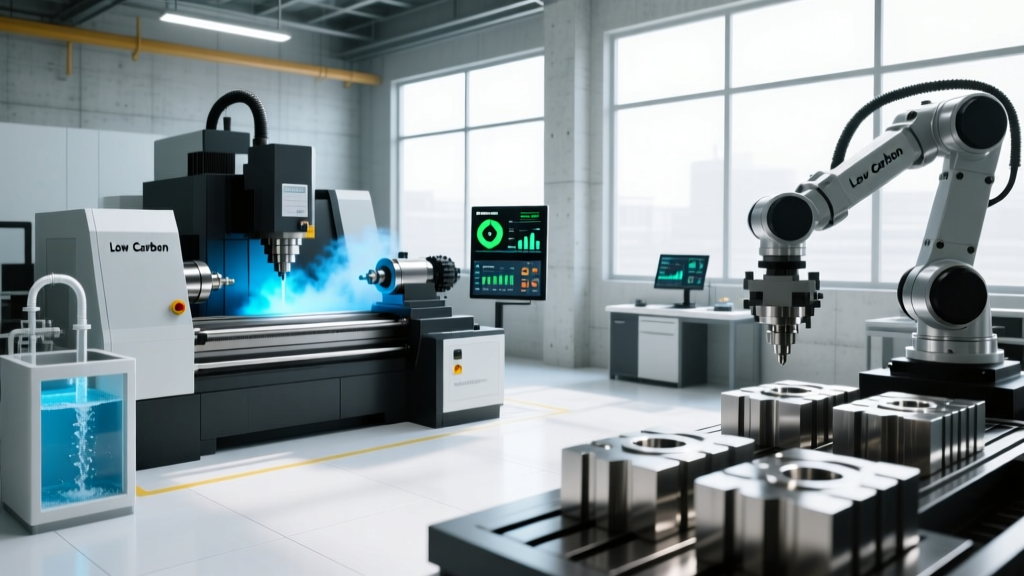
MQL systems, such as those utilizing coaxial spindle-through nozzles, apply a micro-mist of vegetable-based ester oils directly to the cutting edge. Instead of pumping 5 to 10 gallons of coolant per minute, MQL consumes between 3 mL and 10 mL per hour.
Implementation Caveat: MQL is not universally applicable to all medical machining. While it excels in milling and drilling 316L stainless steel and PEEK polymers, deep-hole gun drilling of titanium femoral stems still requires high-pressure flood coolant to evacuate chips and prevent tool deflection. A hybrid facility approach is recommended.Financial and Environmental Impact of MQL
- Coolant Cost Reduction: A mid-sized medical CNC cell spending $4,000 monthly on flood coolant and tramp oil skimming can reduce fluid costs to under $150 monthly using ester-based MQL fluids (e.g., ITW ROCOL Tri-Logic).
- Part Cleaning: Parts machined with MQL emerge nearly dry, reducing the required wash time in the subsequent aqueous cleaning stage by 40%.
- Energy Savings: Eliminating the 5HP to 10HP coolant pumps and chillers on each CNC center reduces per-machine energy draw by 15-20%.
Decision Framework: Selecting Green Tech for Your Facility
Transitioning to sustainable manufacturing equipment requires a phased approach to mitigate validation risks. A medical original equipment manufacturer should utilize the following matrix to prioritize capital investments based on ROI and regulatory impact.
Step-by-Step Implementation Matrix
- Phase 1: Passivation Conversion (Months 1-3)
Switch from nitric to citric acid. This requires the lowest CapEx (often just replacing the chemical totes and updating the PLC temperature setpoints on existing wet benches) and yields immediate hazardous waste disposal savings. - Phase 2: MQL Integration on New Mills (Months 4-9)
Rather than retrofitting legacy machines, specify factory-integrated MQL systems on all new CNC procurement. Ensure the CAM software is updated to optimize toolpaths for micro-lubrication environments. - Phase 3: Aqueous Megasonic Deployment (Months 10-18)
Replace vapor degreasers at the end of their lifecycle. Because aqueous cleaning relies heavily on water chemistry, partner with a supplier who provides ongoing titration and RO membrane maintenance to ensure the system meets ISO 10993 bioburden limits.
'The most successful medical OEMs in 2026 are those that view sustainability not as a compliance burden, but as a process optimization tool. Eliminating toxic solvents and flood coolants inherently reduces secondary cleaning steps, accelerates cycle times, and protects the long-term health of the precision workforce.'
Final Considerations for the Medical OEM
Adopting sustainable manufacturing equipment requires upfront capital and rigorous re-validation. However, the long-term operational benefits—drastically reduced hazardous waste manifests, lower energy consumption, and improved operator safety—create a highly resilient production environment. By strategically replacing nitric acid, nPB solvents, and flood coolants with citric passivation, closed-loop megasonics, and MQL technology, a medical original equipment manufacturer can achieve ISO 14001 environmental certification while simultaneously improving the unit economics of life-saving medical devices.