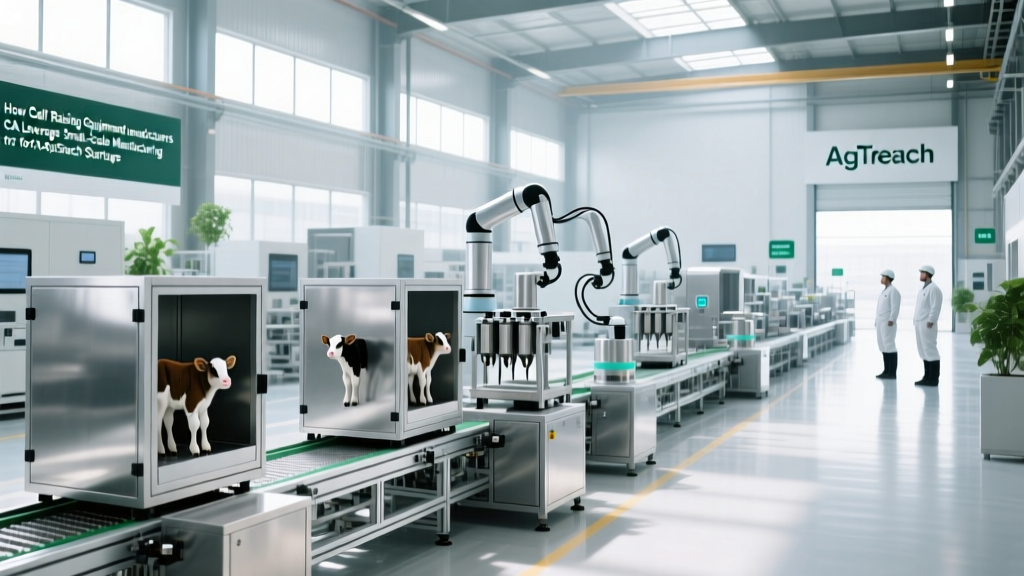
How Calf Raising Equipment Manufacturers CA Leverage Small-Scale Manufacturing for AgTech Startups
Explore how AgTech startups and calf raising equipment manufacturers CA use small-scale manufacturing equipment to prototype automated livestock systems.
The Material Science of Dairy Hardware
Calf raising equipment operates in one of the most corrosive environments in modern agriculture. Parts are continuously exposed to lactic acid, ammonia, intense UV radiation, and daily 1,500 PSI hot-water pressure washing. Material selection is not merely a cost decision; it is a regulatory and operational necessity.
- Fluid Contact Surfaces: Must be 316L stainless steel. Using 304 SS in milk replacer manifolds leads to severe pitting corrosion from lactic acid buildup within six months, violating sanitary standards.
- Structural Plastics: High-Density Polyethylene (HDPE) and Nylon 12 (PA12) are mandatory. Standard prototyping plastics like PLA and PETG will shatter under Central Valley summer heat (105°F+) and degrade rapidly under UV exposure.
The Small-Scale Manufacturing Stack
To produce compliant, durable prototypes and short-run production batches, California AgTech startups are standardizing around three core pieces of small-scale manufacturing equipment.
1. Haas Mini Mill 2 for Sanitary Fittings
Automated calf feeders require complex fluid manifolds to mix milk powder and water at precise temperatures. The Haas Mini Mill 2 (base price ~$54,900) with a 40-taper spindle and 7,500 RPM provides the necessary torque to hog out 316L stainless steel blocks for sanitary tri-clamp ferrules.
Machining Tip: 316L work-hardens rapidly. Startups must use rigid tapping and specialized cobalt end mills with high-pressure coolant to prevent tool breakage during deep-hole drilling for internal fluid channels.
2. Formlabs Fuse 1+ 30L for IoT Housings
RFID ear tag readers and hutch latches require complex, watertight geometries that are too expensive to mold for short runs. The Formlabs Fuse 1+ 30L (~$30,000) uses Selective Laser Sintering (SLS) with Nylon 12 powder. The resulting parts boast a tensile strength of 48 MPa and inherent chemical resistance, surviving the harsh sanitation protocols required by the California Department of Food and Agriculture (CDFA).
3. Gweike Cloud Pro (50W CO2) for Modular Panels
Calf weaning panels and hutch dividers are frequently cut from 1/2-inch HDPE. A 50W CO2 laser like the Gweike Cloud Pro (~$6,000) can cut and engrave HDPE with sealed edges, preventing bacterial ingress—a critical requirement for compliance with 3-A Sanitary Standards for dairy environments.
Critical Failure Modes in Dairy Prototyping
When engineering automated calf feeders, startups frequently encounter three catastrophic failure modes during the transition from prototype to field deployment:
- Thermal Shock Cracking: Milk replacer must be mixed at exactly 104°F to 110°F to ensure proper calf digestion. If startups use standard ABS for the mixing chamber, the rapid transition from 110°F liquid to 40°F ambient wash-down water causes micro-fractures. SLS Nylon 12 or machined UHMWPE is mandatory.
- Galvanic Corrosion: Mixing 304 stainless steel fasteners with 316L fluid manifolds in a high-chloride (sanitizer) environment creates a galvanic cell. The 304 SS will corrode rapidly. Startups must strictly source 316L or titanium hardware for all assembly joints.
- RFID Detuning: Calf ear tags and hutch-mounted readers operate at 134.2 kHz (FDX-B) or UHF bands. Moisture and metallic dairy environments detune antennas. Prototyping RF housings requires low-loss dielectric plastics like polypropylene (PP), which requires specific laser focal lengths to avoid melting the edges during fabrication.
Case Study: Fresno-Based Automated Mixer Startup
Consider a recent hardware startup developing an IoT-enabled milk replacer mixer for group-housed calves. Their initial challenge was producing 200 beta units without committing to $120,000 in aluminum injection molds for the exterior housing and powder hoppers.
| Component | Traditional OEM Method | Small-Scale Agile Method | Cost Savings (200 units) |
|---|---|---|---|
| 316L Mixing Valve | 5-Axis CNC Outsource ($450/ea) | In-house Haas Mini Mill ($180/ea + labor) | $54,000 |
| Nylon 12 RFID Latch | Urethane Casting ($85/ea) | SLS 3D Printing ($12/ea) | $14,600 |
| HDPE Divider Panels | Waterjet Outsource ($60/ea) | In-house CO2 Laser ($18/ea) | $8,400 |
By keeping production in-house using small-scale equipment, the startup reduced their beta-run burn rate by over $77,000, allowing them to reallocate capital toward software development and field testing.
Navigating California's Manufacturing Ecosystem
While in-house equipment is powerful, startups must eventually scale. When analyzing the supply chain for calf raising equipment manufacturers CA offers a unique support network. Organizations like the California Manufacturing Technology Center (CMTC) provide vital resources for AgTech hardware companies, offering grant matching, lean manufacturing audits, and supplier matchmaking to help transition from garage prototyping to factory-scale production.
"The biggest mistake AgTech hardware startups make is designing for mass production on day one. In dairy automation, you need 50 units in the field to gather data on lactic acid buildup and sensor drift before you even look at a steel mold." — Senior AgTech Hardware Engineer, Central Valley Innovation Hub.
Strategic Decision Framework for Startups
For founders entering the livestock automation space, follow this phased equipment acquisition strategy:
- Phase 1 (0-50 Units): Rely entirely on SLS 3D printing and outsourced waterjet cutting. Focus on PMO compliance, sensor integration, and proving the core technology.
- Phase 2 (50-500 Units): Acquire benchtop CNC (Haas Mini Mill) and CO2 lasers. Bring fluid-contact and structural plastic manufacturing in-house to protect IP, iterate on tolerances, and reduce per-unit costs.
- Phase 3 (500+ Units): Partner with established contract manufacturers for high-volume injection molding and robotic welding. Utilize your small-scale machines strictly for R&D, custom orders, and rapid replacement part fulfillment.