Original Equipment Manufacture Relocation: 2026 Tech Trends
Discover how digital twins, IoT telemetry, and AR are transforming original equipment manufacture relocation and installation in 2026.
The Shift from Analog Rigging to Digital-First Relocation
Relocating heavy original equipment manufacture (OEM) assets—such as 5-axis CNC machining centers, multi-ton stamping presses, and automated injection molding lines—has historically been a brute-force, analog operation. Facility managers relied on paper blueprints, manual tape measurements, and the tribal knowledge of veteran riggers. In 2026, this approach is financially untenable. The cost of unplanned downtime during a physical move averages $22,000 per hour for high-volume automotive and aerospace production lines. Consequently, the industry has pivoted toward digital-first relocation strategies, leveraging spatial computing, IoT telemetry, and augmented reality to compress installation timelines and eliminate catastrophic calibration failures.
⚠️ WARNING: The Hidden Cost of Legacy MovesFailure to properly lock the Z-axis and secure the spindle on a 5-axis mill (e.g., DMG MORI DMU 50) during transit can cause micro-fractures in ceramic hybrid bearings. This invisible damage often manifests as chatter marks on milled surfaces 3 to 4 weeks post-installation, leading to scrapped batches and warranty disputes with the OEM.
Digital Twins: Pre-Moving the Factory Before a Single Bolt is Turned
The most significant innovation in modern equipment relocation is the use of factory digital twins. Before physical rigging begins, engineers use terrestrial laser scanners (like the FARO Focus Premium) to capture a millimeter-accurate point cloud of both the origin and destination facilities. This data is imported into simulation environments such as Siemens Tecnomatix to create a kinematic digital twin of the entire move.
Simulation software allows planners to map the exact transit path of a 40-ton press, identifying spatial clashes that are invisible to the naked eye. For example, a digital simulation might reveal that the overhead crane hook height in the new facility lacks the 14-inch clearance required to lift a Haas UMC-750 over a specific HVAC ductwork junction. Resolving this in the software costs nothing; resolving it on move-day requires emergency ductwork demolition and halts the entire project.
Comparison Matrix: Traditional vs. Digital Twin-Assisted Installation
| Metric | Analog Rigging (Legacy) | Digital Twin Pre-Planning |
|---|---|---|
| Path Clash Detection | On-site visual inspection (High error rate) | Automated 3D spatial collision alerts |
| Floor Load Verification | Manual calculation from architectural PDFs | Dynamic FEA stress mapping on point-cloud floors |
| Average Physical Downtime | 5 to 8 days | 2 to 3 days (22-30% reduction) |
| Utility Hookup Accuracy | 60% first-time connection success | 98% first-time connection success |
IoT Telemetry and Shock-Logistics for Precision Assets
Once the equipment leaves the loading dock, the risk profile shifts from spatial clearance to kinetic shock. High-precision original equipment manufacture assets, particularly Coordinate Measuring Machines (CMMs) like the Zeiss CONTURA or high-speed laser cutters, are extraordinarily sensitive to transit vibrations. A vertical shock exceeding 1.5G can misalign the granite bridge or degrade the linear scale encoders.
To mitigate this, modern relocation teams deploy wireless tri-axial IoT accelerometers (such as SPEAR shock-loggers, costing approximately $450 per unit) directly bolted to the machine's primary casting. These sensors stream real-time telemetry via cellular networks to a cloud dashboard. If a transport truck hits a severe pothole and the G-force threshold is breached, the system instantly flags the exact GPS coordinate and timestamp. Upon arrival, OEM technicians know precisely which axis requires laser interferometry recalibration, rather than performing a盲目 (blind) 12-hour full-machine diagnostic.
Augmented Reality (AR) in OEM Equipment Re-Installation
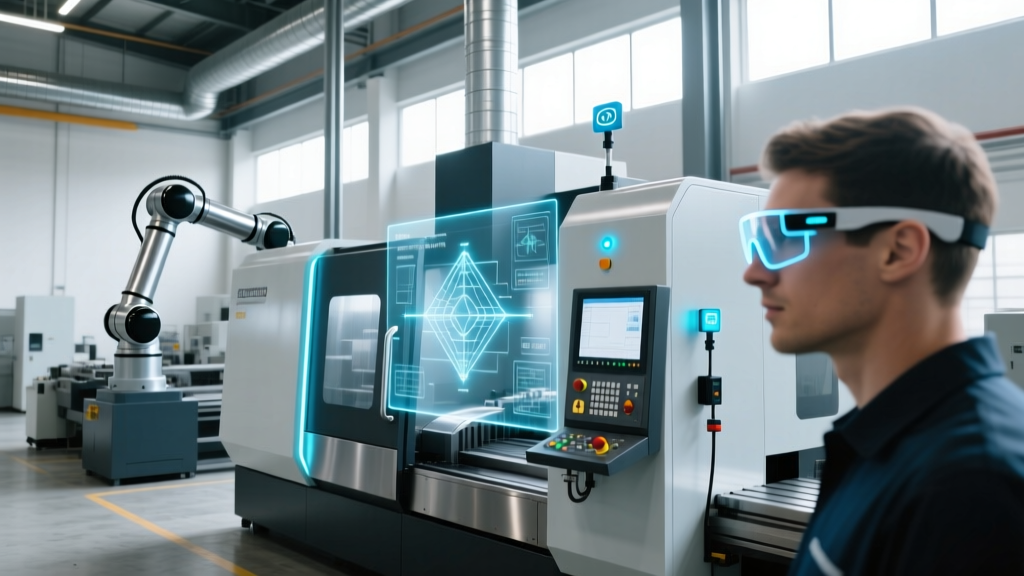
The re-installation and re-commissioning phase is traditionally the most labor-intensive bottleneck. It usually requires flying in specialized OEM technicians at rates exceeding $2,500 per day, plus travel expenses. Augmented Reality (AR) has fundamentally disrupted this cost structure. Using enterprise headsets like the Microsoft HoloLens 2 paired with PTC Vuforia spatial computing software, local maintenance teams can execute complex OEM reassembly procedures guided by remote experts.
AR overlays 3D holographic wiring diagrams, pneumatic routing paths, and exact torque specifications directly onto the physical machine. If a local technician is reconnecting the 480V 3-phase power and pneumatic pilot lines on an Engel injection molding machine, the AR visor highlights the correct terminal blocks in green and flashes red if the technician reaches for an incorrect valve.
Step-by-Step AR Installation Workflow
- Spatial Anchoring: The technician scans the machine's QR fiducial markers to lock the 3D holographic schematic to the physical asset with sub-millimeter accuracy.
- Sequential Overlay: The software isolates the first reassembly step (e.g., spindle coolant line routing), dimming the rest of the machine's visual field to reduce cognitive load.
- Remote Expert Verification: A remote OEM engineer views the technician's first-person perspective, drawing 3D annotations in the air that the technician sees through the headset.
- Automated Torque Logging: Bluetooth-enabled torque wrenches automatically log the exact Newton-meter (Nm) value applied to critical anchor bolts, saving the data directly to the machine's digital compliance ledger.
Heavy-Payload Robotics and Automated Guided Vehicles (AGVs)
For moving massive OEM equipment within the facility footprint, the industry is moving away from manual forklifts and chain-drag skates. Heavy-payload Autonomous Mobile Robots (AMRs) and air-cushion AGVs, such as those developed by KUKA, can autonomously transport loads exceeding 50 tons. These vehicles use LiDAR and ultra-wideband (UWB) indoor positioning to navigate factory floors with a positional tolerance of ±10mm. This eliminates the need for manual steering of multi-axle trailers through tight production corridors, drastically reducing the risk of collateral damage to adjacent, operating production lines.
Strategic Framework: When to Deploy Next-Gen Relocation Tech
Not every machine requires a $50,000 digital twin simulation. Facility managers must apply a risk-based framework to determine the appropriate level of technological intervention. According to guidelines supported by research from NIST's Advanced Manufacturing initiatives, aligning tech spend with asset criticality is paramount.
Decision Matrix for Relocation Technology:
1. High-Precision / High-Value (e.g., 5-Axis CNC, CMM, Laser Interferometers):
Mandatory: Digital Twin simulation, IoT shock-loggers, and AR-assisted OEM re-commissioning. Budget allocation: $15,000 - $30,000 per asset.
2. Heavy / High-Footprint (e.g., 1000-ton Stamping Presses, Conveyor Networks):
Mandatory: LiDAR point-cloud spatial mapping and Heavy-Payload AGV transport. AR is optional. Budget allocation: $20,000 - $45,000 per project.
3. Standard / Modular Assets (e.g., Manual Lathes, Standalone Packaging Units):
Traditional analog rigging with standard 2D CAD layout planning remains cost-effective. Budget allocation: $2,000 - $5,000 per asset.
By matching the technological sophistication of the move to the mechanical sensitivity of the original equipment manufacture asset, facilities in 2026 are achieving faster commissioning times, preserving OEM warranties, and eliminating the catastrophic hidden costs of analog relocation.