Original Equipment Manufacturer Automotive Industry: Maintenance SLAs
Evaluate contract manufacturing equipment maintenance SLAs, MTBF, and service schedules to meet strict automotive OEM production requirements.
The Hidden Bottleneck in Contract Manufacturing Selection
Selecting contract manufacturing equipment for the original equipment manufacturer automotive industry sector requires looking far beyond initial capital expenditure (CapEx). For automotive OEMs and their Tier 1 suppliers, the true supply chain bottleneck is the contract manufacturer's (CM) maintenance and service schedule adherence. A mere 5% deviation in preventive maintenance (PM) schedules on a 2,000-ton servo stamping press can result in catastrophic die damage, micro-fractures in chassis components, and cascading line stoppages.
When auditing a CM's equipment portfolio, procurement teams must evaluate the Mean Time Between Failures (MTBF), predictive maintenance (PdM) sensor integration, and the machine builder's Service Level Agreements (SLAs). In 2026, relying on calendar-based maintenance is obsolete; usage-based and edge-AI-driven maintenance schedules are the baseline for automotive compliance.
⚠️ IATF 16949 Compliance WarningUnder IATF 16949 (Clause 8.5.1.6 - Total Productive Maintenance), automotive CMs are legally required to maintain documented contingency plans for equipment failure. Selecting contract manufacturing equipment without guaranteed OEM service SLAs and localized spare parts inventories directly violates this core compliance requirement, risking your OEM certification.
Core Maintenance Selection Criteria for CM Equipment
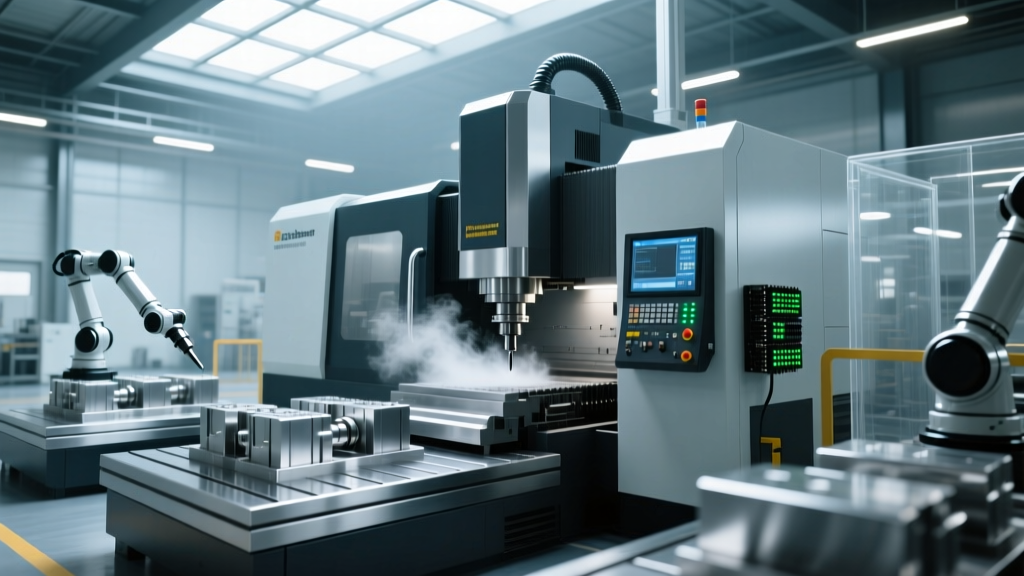
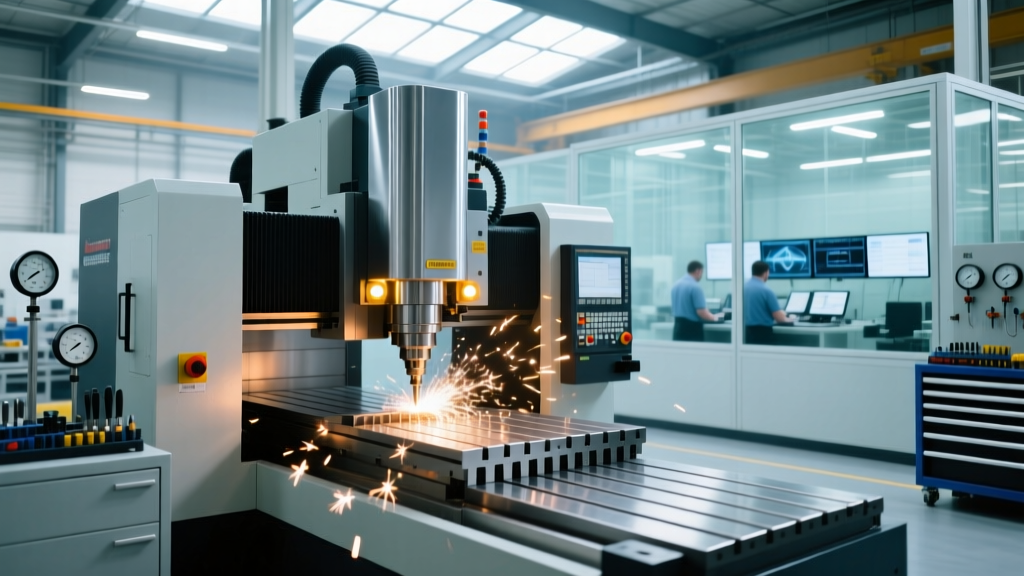
Not all manufacturing equipment is built for the punishing cadence of automotive production. A standard 3-axis CNC mill designed for general job shops will fail under the 24/7, high-volume demands of automotive powertrain or EV battery tray machining. Procurement engineers must demand specific reliability metrics from equipment vendors.
1. MTBF and MTTR Benchmarks
For critical path equipment—such as Aida NC1 series servo presses or Mazak INTEGREX multi-tasking CNCs—the MTBF must exceed 8,000 to 10,000 operating hours. This is achieved by eliminating high-wear components; for instance, modern servo presses eliminate traditional hydraulic valves and mechanical clutches, drastically reducing fluid leaks and friction-based degradation.
Equally critical is the Mean Time To Repair (MTTR). Equipment selection must prioritize modular designs. A DMG Mori machining center with quick-swap spindle cartridges and pre-wired plug-and-play axis motors can reduce MTTR from 14 hours to under 4 hours, keeping the CM within the automotive OEM's allowable downtime window.
2. OEM Service Level Agreements (SLAs)
The machine builder's SLA dictates the CM's ability to maintain the production schedule. General manufacturing equipment often comes with 'next business day' support. Automotive-grade equipment requires stringent, contractually bound SLAs.
| SLA Metric | General Mfg Equipment | Automotive OEM-Compliant Equipment |
|---|---|---|
| Response Time | 24 - 48 hours | 4-hour remote / 12-hour on-site |
| First-Time Fix Rate | ~70% | ≥ 95% (Guaranteed) |
| Spare Parts Inventory | Centralized warehouse | Regional hubs + CM on-site consignment |
| PM Schedule Adherence | Calendar-based (Monthly/Yearly) | Usage-based (Stroke count / Spindle hours) |
| Software / IIoT Updates | Manual / Paid upgrades | OTA edge updates via MTConnect / OPC UA |
Predictive Maintenance (PdM) and IIoT Integration
In 2026, edge-computed AI vibration analysis and thermal monitoring are non-negotiable for automotive contract manufacturing. According to McKinsey's research on AI in heavy asset production, predictive maintenance can reduce machine downtime by up to 50% and lower maintenance costs by 10% to 40%.
When evaluating equipment, verify the native inclusion of the following PdM hardware and protocols:
- Tri-axial Vibration Sensors: Must be hardwired into spindle housings and press slide gibs, sampling at ≥ 10 kHz to detect early-stage bearing spalling.
- Thermal Imaging Arrays: Critical for injection molding equipment (e.g., Engel or Husky systems) to monitor barrel heater band degradation and hot runner thermal imbalances before they cause flash or short shots.
- Standardized Protocols: Equipment must natively output data via MTConnect or OPC UA. Proprietary, closed-loop data ecosystems prevent the CM from integrating the machine into the OEM's centralized digital twin.
Evaluating the CM's Preventative Maintenance (PM) Cadence
The most advanced equipment will still fail if the CM's PM cadence is misaligned with the machine's actual wear profile. Procurement teams must audit how the equipment vendor trains the CM's maintenance staff.
"The shift from calendar-based to condition-based maintenance is the defining factor in Tier 1 automotive supplier profitability. A machine that requires a $6,000 ball screw replacement based on a 12-month calendar schedule, rather than actual thrust-load telemetry, destroys margin and creates unnecessary downtime."
— Director of Global Maintenance Operations, Top 5 Automotive Tier 1 Supplier
Equipment selection criteria must include the vendor's provision of dynamic PM scheduling software. For example, Schuler's Digital Suite monitors press tonnage and slide alignment in real-time, automatically adjusting the lubrication and inspection intervals based on the actual tonnage applied per stroke, rather than a static time-based metric.
Total Cost of Ownership (TCO) Maintenance Calculator Framework
To accurately compare contract manufacturing equipment, procurement engineers must utilize a maintenance-weighted TCO model. Do not rely on the vendor's stated 'cost per part' without validating the maintenance assumptions.
- Base CapEx: Initial machine cost, rigging, and commissioning (e.g., $1.4M for a 5-axis Okuma MU-8000V).
- Energy & Consumables: Calculate based on 24/7 operation, factoring in servo-regenerative braking power savings (often 15-20% lower on modern presses).
- Scheduled PM Costs: Multiply the OEM's recommended usage-based PM intervals by the cost of certified OEM parts and labor. (e.g., $4,500 bi-annually for spindle chiller flush and way-cover replacement).
- Unplanned Downtime Penalty: Multiply the machine's historical failure rate by the automotive OEM's contractual line-stoppage penalty. In automotive stamping and assembly, downtime costs average between $2,500 and $5,000 per minute across the broader supply chain, but direct CM throughput loss and expedited freight penalties typically run $3,200 per hour.
Summary Checklist for Equipment Procurement
Before finalizing a contract manufacturing equipment purchase for automotive applications, ensure the following maintenance criteria are explicitly written into the purchase agreement:
- Guaranteed MTBF/MTTR: Contractual financial penalties for the machine builder if MTTR exceeds 6 hours for critical path components.
- Local Consignment Stock: The OEM must agree to stock $50,000+ in high-wear spare parts (servo drives, limit switches, seals) at the CM's physical facility.
- Open IIoT Architecture: Full, unrestricted read/write access to machine telemetry via OPC UA without requiring recurring SaaS licensing fees to the machine builder.
- IATF 16949 Documentation: Vendor provides pre-formatted, auditor-ready PM checklists and contingency planning templates mapped directly to IATF Clause 8.5.1.6.
By enforcing these rigorous maintenance and service schedule criteria, automotive OEMs ensure their contract manufacturing partners can sustain the zero-defect, high-uptime environment required in modern vehicle production.
Related reading

Modular Production Trends for Medical Laser Equipment Manufacturers
Batch vs Continuous Lines for the Sports Equipment Manufacturer