Comparing Lean Workstations for a Tank Cleaning Equipment Manufacturer
Compare lean workstation alternatives for a tank cleaning equipment manufacturer. Analyze aluminum, steel, and AGV setups for CIP assembly.
Executive Summary
Designing lean workstations for a tank cleaning equipment manufacturer requires balancing heavy load-bearing capacities with precision clean-assembly environments. This guide compares three primary workstation alternatives—modular aluminum extrusion, heavy-duty welded steel, and AGV-integrated dynamic pallets—specifically for the assembly of Clean-In-Place (CIP) systems, rotary impingement devices, and spray balls. We analyze cost per linear foot, load deflection limits, and hydro-testing integration to help plant managers eliminate motion waste (muda) while maintaining strict ISO 9001 quality standards.
The Unique Assembly Challenges of Tank Cleaning Equipment
Manufacturing tank cleaning equipment is not a standard light-assembly process. A single 3-inch rotary jet head, machined from 316L stainless steel, can weigh between 45 and 85 pounds. Conversely, the internal components—such as PTFE thrust bearings, ceramic seals, and precision-machined nozzles—require clean, anti-static, and highly organized work surfaces to prevent contamination.
Furthermore, lean manufacturing in this sector demands integrated hydro-testing. Before final packaging, CIP nozzles must be tested at line pressures ranging from 40 to 150 PSI. A workstation that cannot accommodate integrated catch basins and pneumatic test manifolds forces operators to transport heavy assemblies to a separate testing cell, creating massive transportation waste and violating core lean principles.
Workstation Comparison Matrix
The following matrix compares the three dominant workstation configurations used by modern tank cleaning equipment manufacturers in 2026.
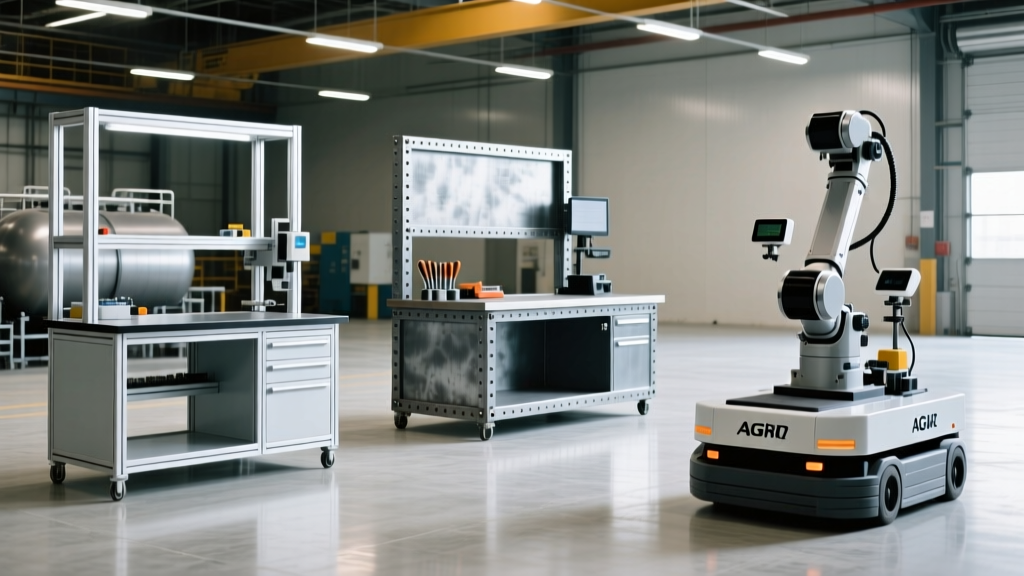
| Feature | Modular Aluminum (e.g., Item/Bosch) | Welded Steel (e.g., Borroughs) | AGV-Integrated Pallets |
|---|---|---|---|
| Max Load Capacity | 400 - 800 lbs (distributed) | 2,000 - 5,000 lbs | 1,500 lbs (per pallet) |
| Cost per Linear Foot | $180 - $260 | $320 - $450 | $800+ (system dependent) |
| Reconfiguration Time | 2 - 4 hours | Days (requires welding/grinding) | Instant (software routing) |
| Hydro-Test Basin Integration | Moderate (requires custom drop-in pans) | Excellent (welded sumps) | Poor (routing fluid to AGV is complex) |
| Best Application | Spray balls, sensor integration, light CIP | Heavy rotary impingement heads, hydro-testing | High-mix, low-volume custom skid assemblies |
Deep Dive: Modular Aluminum Extrusion Systems
Modular aluminum framing (utilizing 45x45mm or 80x80mm T-slot profiles) is the default choice for assembling lighter tank cleaning components, such as static spray balls and electronic flow sensors. The primary advantage is extreme flexibility. If a plant transitions from assembling 1-inch nozzles to 2-inch nozzles, the fixture mounts can be slid along the T-slot and retightened in minutes.
Pros and Cons for CIP Assembly
- Pro: ESD-Safe Integration. Smart tank cleaning equipment increasingly features IoT conductivity sensors. Aluminum frames easily integrate with ESD-safe laminates and grounding lugs, protecting sensitive PCBs during assembly.
- Pro: Ergonomic Adjustability. Hand-crank adjustable legs allow the workstation to shift from a seated height of 28 inches to a standing height of 42 inches, accommodating different operators and reducing fatigue.
- Con: Deflection Under Torque. When operators use pneumatic torque wrenches to tighten 316L stainless steel flange bolts to 65 ft-lbs, standard 45mm aluminum profiles will flex. This deflection can lead to inaccurate torque readings and cross-threading.
- Con: Fluid Trap Risks. The T-slot grooves can trap water and cleaning chemicals during hydro-testing, leading to localized corrosion if not properly sealed with slot covers.
Deep Dive: Heavy-Duty Welded Steel Workstations
For the assembly of large rotary impingement machines (which utilize heavy gearboxes and high-impact stainless steel housings), 12-gauge welded steel workstations are mandatory. These benches prioritize absolute rigidity and integrated fluid management over modularity.
"When assembling a 4-inch rotary jet head, the operator must press-fit ceramic bearings and torque the main retaining nut to over 120 ft-lbs. Any workstation deflection at this stage compromises the concentricity of the spin bearing, leading to premature failure in the field. Welded steel with cross-bracing is the only viable lean alternative for this specific cell."
— Senior Manufacturing Engineer, Industrial Fluid Dynamics
To maintain lean principles, these heavy steel benches must be equipped with integrated Ingersoll Rand or Gorbel pneumatic balancers. This allows an operator to lift an 80-pound stainless steel housing with zero physical strain, moving it from the sub-assembly rack to the main fixture in a single, fluid motion.
Integrating Hydro-Testing into the Lean Cell
A critical failure in many manufacturing layouts is separating assembly from testing. For a tank cleaning equipment manufacturer, lean design dictates that hydro-testing must occur at the point of assembly.
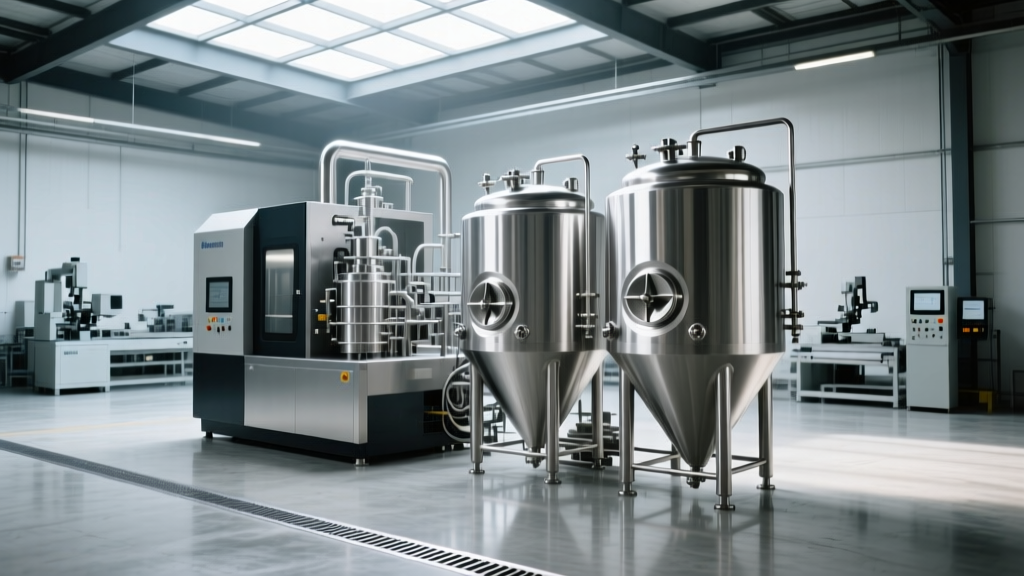
Welded steel workstations can be fabricated with a sloped 304 stainless steel top surface that drains directly into an integrated 15-gallon sump. The workstation should include a mounted pneumatic test manifold with quick-disconnect fittings. The operator attaches the manifold, cycles the automated 150 PSI water test for 45 seconds, and visually inspects for leaks without ever moving the part from the bench. This eliminates the transport waste and waiting waste associated with batch-testing.
Decision Framework: Selecting the Right Workstation
Use the following logic tree to specify workstations for your production floor:
If / Then Specification Guide
- IF the product is a static spray ball or IoT sensor-equipped CIP nozzle (< 20 lbs) THEN specify Modular Aluminum (80x80mm profile) with ESD-safe high-pressure laminate tops and integrated shadow boards for torque drivers.
- IF the product is a heavy rotary impingement head or gearbox-driven tank washer (> 50 lbs) THEN specify Welded 12-Gauge Steel with a sloped 304 SS drain top, integrated sump, and an overhead 200-lb capacity pneumatic balancer.
- IF the facility produces high-mix, low-volume custom CIP skid systems THEN specify AGV-Integrated Pallets routed via magnetic tape, allowing the skid to move dynamically between welding, assembly, and PLC programming cells.
Ergonomics, 5S, and Regulatory Compliance
Lean manufacturing is intrinsically linked to operator safety and ergonomics. According to OSHA's Ergonomics Guidelines for Manual Material Handling, workstations must be designed to keep heavy lifting within the 'power zone'—between mid-thigh and mid-chest height. For tank cleaning equipment, where stainless steel bodies are dense and awkward, workbenches should feature cutouts or drop-down sections that allow operators to slide heavy parts onto the bench from a pallet jack rather than lifting them vertically.
Furthermore, applying the NIOSH lifting equation to your cell design will often reveal that the frequency of lifting heavy CIP nozzles exceeds safe limits without mechanical assistance. This data justifies the capital expenditure for integrated zero-gravity tool balancers and pneumatic hoists at every heavy-assembly steel workstation.
5S Shadow Boarding for Precision Tools
Tank cleaning equipment requires strict adherence to torque specifications. A loose flange bolt on a high-pressure rotary jet head will cause catastrophic failure inside a food or pharmaceutical processing tank. Implement 5S by utilizing foam-cut shadow boards mounted directly to the aluminum extrusion uprights. Every torque wrench, feeler gauge, and PTFE seal installation tool must have a dedicated, color-coded slot. If a tool is missing at the end of a shift, the visual management system immediately flags the anomaly before the next shift begins, preventing foreign object debris (FOD) from being sealed inside a tank cleaning unit.
Sustainability and Lean Environmental Impact
Modern lean manufacturing also encompasses environmental waste reduction. The EPA's framework on Lean and Environment highlights that optimizing workstation layouts reduces the energy and materials consumed during production. By integrating hydro-testing directly into the steel workstations with closed-loop water filtration sumps, manufacturers can recycle test water, reducing municipal water consumption by up to 40% compared to traditional open-loop batch testing setups. Additionally, the modular nature of aluminum extrusions means that when a product line is retired, the workstation materials can be 100% repurposed for new assembly cells, eliminating the scrap waste associated with tearing down custom-welded fixtures.