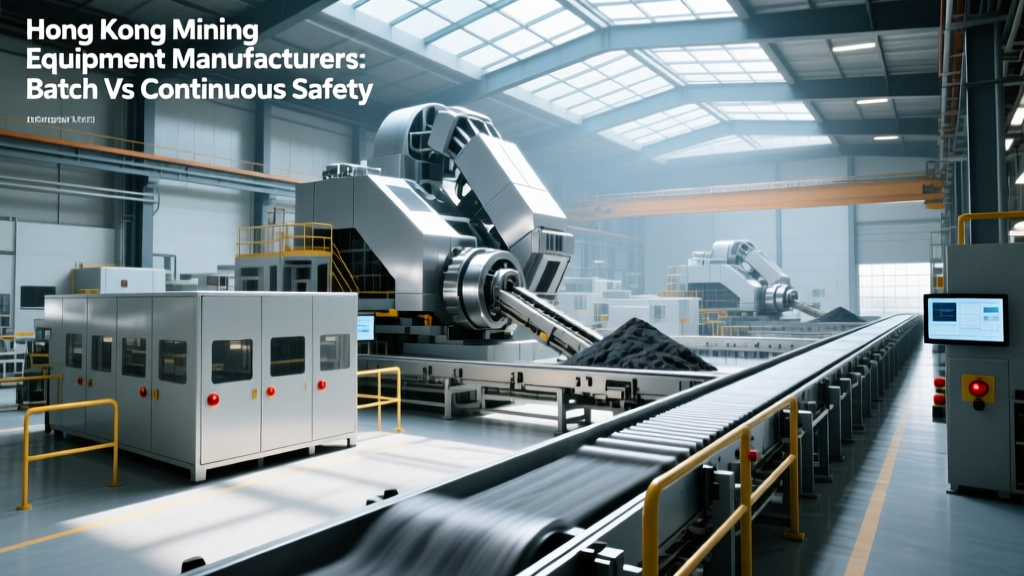
Hong Kong Mining Equipment Manufacturers: Batch vs Continuous Safety
Compare batch vs continuous processing safety standards for Hong Kong mining equipment manufacturers. Covers IECEx, ISO 13849, and compliance costs.
The Regulatory Divide: Export Design vs. Mainland Fabrication
The operational model for most Hong Kong mining equipment manufacturers relies on a distinct geographical split: intellectual property, international trade compliance, and system architecture are managed in Hong Kong, while heavy fabrication occurs in the Greater Bay Area (GBA), primarily Guangdong. This bifurcation creates a unique safety compliance matrix when designing mineral processing circuits. Equipment destined for export to jurisdictions like Western Australia, Canada, or the European Union must adhere to stringent safety directives (CE, MDHA, AS/NZS), whereas domestic Chinese installations follow GB (Guobiao) standards.
When comparing batch versus continuous manufacturing and processing equipment, the safety engineering requirements diverge sharply. Batch systems—such as vat leaching tanks, batch roasters, and intermittent autoclaves—are defined by high human interaction and cyclic thermal/chemical stresses. Continuous systems—such as SAG milling circuits, continuous flotation columns, and conveyor roasters—are characterized by enclosed, high-kinetic-energy environments where the primary risks are runaway reactions, catastrophic blockages, and continuous combustible dust generation.
⚠️ WARNING: The GBA Compliance GapA frequent failure mode among Hong Kong OEMs is specifying Category 3 or 4 safety circuits (per ISO 13849-1) in the Hong Kong engineering phase, only to have mainland fabricators substitute standard PLCs for failsafe PLCs during assembly to cut costs. Always mandate third-party QA (e.g., TÜV SÜD or SGS) at the GBA facility specifically to audit safety relay wiring and guard interlock logic before the equipment is crated for export.
Batch Processing Equipment: Intermittent Hazard Profiles
Batch processing in mining and metallurgy is typically utilized for high-value, low-volume extraction (e.g., gold cyanidation, precious metal refining) or pilot-scale testing. The defining safety challenge of batch equipment is the human-in-the-loop requirement. Operators must manually open hatches, load reagents, and unload precipitates, exposing them to entanglement, chemical inhalation, and thermal shock hazards.
Human-in-the-Loop Risks and LOTO Protocols
To comply with international safety standards, batch equipment must feature hardwired Lockout/Tagout (LOTO) integration and trapped-key interlock systems. For example, a 10,000-liter batch autoclave used for high-pressure acid leaching (HPAL) cannot rely solely on software interlocks. The main access hatch must be equipped with a mechanical trapped-key system (such as those manufactured by Castell or IDEM Safety) that physically prevents the hatch from opening until the internal pressure is verified at 0 PSI and the agitator motor is electrically isolated.
Furthermore, batch vessels operating above 15 PSI must comply with ASME Section VIII, Division 1 pressure vessel codes. This requires radiographic testing of all welds and the installation of dual redundant pressure relief valves (PRVs) sized for fire-case scenarios, adding approximately 22% to the base fabrication cost compared to non-coded atmospheric tanks.
| Safety Component (Batch Systems) | Specification / Standard | Estimated BOM Cost Addition (USD) |
|---|---|---|
| Failsafe Safety PLC | Siemens S7-1500F / ISO 13849-1 Cat 4 | $12,500 - $16,000 |
| Trapped Key Interlock System | Castell K-Series / 3-key sequence | $2,800 - $4,200 |
| Localized Exhaust Ventilation (LEV) | ATEX Zone 22 rated / 1,500 CFM | $8,500 - $11,000 |
| ASME Sec VIII PRV & Burst Disc | Dual redundant, 316L SS wetted parts | $3,200 - $5,500 |
Continuous Processing Lines: Runaway Risks and Automated Safeguards
Continuous manufacturing and processing equipment dominates base metal extraction (copper, iron ore, bauxite) due to its high throughput. The safety paradigm here shifts from operator interaction to process containment and automated fault tolerance. Continuous systems store massive amounts of kinetic and thermal energy; a failure in a continuous SAG mill or a conveyor-fed roaster can result in catastrophic mechanical destruction or explosive dust deflagration.
IECEx and Combustible Dust Management
For Hong Kong manufacturers exporting continuous coal processing or sulfide grinding circuits, managing combustible dust is the highest compliance hurdle. According to OSHA guidelines on combustible dust and the international IECEx Scheme, continuous conveyors, bucket elevators, and grinding mills must be classified by Equipment Protection Level (EPL).
A continuous grinding circuit handling sulfide ores must utilize EPL 'Db' (protection by enclosure 'tD' or pressurization 'pD') motors and sensors. Equipping a continuous mining conveyor system with full IECEx/ATEX certification—including certified slip monitors, bearing temperature sensors, and anti-static belting—costs between $18,000 and $35,000 per conveyor line and adds 14 to 20 weeks to the lead time for certification audits.
"The liability for a continuous processing plant explosion falls squarely on the OEM if the safety SCADA logic was not validated against a formal HAZOP study. Hong Kong engineering firms must retain stamped HAZOP documentation specifically addressing continuous runaway scenarios, such as a loss of cooling water to a continuous exothermic roaster, to defend against international product liability claims."
— Dr. Aris Thorne, Lead Process Safety Engineer, Mining Risk Consultants Ltd.
Blockage and Runaway Detection
Continuous equipment is highly susceptible to blockages (e.g., chute plugging in continuous crushing plants). If a blockage occurs and the upstream feed is not immediately halted, the equipment can overfill, leading to structural collapse or motor burnout. Modern compliance requires the integration of microwave level switches (e.g., Emerson Rosemount 5408) and zero-speed switches (ZSS) on all continuous drive shafts. These must be wired into a safety relay network (such as Pilz PNOZ s4.1 units, costing roughly $450 each) that triggers an immediate Category 0 stop (uncontrolled removal of power) to the upstream feeders within 200 milliseconds of detecting a zero-speed anomaly.
Decision Matrix: Specifying Batch vs. Continuous for Safety Tolerances
When Hong Kong mining equipment manufacturers consult with clients on plant design, the choice between batch and continuous processing should not be based solely on throughput economics. Safety tolerances and the client's operational maturity must dictate the equipment architecture.
- Choose Batch Equipment When: The process involves highly volatile, exothermic chemical reactions (e.g., nitric acid leaching) where a runaway reaction in a continuous system would be impossible to contain. Batch systems allow for immediate quenching and isolation. It is also preferred when the client's workforce lacks advanced SCADA troubleshooting skills, as batch systems are easier to manually lock out and maintain.
- Choose Continuous Equipment When: The primary hazard is toxic gas exposure (e.g., continuous cyanidation or chlorine dioxide generation). Continuous systems can be hermetically sealed and operated under negative pressure via automated ventilation systems, entirely removing the operator from the hazard zone. It is also mandatory for high-tonnage operations where the fatigue of manual batch loading would introduce unacceptable human-error risks.
Actionable Compliance Checklist for HK OEMs
To ensure seamless export compliance and avoid costly port rejections or site-installation delays, Hong Kong engineering teams must enforce the following protocols during the GBA fabrication phase:
- Mandate Failsafe Wiring Topologies: Ensure all emergency stop (E-Stop) circuits use normally-closed (NC) contacts wired in series, monitored by a dual-channel safety relay. Single-channel PLC monitoring is universally rejected by Australian and Canadian mine inspectors.
- Verify Guarding Mesh Dimensions: Continuous drive shafts and pulleys must be guarded per ISO 14120. The mesh aperture must be calculated based on the distance from the hazard; a 50mm aperture is only permissible if the guard is at least 920mm from the moving part.
- Audit ATEX/IECEx Nameplates: For continuous dust-handling equipment, verify that the mainland fabricator has not obscured or replaced certified explosion-proof motor nameplates with standard IP55 nameplates during final painting.
- Provide Bilingual Safety Logic Narratives: Supply the end-user with a comprehensive Safety Logic Narrative document detailing the exact trip conditions, reset procedures, and bypass authorizations for both batch interlocks and continuous SCADA safety loops.