Evaluate the Power Equipment Manufacturing Company EGO on Push Mower Compliance
Learn how to evaluate the power equipment manufacturing company EGO on push mower CE, UL, and CSA compliance marks for industrial procurement and safety audits.
The Intersection of OEM Production and Safety Certification
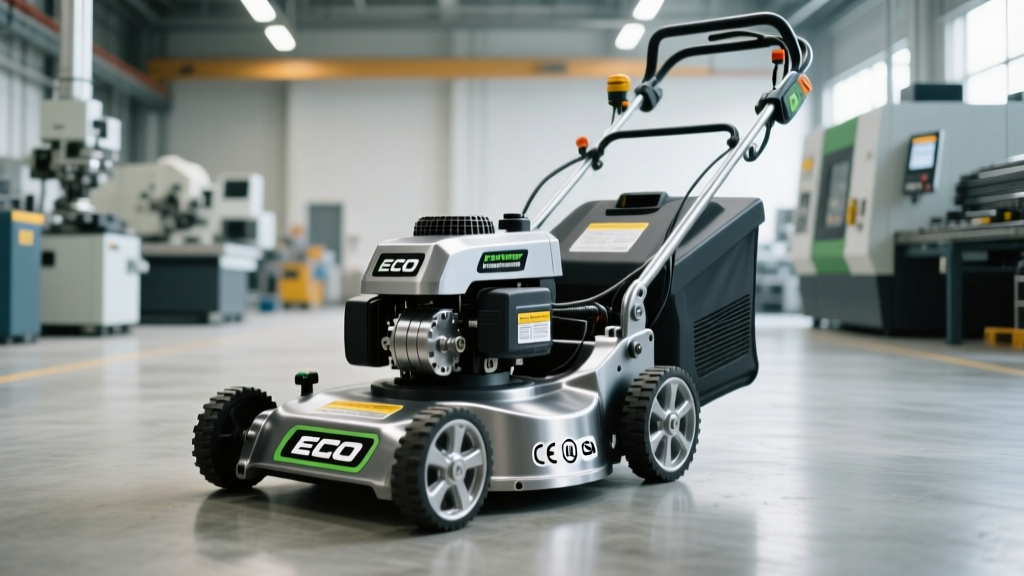
Procurement managers and facility safety officers sourcing outdoor power equipment (OPE) for commercial groundskeeping face a complex matrix of regulatory requirements. While consumer buyers might only look at battery voltage and deck width, industrial procurement requires a rigorous audit of the manufacturing processes that guarantee safety. When auditors evaluate the power equipment manufacturing company EGO on push mower assembly lines, they must look beyond the molded plastic badges and examine the underlying manufacturing equipment compliance—specifically how CE, UL, and CSA marks are validated on the factory floor.
Applying a compliance mark to a 56V brushless pedestrian mower is not merely a paperwork exercise. It requires highly calibrated End-of-Line (EOL) manufacturing equipment, rigorous dielectric withstand testing, and strict adherence to standards like UL 60335-2-77 and ANSI/OPEI B71.1. This guide details the exact engineering and manufacturing compliance frameworks required to verify that OEM safety marks are legitimately earned and consistently maintained in high-volume production.
Decoding the Core Regulatory Framework
Before auditing the manufacturing equipment used to build the mowers, one must understand the specific parameters the equipment is programmed to test. Pedestrian-controlled lawn mowers fall under strict mechanical and electrical safety directives globally.
1. North American Standards (UL & CSA)
In the United States and Canada, battery-powered push mowers must comply with UL 60335-2-77 (Household and similar electrical appliances – Safety – Part 2-77: Particular requirements for pedestrian-controlled mains-operated lawn mowers) and its battery-powered equivalents, alongside ANSI/OPEI B71.1. According to the U.S. Consumer Product Safety Commission (CPSC), these standards dictate critical failure-mode protections, including blade stop times and foot-probe intrusion tests.
2. European Compliance (CE Machinery Directive)
For the European market, the European Commission Machinery Directive 2006/42/EC applies. This requires the manufacturer to compile a Technical Construction File (TCF) proving that the mower's electromagnetic compatibility (EMC) and mechanical guarding meet Annex I Essential Health and Safety Requirements. The manufacturing equipment on the assembly line must be capable of verifying these EMC shielding properties and physical guard clearances on every single unit.
📊 Compliance Matrix: Pedestrian Mower Testing Parameters| Standard | Region | Primary Focus Area | Critical Manufacturing Test Parameter |
|---|---|---|---|
| UL 60335-2-77 | North America | Electrical & Thermal Safety | Hi-Pot (Dielectric Withstand) at 1500V AC / 2121V DC for 60s |
| ANSI/OPEI B71.1 | North America | Mechanical & Blade Safety | Blade stop time ≤ 3.0 seconds after operator releases handle |
| CE 2006/42/EC | Europe | Machine Guarding & EMC | IP2X foot probe articulation & motor EMI shielding continuity |
| UL 2595 / 2271 | Global | Battery Pack Integrity | Cell balancing verification & thermal runaway containment |
Auditing the Manufacturing Equipment: EOL Testing Rigs
To properly evaluate the power equipment manufacturing company EGO on push mower production integrity, auditors must inspect the End-of-Line (EOL) testing rigs. A certification mark is only valid if the factory equipment used to verify the product is calibrated to ISO/IEC 17025 standards. Here is what to look for on the assembly line:
Dielectric Withstand (Hi-Pot) Testing Stations
High-voltage (56V and 80V) OPE systems require rigorous isolation testing. The EOL hi-pot tester must inject a minimum of 1500V AC (or 2121V DC) between the battery terminals and the mower's metallic chassis or operator contact points. Information Gain: Auditors should check the calibration logs of the hi-pot tester's leakage current sensors. If the sensor is calibrated to a 5mA trip threshold, but the UL standard requires a 3mA threshold for specific Class II double-insulated circuits, the manufacturing equipment is fundamentally incapable of legally applying the UL mark.
Automated Blade Brake Clutch (BBC) Verification
The Outdoor Power Equipment Institute (OPEI) mandates strict blade stop times. On a modern OEM assembly line, this is not tested manually. Optical encoders and magnetic tachometers are integrated into the EOL test bench. When the operator release bail is triggered, the EOL software must record the exact millisecond the blade drops below 50 RPM. If the manufacturing equipment's sampling rate is too low (e.g., polling every 100ms instead of 10ms), it may pass a mower that actually takes 3.2 seconds to stop, creating a severe amputation hazard and violating the ANSI B71.1 standard.
⚠️ Warning: The Foot Probe Articulation Edge CaseCE and UL standards require that a specialized articulated test probe (simulating a human foot or child's finger) cannot reach the moving blade through the deck discharge chute or side guards. In high-volume manufacturing, injection-molded deck tolerances can shift by 2-3mm due to tool wear. If the factory relies solely on manual visual inspection rather than automated laser-scanning CMM (Coordinate Measuring Machine) checks on the deck skirts, the physical guarding may fail the IP2X probe test in the field, rendering the CE mark invalid.
Battery Pack Compliance: The 56V ARC Lithium Factor
Evaluating battery-powered OPE requires a distinct focus on the power source. The transition from 40V to 56V and 80V platforms has exponentially increased the thermal and electrical risks on the manufacturing floor.
- Cell Matching and Welding: The battery pack assembly line must use automated wire-bonding or laser-welding equipment with real-time tensile strength monitoring. A weak weld increases internal resistance, leading to localized heating during high-load mowing (e.g., cutting wet, thick grass).
- BMS (Battery Management System) Flashing: The manufacturing equipment used to flash the BMS firmware must verify the checksum post-installation. If the thermal cutoff thresholds are flashed incorrectly, the pack will not comply with UL 2271 (Light Electric Vehicle batteries) or UL 2595.
- Potting and Conformal Coating: To meet IPX4 water resistance ratings required for outdoor equipment, the BMS boards must be potted with polyurethane or silicone. Auditors should verify the automated dispensing equipment's volumetric calibration to ensure no micro-gaps are left in the potting compound.
Supply Chain Traceability and Counterfeit Mitigation
A critical failure mode in OPE manufacturing is the unauthorized substitution of Tier-2 battery cells (e.g., swapping genuine Samsung or LG 21700 cells for uncertified alternatives) to cut costs. When you evaluate the power equipment manufacturing company EGO on push mower supply chain controls, demand to see the factory's automated cell-scanning stations. These stations read the QR codes on every individual 18650 or 21700 cell before they are slotted into the battery pack jig, logging the exact cell batch to the mower's serial number in the MES (Manufacturing Execution System).
Industrial Procurement Checklist for OEM Compliance
Facility managers purchasing fleets of commercial push mowers should request the following documentation from the OEM or their authorized industrial distributor to verify legitimate compliance:
- ISO 17025 Calibration Certificates: Specifically for the factory's hi-pot testers, torque transducers (used on blade spindles), and optical tachometers.
- UL Follow-Up Service (FUS) Reports: Proof that UL field inspectors are actively auditing the factory's EOL testing equipment and procedures quarterly.
- Declared Sound Power Levels (LWA): Verified via ISO 11094 testing on the assembly line, crucial for facilities operating in noise-restricted urban or campus environments.
- Declaration of Conformity (DoC): The exact EU DoC listing all harmonized standards (e.g., EN 60335-2-77, EN 55014-1 for EMC) applied to the specific model number being procured.
Ultimately, safety marks are only as reliable as the manufacturing equipment used to verify them. By shifting the audit focus from the finished product to the EOL testing rigs, calibration logs, and MES traceability systems, industrial buyers can ensure their OPE fleet meets the highest thresholds of operational safety and regulatory compliance.