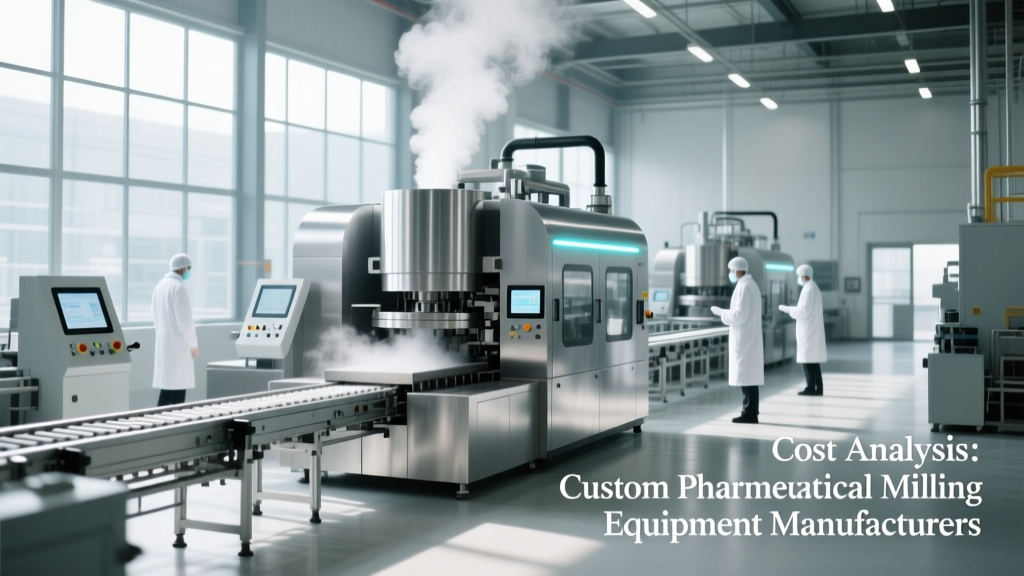
Cost Analysis: Custom Pharmaceutical Milling Equipment Manufacturers
Analyze fabrication costs, OEB containment pricing, and validation budgets when contracting custom pharmaceutical milling equipment manufacturers.
Financial Realities of Custom Pharma Milling Design
When process engineers determine that off-the-shelf conical screen mills or standard fluid energy mills cannot meet the specific particle size distribution (PSD), heat-sensitivity limits, or containment requirements of a novel active pharmaceutical ingredient (API), they must engage specialized pharmaceutical milling equipment manufacturers for custom design and fabrication. Budgeting for these bespoke systems requires moving beyond standard catalog pricing. As of 2026, a fully customized, high-containment jet milling system typically ranges from $450,000 to $950,000. This wide variance is driven by stringent Good Manufacturing Practice (GMP) requirements, advanced computational modeling, and specialized metallurgy.
Unlike standard industrial milling, pharmaceutical fabrication demands absolute traceability, specific surface finishes to prevent cross-contamination, and rigorous occupational exposure band (OEB) containment. Understanding where the capital expenditure (CAPEX) actually goes is critical for plant managers and procurement teams planning their fiscal year budgets.
Typical Budget Allocation for a $650,000 Custom Milling Project:- Engineering & Computational Modeling (DEM/CFD): 18% - 22%
- Raw Materials & 5-Axis CNC Machining: 35% - 40%
- Containment Hardware (RTPs, Split Valves): 20% - 25%
- Surface Finishing & Electropolishing: 5% - 8%
- FAT/SAT Validation & Documentation: 12% - 18%
Material Selection and Metallurgical Multipliers
The contact parts of any pharmaceutical mill—the milling chamber, rotor, stator, and classifier wheel—must resist both the abrasive nature of the API and the aggressive solvents or cleaning agents (like CIP solutions) used during changeovers. While 316L stainless steel is the industry baseline, highly corrosive compounds or halogenated APIs require exotic alloys, drastically altering the fabrication budget.
| Material Specification | Cost Multiplier (vs 316L) | Machining Impact | Primary Pharma Application |
|---|---|---|---|
| 316L Stainless Steel | 1.0x (Baseline) | Standard tooling, $130-$150/hr CNC | Standard APIs, excipients, placebo runs |
| Hastelloy C-276 | 2.8x - 3.4x | High tool wear, $180-$220/hr CNC | Halogenated APIs, aggressive solvent wet-milling |
| Titanium Grade 2 | 2.2x - 2.6x | Requires specialized coolants, $170/hr CNC | Highly reactive metal-sensitive biologics |
| Alumina Ceramic Liners | 1.8x (Installation heavy) | Grinding/sintering required, low CNC | Extreme abrasion APIs (e.g., crystalline silica bases) |
Procurement teams must also factor in the cost of material certification. Requiring full Mill Test Reports (MTRs) and Positive Material Identification (PMI) verification for every Hastelloy component adds roughly $4,500 to $8,000 to the quality assurance phase of the build, but is non-negotiable for FDA compliance.
Containment Engineering: Pricing OEB 4 and OEB 5 Systems
With the rise of highly potent active pharmaceutical ingredients (HPAPIs), occupational exposure limits (OELs) frequently drop below 1 µg/m³. This necessitates OEB 4 or OEB 5 containment strategies, which represent the single largest variable cost in custom milling fabrication.
The Cost of Rapid Transfer Ports (RTPs) and Isolators
Standard butterfly valves leak far too much particulate matter for HPAPI milling. Custom manufacturers integrate Rapid Transfer Ports (RTPs) and continuous liner systems. A single, high-grade pharmaceutical RTP (such as those from Valitech or Chargepoint) costs between $12,000 and $18,000. A custom jet mill requiring an inlet RTP, an outlet RTP, and a sampling RTP will see $45,000+ added to the hardware budget purely for transfer interfaces.
Furthermore, integrating the mill into a closed-loop isolator requires custom flange designs and specialized air-sweep seals on the drive shaft. Designing a magnetically coupled drive shaft to eliminate dynamic seal leaks (a common failure point in OEB 5 systems) adds approximately $35,000 to the mechanical engineering and fabrication costs, but entirely eliminates the risk of API exposure through seal degradation.
Computational Modeling: DEM and CFD in Mill Design
Custom pharmaceutical milling equipment manufacturers do not simply guess the geometry of a milling chamber. To ensure the target D50 and D90 particle sizes without generating excessive heat (which can degrade thermolabile APIs), engineers rely on advanced simulations. According to current engineering standards outlined by the International Society for Pharmaceutical Engineering (ISPE), process understanding is a foundational element of modern facility design.
- Discrete Element Method (DEM): Used to model particle-to-particle and particle-to-wall collisions in conical and pin mills. DEM modeling typically costs $15,000 to $25,000 per iteration but prevents costly physical prototyping of rotor geometries.
- Computational Fluid Dynamics (CFD): Essential for fluid energy (jet) mills to optimize the Laval nozzle geometry and classifier wheel airflow. CFD analysis ensures that the expansion of compressed air achieves the precise supersonic velocities required for particle-on-particle attrition without causing localized hot spots.
Budgeting $30,000 upfront for comprehensive DEM and CFD modeling routinely saves $80,000+ in downstream physical modifications and failed Factory Acceptance Testing (FAT) runs.
Surface Finishing and Cleanability Constraints
In pharmaceutical manufacturing, the surface finish of the milling chamber dictates the cleanability and the risk of cross-contamination. Standard industrial mills feature a machined finish of Ra 1.6 µm. Pharmaceutical GMP requires a minimum of Ra 0.8 µm, with many custom HPAPI systems demanding Ra < 0.4 µm achieved via mechanical polishing followed by electropolishing.
"Achieving an Ra 0.3 µm finish on a complex, 5-axis milled Hastelloy rotor requires up to 40 hours of manual polishing by specialized technicians, followed by a localized electropolishing bath. This single step can add $14,000 to $22,000 to the fabrication cost of a single rotor assembly, but it reduces cleaning validation swab failures by over 85%."
— Senior Manufacturing Engineer, Custom Pharma Equipment Division
Additionally, all internal welds must be continuous, ground flush, and polished to match the parent material. Automated orbital welding is used where possible, but the complex geometries of milling chambers often require manual TIG welding by ASME Section IX certified welders, commanding rates of $110 to $150 per hour in 2026.
Validation, FAT, and the Hidden Compliance Costs
The physical fabrication of the mill is only half the battle. The documentation and validation required to prove the equipment operates within the FDA's Process Analytical Technology (PAT) framework and general GMP guidelines constitute a massive portion of the budget. Manufacturers must provide a comprehensive Data Book, including material traceability, weld logs, surface finish profilometry reports, and calibration certificates for all integrated sensors.
Factory and Site Acceptance Testing (FAT/SAT)
For a custom contained milling system, FAT involves running placebo or surrogate materials (like riboflavin or acetaminophen) through the system to verify PSD, throughput, and containment integrity.
Warning: Surrogate Material CostsDo not underestimate the cost of surrogate materials for FAT. Running a 50kg validation batch of specialized, micronized placebo through a custom jet mill to verify OEB 4 containment can cost upwards of $12,000 in material and specialized third-party industrial hygiene air monitoring. Ensure this line item is explicitly defined in the manufacturer's proposal to avoid change-order disputes later.
Furthermore, alignment with WHO Technical Report Series guidelines on GMP dictates that custom equipment must undergo rigorous Installation Qualification (IQ) and Operational Qualification (OQ). Expect to pay the equipment manufacturer an additional $35,000 to $60,000 for the generation, execution, and handover of these validation protocols.
Decision Matrix: Custom vs. Modified Off-The-Shelf (MOTS)
Before committing to a fully custom build, engineering teams should evaluate whether a Modified Off-The-Shelf (MOTS) approach meets the process requirements. The table below provides a financial and technical framework for this decision.
| Evaluation Criteria | Fully Custom Design | MOTS (Modified Standard) |
|---|---|---|
| Base CAPEX | $450,000 - $950,000+ | $180,000 - $350,000 |
| Lead Time (2026 Avg) | 9 - 14 Months | 4 - 7 Months |
| Geometry Optimization | 100% tailored to specific API rheology | Limited to existing chamber profiles |
| Containment Integration | Native OEB 5 design (magnetic drives, RTPs) | Retrofitted OEB 3/4 (often relies on external isolators) |
| Validation Burden | Extensive (Requires full IQ/OQ/PQ from scratch) | Moderate (Leverages existing baseline OQ data) |
Final Procurement Strategy
When issuing an RFQ to pharmaceutical milling equipment manufacturers, avoid requesting "custom mills" in the abstract. Provide the manufacturer with the API's Bond Work Index, moisture sensitivity, target PSD curve, and required OEL. By supplying this data upfront, manufacturers can utilize their existing DEM libraries to propose a MOTS solution with custom rotor profiles, potentially saving 30% on the engineering budget while still achieving the exact process parameters required for your commercial production line.