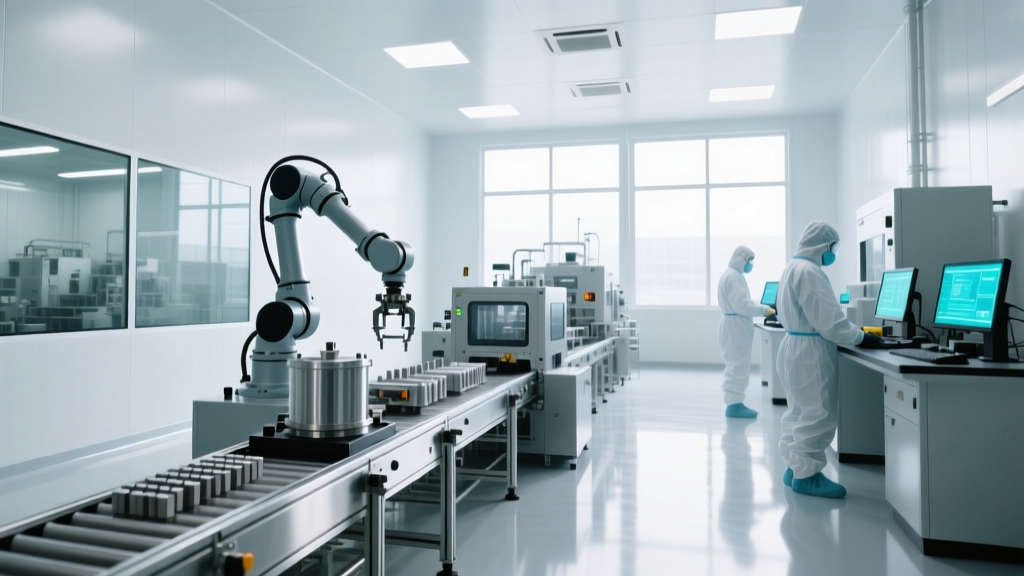
Cleanroom Requirements for Metallurgical Lab Equipment Manufacturers
Explore how metallurgical lab equipment manufacturers adapt to ISO Class 5 cleanroom requirements for semiconductor and aerospace alloy testing.
The Convergence of Advanced Metallurgy and Contamination Control
As of 2026, the transition to 1.4nm semiconductor architectures and the widespread adoption of additive manufacturing for reactive aerospace alloys (such as Ti-6Al-4V and Inconel 718) have fundamentally altered the environmental requirements for failure analysis and quality control. Airborne particulates and molecular contamination no longer just skew data; they destroy multi-million-dollar yield rates by introducing false-positive defect signatures during energy-dispersive X-ray spectroscopy (EDS) and electron backscatter diffraction (EBSD). Consequently, metallurgical lab equipment manufacturers are aggressively redesigning sample preparation, polishing, and imaging hardware to operate flawlessly within ISO 14644-1 Class 5 and Class 7 cleanrooms.
2026 Cleanroom Metallurgy Data Snapshot
- ISO Class 5 Particle Limit: 3,520 particles ≥0.5µm per cubic meter.
- Target Outgassing (TML): ≤1.0% Total Mass Loss per ASTM E595.
- Equipment Cost Premium: 140% to 220% over standard ambient lab equivalents.
- Primary Contamination Vector: Lubricant outgassing and polishing slurry aerosolization.
Material Science and Outgassing: The ASTM E595 Mandate
The most critical hurdle for metallurgical lab equipment manufacturers designing for cleanrooms is controlling outgassing—the release of volatile organic compounds (VOCs) from equipment materials under vacuum or thermal stress. In a standard metallographic lab, the off-gassing from standard nitrile O-rings, PVC tubing, and lithium-based greases is negligible. In a cleanroom, these compounds condense on silicon wafers or optical sensors, creating catastrophic haze defects.
To comply with SEMI standards and aerospace cleanroom protocols, manufacturers are overhauling their bill of materials (BOM):
- Seals and Gaskets: Standard Buna-N and Viton are replaced with perfluoroelastomers (FFKM), such as Chemours Kalrez, which exhibit near-zero outgassing and withstand aggressive acidic etchants used in metallurgical prep.
- Lubricants: Hydrocarbon greases are entirely eliminated. Manufacturers now specify perfluoropolyether (PFPE) lubricants like Krytox, which maintain viscosity without releasing volatile siloxanes.
- Chassis Materials: Painted mild steel is abandoned in favor of electropolished 316L stainless steel or hard-anodized 6061-T6 aluminum, which resist particle shedding and tolerate frequent wiping with isopropyl alcohol (IPA) or hydrogen peroxide cleaners.
Comparison Matrix: Standard vs. Cleanroom-Rated Prep Equipment
The table below illustrates the exact engineering divergences between standard ambient metallurgical equipment and cleanroom-rated variants produced by leading manufacturers.
| Component | Standard Lab Spec | Cleanroom Spec (ISO 5/7) | Failure Mode if Ignored |
|---|---|---|---|
| Polisher Drive Motor | Open-frame brushed DC | Sealed brushless DC (BLDC) with magnetic couplings | Carbon brush dust contaminates wafer surfaces |
| Slurry Delivery | Open drip-feed peristaltic | Closed-loop recirculating with PTFE tubing | Aerosolized silica/diamond slurry coats HEPA filters |
| Vacuum Chamber (SEM) | Oil-sealed rotary vane pump | Dry scroll pump (e.g., Edwards nXDS series) | Oil backstreaming ruins EDS detector beryllium windows |
| Control Interfaces | Membrane keypads, exposed ports | Flush-mounted capacitive touch, IP65 rated | Particulate trapping in crevices; microbial growth |
Automated and Sealed Sample Preparation Systems
Manual grinding and polishing generate massive amounts of particulate debris and aerosolized coolants. To meet cleanroom requirements, metallurgical lab equipment manufacturers have shifted toward fully enclosed, automated preparation cells. Systems like the Struers Tegrasystem series or Buehler’s automated lines are now being fitted with custom cleanroom shrouding and localized HEPA-filtered exhaust systems.
These enclosed systems utilize negative pressure zones to ensure that any microscopic diamond suspension or alumina slurry aerosol generated during the high-RPM polishing phase is immediately captured and filtered before it can escape into the cleanroom airstream. Furthermore, the integration of deionized (DI) water rinse stages with closed-loop filtration prevents the introduction of municipal water ions (like calcium or chlorine) which can cause galvanic corrosion on sensitive microelectronic cross-sections.
⚠️ Warning: The Hidden Cost of Ultrasonic Cleaners
Many facility planners specify standard ultrasonic cleaners for post-polishing sample rinsing. In a cleanroom environment, the cavitation process in an open-top ultrasonic bath atomizes the cleaning solvent, blasting microscopic droplets into the ambient air. Cleanroom-compliant metallurgical labs must use megasonic cleaners with enclosed, ventilated lids and high-purity NMP (N-Methyl-2-pyrrolidone) or specialized aqueous surfactants to prevent molecular airborne contamination (AMC).
Electron Microscopy and Dry Vacuum Integration
Scanning Electron Microscopes (SEM) and Focused Ion Beam (FIB) systems are the end-point of the metallurgical workflow. While the electron column itself operates in a high vacuum, the roughing pumps used to achieve that vacuum have historically been oil-sealed mechanical pumps. In 2026, specifying an oil-sealed pump for a cleanroom SEM is considered a critical engineering failure.
Metallurgical lab equipment manufacturers now partner with vacuum specialists to integrate dry scroll or dry diaphragm pumps (such as the Edwards nXDS6 or Agilent IDP series). These dry pumps eliminate the risk of hydrocarbon backstreaming, which coats the sample chamber and creates a carbon-rich layer that completely obscures low-Z element detection during EDS mapping. The cost premium for a dry vacuum integration is typically $8,500 to $12,000 per tool, but it prevents catastrophic detector contamination that can cost upwards of $45,000 to remediate.
Step-by-Step: Specifying a Cleanroom Metallographic Line
When procuring equipment from metallurgical lab equipment manufacturers for an ISO Class 7 or Class 5 facility, follow this specification framework to ensure compliance and operational longevity:
- Request the BOM Outgassing Certificate: Do not accept generic "cleanroom compatible" marketing claims. Require third-party testing data verifying that all polymers and lubricants meet IEST and ASTM E595 outgassing limits (TML ≤1.0%, CVCM ≤0.10%).
- Mandate IP65+ Washdown Ratings: Cleanrooms require frequent, aggressive decontamination. Equipment housings must be rated for high-pressure IPA wiping without degrading seals or fogging viewports.
- Specify Non-Shedding Belts and Cables: Motion systems inside automated polishers must use low-particulate polyurethane timing belts and high-flex cleanroom-rated drag chains (e.g., igus e-chain systems).
- Integrate Localized Exhaust Ventilation (LEV):strong> Ensure the equipment footprint aligns with your facility’s drop-ceiling exhaust grid. Prep stations should feature integrated top-mounted HEPA filters with brushless EC fans that do not disrupt the cleanroom’s laminar downflow.
- Verify EMI Shielding: Cleanrooms are dense with RF noise from plasma etchers and HVAC VFDs. Ensure SEM and EBSD cameras are supplied with double-shielded coaxial cabling and isolated grounding loops.
Cost Implications and ROI for Facility Planners
Upgrading to cleanroom-compliant metallurgical equipment represents a significant capital expenditure. A standard ambient AutoMet polisher might cost $14,500, whereas a fully enclosed, cleanroom-shrouded variant with closed-loop slurry management will range from $38,000 to $45,000. Similarly, a base-model field-emission SEM (like the JEOL JSM-IT800) starts around $185,000, but a cleanroom-configured unit with dry pumps, seismic isolation, and AMC filters pushes the price to $245,000+.
However, the ROI is realized in yield protection and data integrity. A single false-positive defect identification caused by a 2-micron airborne dust particle landing on a semiconductor cross-section can trigger an unnecessary line shutdown, costing a fabrication plant upwards of $150,000 per hour in lost throughput. By enforcing strict cleanroom requirements on metallurgical lab equipment manufacturers, quality assurance teams ensure that the defects they analyze are native to the material, not artifacts of the laboratory environment.
Related reading
Custom Machine Fabrication: What Manufacturing Analytics Tools Provide Machine-Level Performance Tracking?
IIoT Maintenance Schedules for Gym Equipment Manufacturers in China