How Bowling Equipment Manufacturers Budget Custom Fabrication
Analyze CapEx and budget planning for bowling equipment manufacturers investing in custom manufacturing equipment design and fabrication.
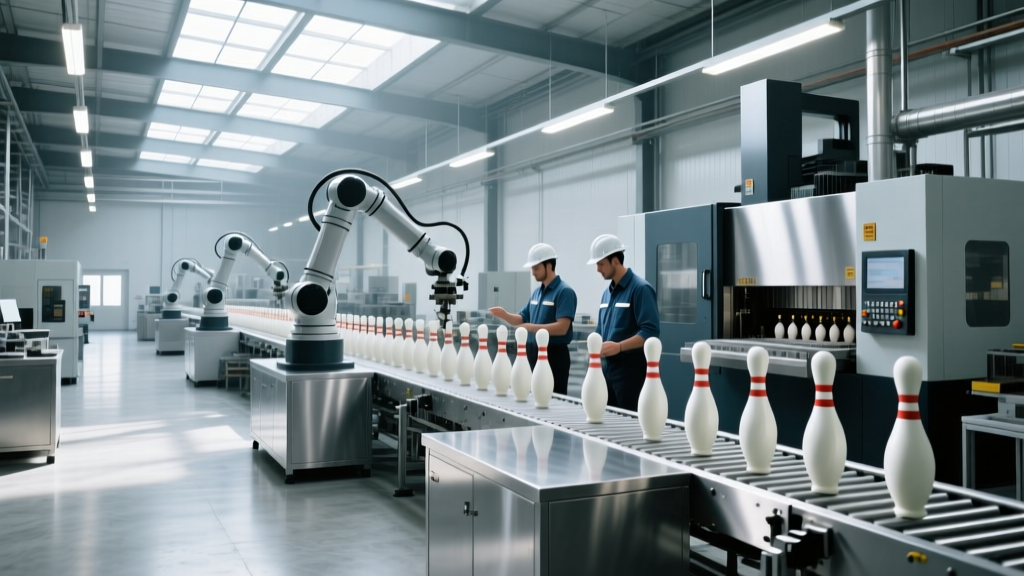
Capital expenditure (CapEx) planning for bowling equipment manufacturers requires navigating a highly specialized niche of custom manufacturing equipment design and fabrication. Unlike high-volume FMCG or standard automotive assembly, the production of United States Bowling Congress (USBC)-certified bowling balls and complex mechanical pinsetters demands bespoke automated rigs. In 2026, the shift toward smart-factory integration and tighter dynamic tolerances has pushed baseline automation costs higher, making rigorous budget analysis essential before greenlighting any custom fabrication project.
The CapEx Reality of Custom Bowling Manufacturing Rigs
When bowling equipment manufacturers transition from manual assembly to automated custom fabrication, the initial equipment cost is only the beginning. A standard off-the-shelf conveyor system might cost $15,000, but a custom pinsetter gearbox assembly station equipped with torque-limiting servo drives and automated grease dispensing typically starts at $120,000. The financial complexity arises from the need to integrate heavy-load robotics with ultra-precise vision systems, specifically to handle the extreme weight variations and dynamic balancing requirements inherent to professional bowling gear.
Budgeting for these systems requires separating mechanical fabrication costs from controls engineering. In current market conditions, mechanical weldments and machined fixtures account for roughly 45% of the total project cost, while PLC programming, HMI development, and robotic teach-pendant configuration consume the remaining 55%.
Cost Breakdown: Urethane Casting vs. Pinsetter Assembly
To understand the financial scope, consider the two most capital-intensive custom fabrication projects for bowling equipment manufacturers: automated urethane core-molding carousels and pinsetter chassis assembly lines. The table below outlines the 2026 CapEx thresholds for these bespoke systems.
| Equipment Type | Base Fabrication Cost | PLC & Controls Cost | Integration & Commissioning | Total Estimated CapEx |
|---|---|---|---|---|
| Urethane Core-Molding Carousel | $110,000 - $140,000 | $45,000 - $60,000 | $35,000 - $50,000 | $190,000 - $250,000 |
| Pinsetter Gearbox Assembly Station | $75,000 - $95,000 | $30,000 - $45,000 | $25,000 - $35,000 | $130,000 - $175,000 |
Hidden Engineering Costs in Bespoke Jigs and Fixtures
The most frequent budget overruns in this sector occur during the jig and fixture design phase. According to the USBC equipment specifications, the dynamic radius of gyration (RG) and differential of a bowling ball must be strictly controlled. This requires the core-positioning jigs inside the molding carousel to hold the dense weight block within a tolerance of ±0.005 inches before the urethane is poured.
Achieving this tolerance means standard welded steel fixtures are insufficient. Manufacturers must budget for CNC-machined 6061-T6 aluminum fixtures with hard-anodized coatings to prevent urethane adhesion and thermal warping. Expect to add $12,000 to $18,000 per molding station strictly for high-precision fixture machining and thermal PID controller integration (such as Watlow EZ-ZONE modules) to manage the exothermic curing reaction.
Budgeting Framework: The 4-Phase Custom Equipment Lifecycle
Accurate cash flow planning requires mapping expenditures to the engineering lifecycle. Bowling equipment manufacturers should allocate their approved CapEx across these four distinct phases:
- Conceptualization and Simulation (10% of Budget): Utilizing discrete event simulation (DES) software to model cycle times. For a lane-oiling machine assembly rig, this phase proves whether a 40-second takt time is physically achievable before cutting steel.
- Mechanical and Electrical Design (25% of Budget): Generating 3D CAD models, pneumatic schematics, and electrical panel layouts. This phase locks in the bill of materials (BOM) for long-lead items like servo motors and gearboxes.
- Fabrication and Machining (40% of Budget): The physical cutting, welding, and assembly of the custom rig. This is where raw material costs (steel, aluminum, UHMW plastics for low-friction guides) are heavily concentrated.
- FAT, SAT, and Commissioning (25% of Budget): Factory Acceptance Testing (FAT) and Site Acceptance Testing (SAT). Budgeting 25% here is critical; flying controls engineers to the manufacturing floor to debug PLC logic and tune robotic paths always takes longer than anticipated.
ROI and Payback Period Analysis
Custom fabrication must be justified by measurable labor savings and defect reduction. Consider the automation of a pinsetter cam-tube assembly process. Manually, a technician requires 14 minutes to align, grease, and torque the heavy cast-iron components. By deploying a custom rig utilizing Atlas Copco QST50 nutrunners for automated torque verification and Graco G3 pumps for precise grease dispensing, the cycle time drops to 3.5 minutes.
Assuming a two-shift operation running 250 days a year, the labor savings alone amount to approximately $85,000 annually. When factoring in the reduction of warranty claims caused by under-greased or improperly torqued cam-tubes (which historically cost manufacturers up to $400 per field-service call), the payback period for a $150,000 custom assembly station is typically 14 to 18 months.
Strategic Sourcing: OEM vs. Systems Integrators
Bowling equipment manufacturers face a critical sourcing decision: build the custom equipment in-house or hire an external systems integrator. Each route carries distinct financial and operational implications.
- In-House Fabrication: Best for proprietary processes (like proprietary urethane mixing nozzles). Pros: Total IP control, lower initial markup. Cons: Requires maintaining a full-time mechanical and controls engineering staff, which adds $350,000+ in annual payroll overhead.
- External Systems Integrator: Best for standard material handling and robotic pick-and-place. Pros: Access to bulk-purchased robotics and standardized code libraries. Cons: Integrators typically apply a 20% to 30% margin on the total project cost.
For safety-critical robotic cells, external integrators are often mandatory to ensure compliance with ANSI/RIA R15.06 robot safety standards. The cost of an external safety audit and risk assessment (typically $8,000 to $12,000) is a necessary line item that in-house teams frequently overlook until the final OSHA compliance review.
Final Budgeting Directives
Successful custom manufacturing equipment design and fabrication in the bowling industry hinges on respecting the physics of the product. Heavy, dynamically balanced components require over-engineered structural weldments and high-torque servos. By allocating budgets toward precision fixturing, securing long-lead automation hardware early, and rigorously modeling cycle times before fabrication, manufacturers can deploy custom rigs that dominate the lane and the balance sheet.