Cost Analysis: Manufacturer of Quality Air and Water-Wastewater Pollution Control Equipment Integration
Analyze CapEx and OpEx for integrating automated air and wastewater pollution control systems into manufacturing lines. Includes 2026 cost benchmarks.
The Hidden CapEx of Environmental Automation
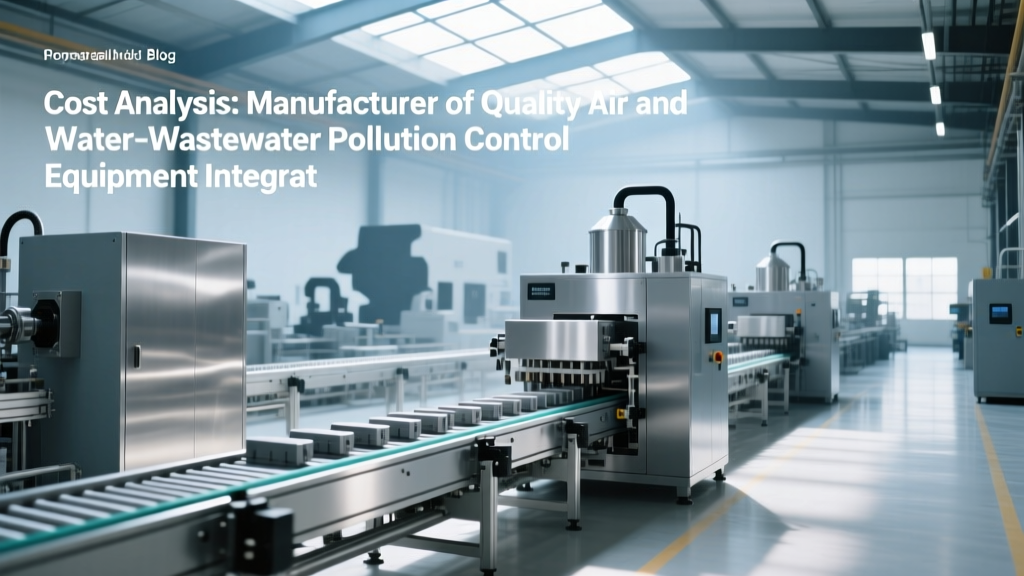
Upgrading a manufacturing facility to a fully automated production line requires more than just synchronizing CNC machines, conveyors, and robotic arms. Environmental compliance systems—specifically industrial scrubbers, API oil-water separators, and automated chemical dosing skids—must operate in lockstep with the main production PLC. Failing to budget for this integration results in catastrophic compliance violations or massive chemical overdosing. When sourcing from a manufacturer of quality air and water-wastewater pollution control equipment, plant managers often underestimate the software and instrumentation costs required to bridge the gap between environmental hardware and the factory's central SCADA network.
2026 Benchmark Data: Integration Costs
For a mid-sized manufacturing plant (processing 50,000 to 100,000 gallons of wastewater daily with concurrent VOC air scrubbing), the base mechanical hardware typically accounts for only 45% of the total project cost. The remaining 55% is consumed by industrial-grade instrumentation, control panel fabrication, OPC-UA licensing, and on-site commissioning. Expect total integration CapEx to range between $380,000 and $620,000 for a fully automated, SCADA-integrated environmental skid.
CapEx vs. OpEx Matrix: Skid-Mounted vs. Custom Engineered
Choosing the right physical architecture dictates your long-term operational expenditure. Below is a comparative breakdown of integrating pre-packaged skids versus custom-engineered systems into an existing automated line.
| System Architecture | Base Hardware Cost | PLC/SCADA Integration Cost | Lead Time | Long-Term OpEx Impact |
|---|---|---|---|---|
| Pre-Packaged OEM Skid | $120,000 - $180,000 | $45,000 - $70,000 (Modbus/OPC mapping) | 12 - 16 Weeks | Higher; proprietary HMI limits in-house troubleshooting. |
| Custom Engineered Build | $250,000 - $400,000 | $85,000 - $130,000 (Native TIA/Studio 5000) | 24 - 32 Weeks | Lower; unified codebase allows seamless line-wide optimization. |
According to ISA-95 enterprise-control integration standards, maintaining a unified control hierarchy is critical for automated manufacturing. Custom builds allow the environmental equipment to share the exact same PLC architecture (e.g., Allen-Bradley ControlLogix or Siemens S7-1500) as the main production line, drastically reducing latency and maintenance overhead.
Step-by-Step Budget Allocation Framework
When drafting the capital request for environmental automation, allocate your budget using this specific percentage breakdown to avoid mid-project change orders:
- Base Mechanical & Metallurgy (35%): Includes FRP (Fiberglass Reinforced Plastic) or 316L stainless steel tanks, piping, and structural steel. Do not value-engineer the metallurgy; 304 stainless will pit and fail within 18 months in high-chloride wastewater environments.
- Instrumentation & Analytics (25%): High-accuracy sensors are the eyes of your automated system. Budget $4,500 to $8,000 per analytical loop. For example, specifying an Endress+Hauser Liquiline CM442R transmitter with Memosens pH and ORP sensors ensures reliable data for automated caustic dosing.
- Control Logic & SCADA Integration (25%): This covers the VFDs (Variable Frequency Drives) for blowers and dosing pumps, the main PLC processor, and the SCADA tag licensing. Ignition SCADA, for instance, requires specific module licensing for advanced alarming and historical data logging.
- FAT, SAT, and Commissioning (15%): Factory Acceptance Testing (FAT) and Site Acceptance Testing (SAT) with wet runs. Budget a minimum of $12,000 to $18,000 for the OEM's automation engineers to be on-site for two weeks during live-production integration.
The Software Cost Trap: SCADA and Protocol Licensing
A frequent budget failure occurs when plant engineers assume the environmental equipment will simply 'plug in' to the main factory network. Many legacy environmental systems rely on Modbus RTU or BACnet, which require protocol converters (like a Prosoft MVI56E-MCM module, costing roughly $3,200) to communicate with modern Ethernet/IP networks.
Warning: OPC-UA Server LicensingIf your chosen manufacturer utilizes a localized edge-gateway to push data to your central SCADA, ensure the OPC-UA server license is included in the base quote. Third-party OPC-UA routers (such as Kepware) charge by the driver and tag count. A 500-tag environmental integration can easily add $4,000 to $6,000 in unforeseen software licensing fees if not explicitly covered in the vendor's scope of work.
Vetting the Manufacturer: Integration Capabilities Checklist
Selecting the right manufacturer of quality air and water-wastewater pollution control equipment requires looking past the mechanical design and auditing their automation engineering department. Use this checklist during the RFQ process to ensure the vendor can handle modern line integration:
- Native Code Delivery: Does the contract stipulate the delivery of unlocked, commented PLC source code? Vendors who lock their logic force you to pay $175/hour for every minor setpoint adjustment.
- Cybersecurity Compliance: Are the integrated HMIs and edge gateways compliant with IEC 62443 industrial security standards? Air-gapped environmental systems are no longer acceptable in 2026; they must be securely integrated into the plant's DMZ.
- State-Based Control Logic: Does the vendor utilize ISA-88 state-based programming models? This allows the main production line to pass 'states' (e.g., 'Production_Run', 'CIP_Cleaning', 'Idle') to the wastewater system, allowing the environmental equipment to automatically adjust chemical dosing rates based on the factory's real-time operational mode.
Adhering to strict EPA enforcement guidelines means your data logging must be bulletproof. The manufacturer must provide automated, tamper-proof SQL database logging for all pH, flow, and chemical usage metrics to satisfy environmental auditors.
Real-World Failure Modes in Automated Environmental Lines
Theoretical budgets rarely account for the physical realities of a harsh manufacturing environment. Here are two specific edge cases that blow up integration budgets if not planned for:
Failure Mode 1: pH Probe Fouling in Automated Dosing Loops
In an automated neutralization tank, if the production line discharges a high-solids slurry, standard glass pH probes will coat and blind within 48 hours. The SCADA system will read a false neutral pH, shutting off the dosing pumps, resulting in an acidic discharge violation. The Fix: Budget an additional $6,500 for an automated ultrasonic probe cleaning system or specify a retractable housing with a flat-surface ISFET sensor, which resists coating.
Failure Mode 2: VFD Harmonic Distortion
Adding 50HP regenerative blowers for air scrubbers via cheap, unshielded VFDs can introduce massive harmonic distortion back into the plant's electrical bus. This noise scrambles the 4-20mA analog signals from your delicate wastewater flowmeters. The Fix: Mandate active front-end (AFE) drives or specify 3% line reactors on all environmental VFDs, adding roughly $2,200 per drive to the electrical budget but saving tens of thousands in signal troubleshooting.
Strategic Takeaways for 2026 Capital Planning
Integrating environmental compliance equipment into an automated production line is a multidisciplinary challenge that bridges mechanical engineering, fluid dynamics, and industrial IT. By shifting your perspective from purchasing 'standalone hardware' to investing in 'networked environmental nodes,' you protect your facility from both regulatory fines and integration cost overruns. Always mandate native PLC compatibility, budget heavily for high-grade analytical instrumentation, and ensure your software licensing is fully mapped before the purchase order is signed.
For further reading on optimizing plant-wide automation networks, industry resources like Plant Engineering's automation archives provide ongoing case studies on SCADA consolidation and edge-computing deployments in heavy manufacturing environments.