Operator Training Guide for Top Thermoforming Equipment Manufacturers
Master operator training protocols for top thermoforming equipment manufacturers. Learn safety, PLC parameter optimization, and troubleshooting frameworks.
The Evolution of the Thermoforming Operator
Modern thermoforming machinery has transitioned from manual, relay-based systems to highly automated, Industry 4.0-enabled platforms. Leading thermoforming equipment manufacturers now integrate advanced PLCs, closed-loop temperature controllers, and IoT-driven predictive maintenance sensors into their machines. Consequently, the role of the operator has shifted from manual sheet threading and dial-turning to systems management, data interpretation, and precision troubleshooting.
Training operators on equipment from top-tier OEMs—such as Illig, Geiss, MAAC, and GN Thermoforming—requires a structured, competency-based approach. Generic onboarding is insufficient; operators must understand the specific kinematic profiles, HMI (Human Machine Interface) logic, and thermal dynamics unique to their assigned machinery. This guide outlines the definitive training framework required to maximize uptime, minimize scrap rates below the industry-standard 4%, and ensure absolute safety on the production floor.
OEM-Specific Training Focus Areas
Different thermoforming equipment manufacturers prioritize distinct mechanical and software architectures. A training program must be tailored to the specific OEM platform running on the floor. Below is a competency matrix mapping the critical training focus areas for the industry's leading machine builders.
| OEM / Machine Series | Core Architecture | Critical Operator Training Focus | Common Edge Cases to Master |
|---|---|---|---|
| Illig (UA / UA-M Series) | Servo-driven forming and trimming stations with integrated HMI. | Servo-curve programming, forming air pressure profiling, and synchronized trimming. | Managing web tension during high-speed indexing; avoiding servo-faults during rapid deceleration. |
| Geiss (T10 / T10a) | Heavy-duty roll-fed systems with advanced quartz heater zoning. | Multi-zone heater calibration, sag control algorithms, and robotic part stacking integration. | Tuning PID controllers for thick-gauge HDPE; preventing sheet sticking to upper heater banks. |
| MAAC (Carousel Systems) | Rotary carousel indexing with independent heating, forming, and cooling stations. | Carousel timing synchronization, independent station dwell adjustments, and hydraulic/pneumatic balancing. | Indexing misalignment causing trim die crashes; managing cooling station water flow rates for warp prevention. |
| GN Thermoforming (GN800 / GN1000) | High-speed inline trim-in-place (TIP) form-cut-stack systems. | Plug assist velocity mapping, cut-pad pressure equalization, and steel-rule die alignment. | Eliminating dust generation during TIP cutting; optimizing plug temperature for PETG crystallization. |
Phase 1: Thermal Safety and Pre-Start Protocols
Safety training must precede HMI operation. Thermoforming ovens operate with quartz or ceramic heater elements that easily exceed 500°C (932°F). According to OSHA's Plastics Industry guidelines, thermal burns and fire hazards from sheet ignition are the most severe risks in the forming area.
The 4-Point Heater Bank Inspection
Operators must be trained to perform a mandatory pre-start inspection before energizing the main heater banks. This prevents catastrophic fires caused by degraded materials or electrical faults.
- Visual Element Check: Inspect quartz tubes for dark banding or localized swelling, which indicates tungsten wire oxidation and imminent failure. Check ceramic elements for cracked casings.
- Debris Clearance: Verify that no polymer drool, degraded edge-trim, or cleaning rags are resting on the lower heater bank reflectors. Polymer buildup on reflectors will ignite once the bank reaches operating temperature.
- Thermocouple Seating: Physically verify that the sheet-surface thermocouples (if equipped with drop-down pyrometers) are unobstructed and that the air-cooling lines are connected to prevent sensor melt-down.
- Emergency Stop (E-Stop) Validation: With the main air supply pressurized, trigger the E-stop to ensure the heater banks immediately retract or drop, and the sheet indexing halts.
Operators must be trained to recognize the sound of a failing retraction pneumatic cylinder. If the heater bank fails to retract during an E-stop or sheet-break event, the stationary plastic sheet will ignite within 4 to 8 seconds. Train operators to manually trigger the localized heater-bank drop switch located on the side of the oven frame if the main PLC fails to execute the retraction sequence.
Phase 2: HMI Navigation and Zone Heating Strategies
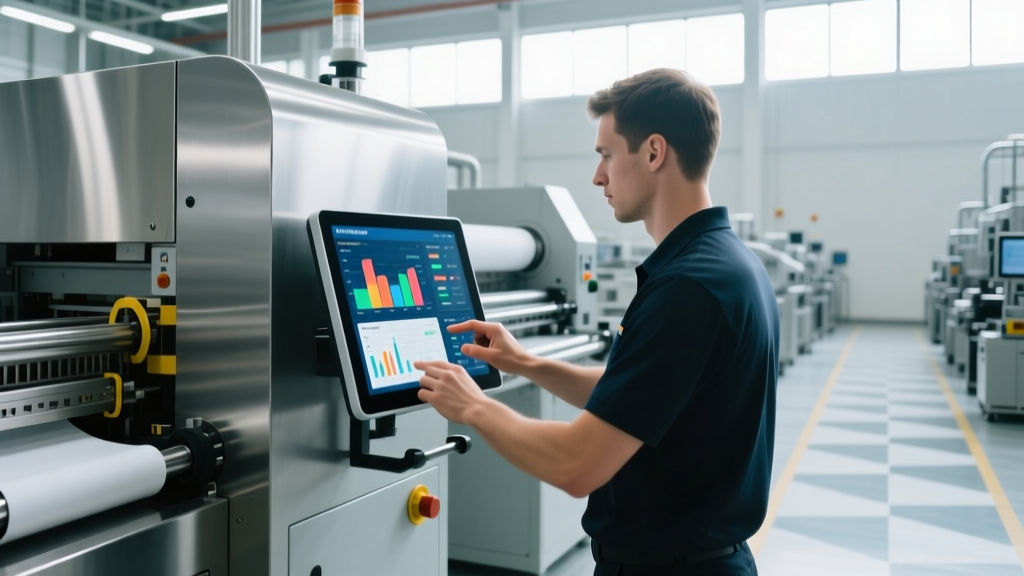
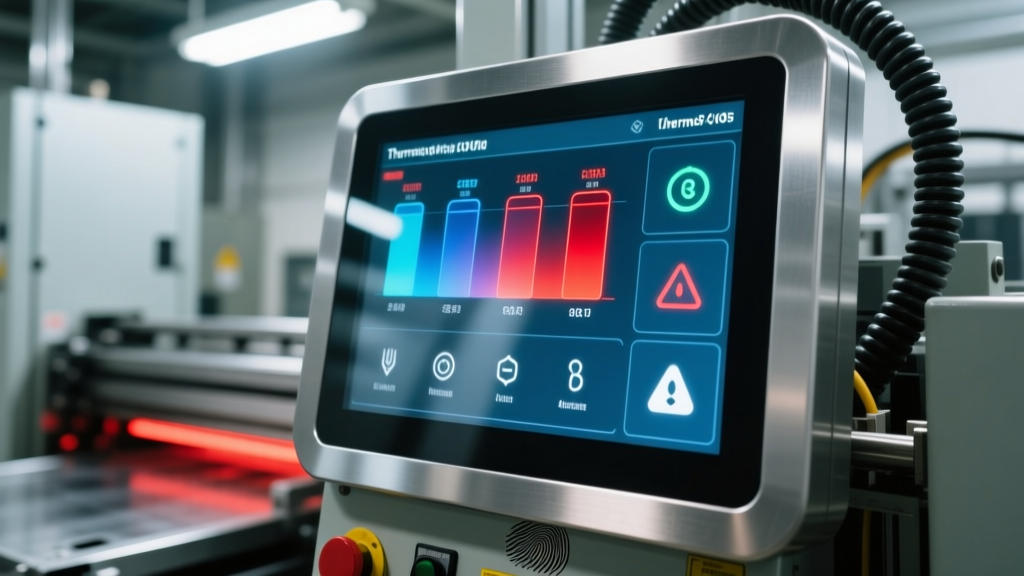
Once safety is established, operators must master the thermal profiling of the plastic sheet. Modern thermoforming equipment manufacturers utilize sophisticated HMI screens that allow for granular control over dozens of independent heating zones. Training must move beyond "recipe recall" to active thermal management.
Material-Specific Thermal Targets
Operators must memorize the forming temperature windows for the most common polymers run on their machines. Relying solely on HMI heater percentages is a critical error; operators must use infrared pyrometers to measure actual sheet surface temperatures.
- PETG (Glycol-modified Polyethylene Terephthalate): Target forming temperature of 160°C - 185°C. Operators must be trained to watch for the "sag" point. If the sheet surface exceeds 195°C, PETG will lose melt strength, resulting in severe webbing and bottom-out thinning.
- HIPS (High Impact Polystyrene): Target forming temperature of 140°C - 160°C. Training must emphasize the narrow processing window; a 10°C drop results in poor detail reproduction, while a 10°C spike causes blowouts in deep-draw areas.
- HDPE (High-Density Polyethylene): Target forming temperature of 135°C - 155°C. HDPE is highly crystalline and prone to warping. Operators must learn to manipulate the cooling station dwell times and water-mist sprays rather than just adjusting oven heat.
Managing Heater Degradation via Amperage Draw
Advanced operators should be trained to monitor the electrical amperage draw of the heater zones on the HMI. As heater elements age, their electrical resistance changes. If Zone 4 is set to 65% output but is drawing 10% less amperage than historical baselines, the element is degrading. Catching this via HMI data prevents mid-run temperature drops that cause sudden spikes in scrap rates.
Phase 3: Defect Resolution Decision Tree
Troubleshooting is where operator expertise directly impacts profitability. The Plastics Industry Association emphasizes that systematic defect resolution reduces machine downtime by up to 30%. Operators should be trained using the following decision framework for the three most common thermoforming defects.
1. Webbing and Pleating in Corners
- Symptom: Folded, overlapping plastic in deep-drawn corners or undercuts.
- Root Cause Analysis: The sheet is too hot (loss of melt strength), the vacuum is applied too aggressively at the initial strike, or the plug assist is pushing too deep before vacuum is triggered.
- Operator Action: Reduce the top-oven pre-heat zones by 3-5%. Delay the plug-assist start position by 10mm. Introduce a "vacuum delay" timer on the HMI (typically 0.2 to 0.5 seconds) to allow the sheet to stretch via billow-air before the vacuum locks it against the mold walls.
2. Wall Thickness Variance (Chill Marks / Thin Spots)
- Symptom: The part is structurally weak at the base, with visible "chill marks" where the plastic hit the cold aluminum mold too early.
- Root Cause Analysis: The mold temperature is too low, causing premature freezing of the polymer, or the sheet temperature is uneven across the transverse direction (TD).
- Operator Action: Increase the mold temperature controller setpoint by 5°C. Check the transverse heater zones on the HMI; increase the outer-edge zones by 8% to compensate for edge heat-loss during indexing. If using a plug assist, verify the plug temperature is maintained at 60°C - 80°C (for PET/PS) to prevent the plug from stealing heat from the sheet center.
3. Part Warpage and Distortion Post-Trim
- Symptom: Parts curl or twist after being cut from the web and stacked.
- Root Cause Analysis: Uneven cooling, residual internal stress from aggressive plug-assist compression, or stacking parts while the core temperature remains above the polymer's heat deflection temperature.
- Operator Action: Extend the cooling station dwell time by 0.5 seconds. Increase the velocity of the cooling fans. Crucially, train operators to use a thermal camera or contact pyrometer on the stacking conveyor; parts must be cooled below 45°C before being nested in the stacker to prevent post-forming distortion.
Continuous Education and OEM Certification
Initial onboarding is only the first step. Top thermoforming equipment manufacturers offer tiered certification programs that are critical for maintaining a world-class production floor. Facilities should budget for annual OEM-led training, either on-site or at the manufacturer's technical center.
For example, sending lead operators to specialized servo-maintenance and HMI-logic courses ensures that the facility relies less on expensive OEM service calls for minor software faults. Furthermore, engaging with industry bodies and local chapters of the Society of Plastics Engineers (SPE) allows operators to cross-pollinate knowledge, learning how competing facilities optimize identical machinery.
💡 Pro-Tip: The "Scrap Audit" Training MethodOnce a week, have operators perform a manual scrap audit. Weigh the skeleton web, the startup purges, and the mid-run rejected parts separately. By forcing operators to physically handle and categorize the waste, they develop a tactile understanding of how their HMI parameter tweaks directly translate to material loss and margin erosion.
Frequently Asked Questions (FAQ)
How long does it take to fully train a thermoforming operator?
Basic safety and machine operation (loading rolls, basic HMI navigation, stacking) takes 2 to 4 weeks. However, achieving "Master Operator" status—where the individual can independently troubleshoot complex thermal defects, optimize cycle times, and perform preventative mechanical maintenance—typically requires 12 to 18 months of continuous floor experience alongside formal OEM training.
Should operators be trained to perform trim-die changes?
Yes. On inline trim-in-place (TIP) systems, the trim die change is the primary bottleneck during product changeovers. Operators must be trained in precise steel-rule die alignment, cut-pad (Teflon or nylon) inspection, and hydraulic platen parallelism checks. Relying solely on setup technicians for die changes creates unnecessary downtime.
What is the most overlooked safety hazard in thermoforming?
Pneumatic stored energy. Operators are often trained to lock out electrical power (LOTO), but they frequently forget to bleed the compressed air lines. A trapped air pocket in a 6-inch bore forming cylinder can generate thousands of pounds of unexpected force, causing the platen to drop during mold maintenance. Comprehensive training must include pneumatic lockout and zero-energy verification.