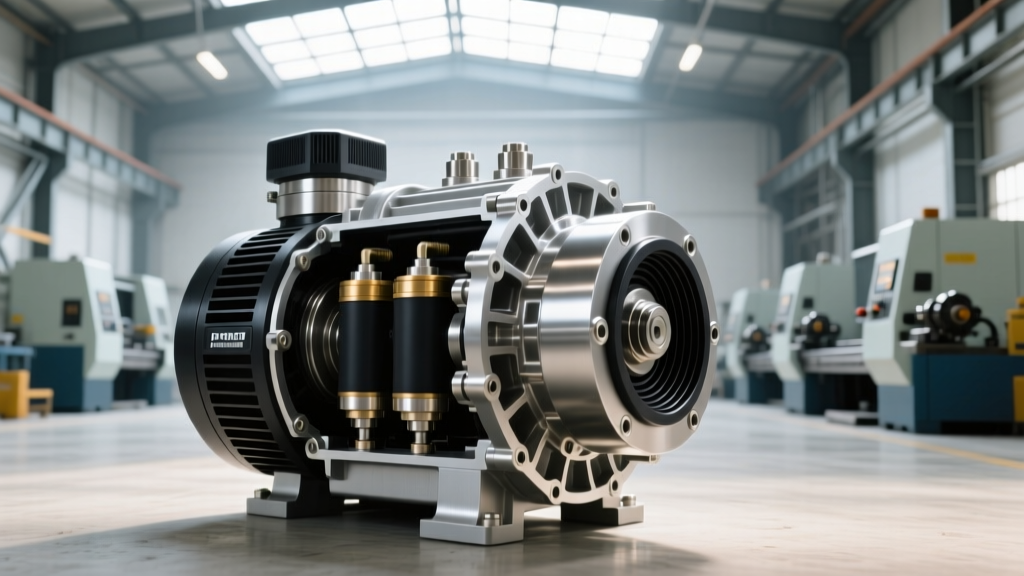
Manufacturers of Equipment Using R-410A Have Redesigned Compressors
Technical breakdown of how R-410A compressors were redesigned for 60% higher pressures, covering POE oils, HNBR seals, and scroll tolerances.
The Thermodynamic Catalyst: 60% Higher Operating Pressures
The transition from legacy chlorodifluoromethane (R-22) to the hydrofluorocarbon blend R-410A was not a simple drop-in substitution. R-410A—a 50/50 zeotropic blend of R-32 and R-125—operates at roughly 60% higher saturation pressures than R-22. This thermodynamic reality forced a complete teardown of legacy pneumatic and fluid power compression architectures. As of 2026, while the broader HVAC and industrial cooling sectors are pivoting toward low-GWP A2L refrigerants under the EPA's AIM Act regulations, the high-pressure engineering frameworks established for R-410A remain the definitive baseline for modern variable-speed fluid compressors.
To understand the mechanical evolution, we must examine the exact pressure differentials that render legacy compressors obsolete in high-pressure circuits.
Baseline Saturation Pressure Comparison
- At 45°F Evaporator: R-22 operates at ~76 psig. R-410A operates at ~130 psig.
- At 130°F Condenser: R-22 operates at ~265 psig. R-410A operates at ~410 psig.
- Discharge Pressures: R-410A systems routinely see discharge spikes exceeding 450 psig during high-ambient conditions, demanding a fundamental shift in material yield strengths.
Metallurgical and Structural Upgrades
The immediate casualty of R-410A's pressure profile was the standard cast-iron and thin-walled steel compressor shell. Manufacturers of equipment using R-410A have redesigned their compressors by increasing shell wall thicknesses by up to 40% in rotary models and reinforcing the weld seams in hermetic scroll compressors to prevent catastrophic casing rupture under peak load.
Discharge Valve Re-engineering
In reciprocating and rotary compressors, the discharge valve is subjected to intense pneumatic shock. Legacy carbon steel valves suffered from rapid fatigue cracking under R-410A's 400+ psi differential pressures. Engineers shifted to high-yield spring steel and titanium-alloy valve reeds. Furthermore, the valve plate geometry was optimized using computational fluid dynamics (CFD) to reduce the 'dead volume' (clearance volume) in the cylinder head. Reducing this dead volume is critical; otherwise, the high-pressure gas trapped in the cylinder expands too much during the suction stroke, destroying volumetric efficiency.
The Lubrication Overhaul: POE Oils and Seal Compatibility
Perhaps the most complex redesign involved the fluid power lubrication circuit. R-410A exhibits virtually zero miscibility with the mineral oils and alkylbenzene (AB) oils used in R-22 systems. Without miscibility, the refrigerant cannot carry the lubricating oil back from the evaporator to the compressor crankcase, leading to rapid mechanical seizure.
Manufacturers transitioned entirely to Polyolester (POE) synthetic oils, such as Mobil EAL Arctic 22 CC or ICI Emkarate RL 32-3MAF. While POE provides excellent high-pressure lubricity and refrigerant return, it introduced severe secondary engineering challenges:
- Hygroscopic Nature: POE oils aggressively absorb atmospheric moisture. If moisture enters the pneumatic circuit, it reacts with POE to form hydrofluoric acid, leading to copper plating on the compressor bearings and motor windings. This necessitated the integration of oversized molecular sieve filter-driers in the liquid line.
- Elastomer Degradation: Standard Nitrile (Buna-N) O-rings and seals swell, extrude, and fail when exposed to POE oils and high-pressure R-410A. Manufacturers redesigned all service valves, Schrader cores, and acoustic mufflers using Hydrogenated Nitrile (HNBR) or Ethylene Propylene Diene Monomer (EPDM) elastomers to maintain seal integrity above 400 psig.
Component Redesign Matrix: R-22 vs. R-410A Architectures
| Component / Subsystem | Legacy R-22 Specification | Redesigned R-410A Specification |
|---|---|---|
| Motor Winding Insulation | Class B (130°C max) | Class F (155°C) or Class H (180°C) |
| Lubricant Type | Mineral Oil / Alkylbenzene | Polyolester (POE) Synthetic |
| Service Valve Seals | Nitrile (Buna-N) | HNBR or EPDM |
| Pressure Transducers | 0-300 psig range | 0-600+ psig range |
| Internal Relief Valve | Set at ~350 psig differential | Set at ~450-500 psig differential |
Thermal Management and Motor Cooling Redesigns
A non-obvious trade-off in R-410A system design is thermal management. Because R-410A has a higher latent heat of vaporization and higher density, a system requires a lower mass flow rate to achieve the same cooling capacity as R-22. In a hermetic compressor, the suction gas flows over the motor stator to cool the windings before entering the compression chamber. The reduced mass flow of R-410A suction gas results in diminished motor cooling.
To compensate, manufacturers implemented two primary redesigns:
- Upgraded Dielectrics: Motor windings were wrapped in Class F or Class H insulation materials to withstand sustained operating temperatures up to 155°C without dielectric breakdown.
- Liquid Injection Cooling: For larger tonnage scroll compressors (such as the Copeland ZP series), engineers integrated liquid injection valves. These valves bleed a small amount of high-pressure liquid refrigerant directly into the compressor shell or suction line when discharge temperatures exceed 275°F, utilizing the latent heat of flash evaporation to aggressively cool the motor and oil sump.
Machining Tolerances in Scroll and Rotary Profiles
Fluid power efficiency at high pressures is entirely dependent on preventing internal blow-by. In scroll compressors, the high-side (discharge) and low-side (suction) are separated only by the meshing geometry of the orbiting and fixed scrolls. At 400+ psig, any microscopic gap results in severe high-to-low leakage, plummeting the isentropic efficiency.
Manufacturers tightened machining tolerances on scroll involute profiles to under 10 microns. Furthermore, axial and radial compliance mechanisms were redesigned. Instead of relying solely on centrifugal oil pressure to seal the scroll tips against the mating plate, modern designs utilize specialized PTFE (Teflon) composite tip seals that dynamically expand under high-pressure thermal loads to maintain a zero-clearance seal.
Real-World Failure Modes in Fluid Power Circuits
Understanding these redesigns is critical for diagnostics. When field technicians treat R-410A compressors with legacy R-22 mental models, specific failure modes emerge:
- POE Oil Foaming (Liquid Slugging): If the crankcase heater fails, liquid R-410A migrates to the oil sump. Because POE holds refrigerant in solution differently than mineral oil, a sudden pressure drop upon startup causes violent outgassing. The resulting oil foam is pumped into the pneumatic discharge line, starving the bearings and causing mechanical lock-up within minutes.
- Acid Sludge from Moisture Ingress: Using standard flared copper tubing without nitrogen purging during brazing introduces copper oxide and moisture. Combined with POE oil and R-410A heat, this creates a highly corrosive acid sludge that grounds the compressor motor windings, leading to a burnt-out hermetic shell.
The engineering shift required to accommodate R-410A fundamentally modernized the fluid compression industry. By forcing the adoption of synthetic lubricants, advanced elastomers, and sub-micron machining tolerances, the transition mandated by environmental regulations ultimately yielded compressors with vastly superior volumetric efficiencies and longer mechanical lifespans. For current system designers and maintenance engineers, respecting the specific metallurgical and chemical boundaries of these high-pressure architectures is non-negotiable for reliable pneumatic and fluid power operation.