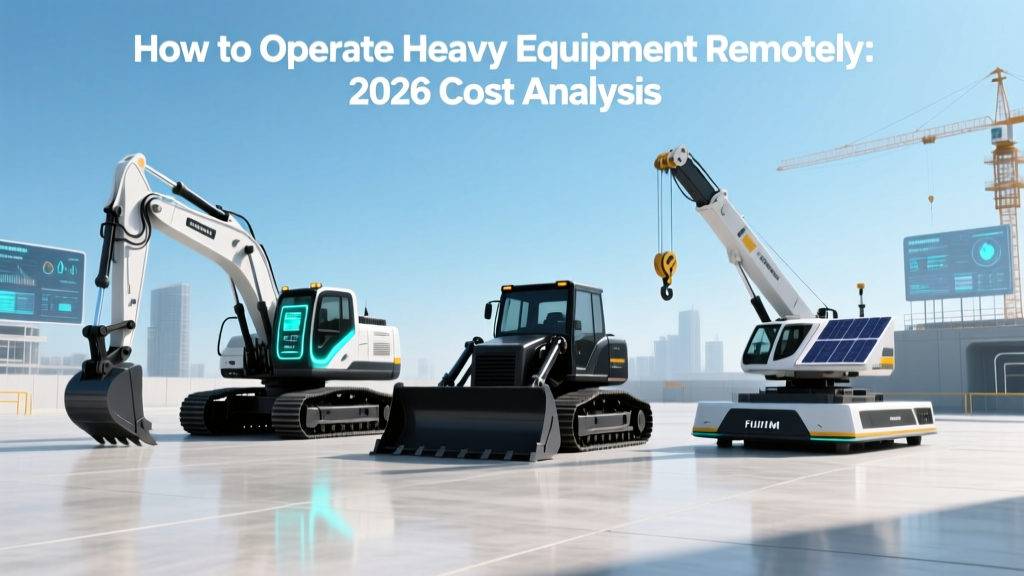
How to Operate Heavy Equipment Remotely: 2026 Cost Analysis
Budgeting for modular and remote-controlled heavy equipment. Analyze CapEx, OpEx, and training costs to learn how to operate heavy equipment safely.
The Financial Shift: Manual vs. Remote-Controlled Heavy Machinery
Transitioning from traditional cab-operated machinery to modular and remote-controlled systems fundamentally alters a construction firm's capital and operational expenditure models. When determining how to operate heavy equipment in high-risk zones like deep trenching, unstable quarry faces, or hazardous waste sites, site managers are increasingly turning to modular teleoperation kits and OEM-integrated remote consoles. However, the financial barrier to entry extends far beyond the initial hardware purchase. A comprehensive 2026 budget analysis must account for private network infrastructure, haptic feedback simulator training, latency mitigation hardware, and shifting insurance premiums.
Remote operation eliminates the physical operator from the machine's immediate vicinity, drastically reducing exposure to rollovers, trench collapses, and airborne silica. Yet, achieving a seamless teleoperation experience requires a meticulously planned budget that addresses both the machine-side modular retrofits and the command-center infrastructure.
Warning: The Hidden Cost of LatencyWhen budgeting for remote-controlled excavators or dozers, failing to allocate funds for local edge-computing servers and private 5G/LTE mesh networks will result in hydraulic stutter. If network latency exceeds 200 milliseconds, operators experience a disconnect between joystick input and machine response, leading to a 30-40% drop in cycle times and accelerated wear on hydraulic proportional valves.
Capital Expenditure (CapEx): Pricing Modular Retrofits vs. OEM Systems
The market for remote-controlled heavy equipment is currently split between factory-integrated OEM solutions and aftermarket modular retrofit kits. Your budget strategy depends heavily on fleet age and utilization rates.
OEM-Integrated Remote Systems
Manufacturers like Caterpillar and Komatsu offer factory-installed remote control architectures. Caterpillar's Cat Command technology for dozing and underground loading provides a fully integrated ecosystem. Purchasing a new Cat D11 dozer equipped with Command for Dozing adds approximately $280,000 to $350,000 to the base machine price. This CapEx includes the machine-side sensors, the proprietary remote operator console, and initial deployment calibration. While the upfront cost is steep, OEM systems benefit from native CAN-bus integration, ensuring zero voiding of powertrain warranties.
Aftermarket Modular Retrofit Kits
For fleets with existing, mid-life assets (e.g., 2018-2022 model year excavators), modular retrofit systems from companies like Built Robotics or Teleo offer a more capital-efficient route. These systems utilize external linear actuators bolted onto existing hydraulic pilot joysticks and external LiDAR/camera arrays. A complete modular retrofit kit for a 30-ton class excavator typically ranges from $120,000 to $180,000 per machine. Many firms opt for a hardware-as-a-service (HaaS) lease model, shifting this CapEx into a monthly OpEx line item of $8,500 to $12,000 per machine, which includes software updates and actuator maintenance.
| System Architecture | Example Technology | Estimated CapEx (Per Unit) | Monthly Lease / OpEx |
|---|---|---|---|
| OEM Integrated (Dozer) | Cat Command for Dozing | $280k - $350k premium | N/A (Typically Purchased) |
| Modular Retrofit (Excavator) | Built Robotics / Teleo | $120k - $180k | $8,500 - $12,000 |
| Teleoperation Console | Robotic Research / Ghost | $45,000 - $65,000 | $1,500 (Software Lic.) |
Network Infrastructure: The Backbone of Teleoperation
Learning how to operate heavy equipment remotely is impossible without a robust, low-latency communications backbone. Public cellular networks (even standard 5G) are entirely unsuited for heavy machinery teleoperation due to unpredictable jitter and packet loss in topographically complex job sites.
Budget planners must allocate funds for a Private LTE/5G network deployment. A temporary, mobile private network setup—utilizing ruggedized edge servers and portable mast antennas from providers like Ericsson or Nokia—costs between $75,000 and $140,000 for a 500-acre deployment. This includes the core network licensing, the physical mast hardware, and the CPE (Customer Premises Equipment) routers installed inside the equipment cabs. For long-term mining or quarry operations, permanent private 5G infrastructure can exceed $500,000 but reduces ongoing data transmission OpEx to near zero.
Training and Simulation: Preparing the Remote Operator
Operating a 40-ton machine via a screen and haptic joystick requires a completely different neurological and physical skill set than sitting in a vibrating cab with direct line-of-sight. Depth perception is compromised when relying on stereoscopic camera feeds, and operators must learn to interpret 2D screen data to judge bucket curl and trench depth.
Simulator Hardware and Software Budgets
To mitigate the learning curve and prevent costly machine damage during the transition phase, firms must invest in high-fidelity simulation. CM Labs Vortex Edge simulators are the industry standard for this transition. A complete Vortex simulator setup, including the physical operator seat, triple-monitor array, and force-feedback hydraulic joystick controllers, requires a CapEx investment of approximately $45,000 to $60,000 per station. Annual software licensing for specific machine modules (e.g., excavator, wheel loader, crane) adds $8,000 to $12,000 per year.
'Firms that skip simulator training and put operators directly onto remote consoles experience a 22% higher rate of hydraulic cylinder blowouts in the first 90 days due to aggressive, uncalibrated joystick inputs. The $50,000 simulator investment pays for itself by preventing a single major structural repair.'
— 2025 Heavy Equipment Fleet Utilization Report
Operational Expenditure (OpEx) and Insurance Shifts
While the CapEx for remote and modular equipment is substantial, the OpEx profile offers distinct advantages that accelerate ROI.
- Hazard Pay Elimination: Operators working in hazardous environments (e.g., slag handling, toxic waste remediation) typically command a 15-25% wage premium. Remote operation eliminates the physical hazard, allowing firms to standardize wage rates.
- Insurance Premium Reductions: Because the operator is physically separated from the machine, workers' compensation and heavy equipment liability insurers are increasingly offering premium discounts. Firms utilizing certified remote-controlled systems in trenching applications report a 12% to 18% reduction in annual policy premiums, as the risk of fatal crush injuries or trench cave-ins drops to near zero.
- Extended Shift Capabilities: Remote consoles can be located in centralized, climate-controlled command centers hundreds of miles away. This allows firms to hire operators in lower-cost-of-living regions and run continuous 24/7 shifts without paying for remote site housing or per diems.
Decision Framework: Allocating Your Teleoperation Budget
To determine if modular remote-control equipment fits your financial model, apply this step-by-step budget allocation framework:
- Audit the Hazard Premium: Calculate the exact dollar amount spent annually on hazard pay, specialized PPE, and high-risk insurance premiums for your most dangerous job sites.
- Evaluate Asset Age: If your fleet is under 4 years old, pursue OEM-integrated remote upgrades to preserve warranty integrity. If the fleet is older, allocate $150,000 per machine for modular aftermarket actuator kits.
- Fund the Network First: Before purchasing a single remote console, allocate $100,000 to conduct a site-specific RF (Radio Frequency) propagation study and deploy a private LTE edge network. Without this, the hardware is useless.
- Mandate Simulator Hours: Budget for 40 hours of Vortex simulator training per operator before they are cleared to move live iron. Factor in the $55,000 hardware cost and the lost billable hours during the training period.
Ultimately, understanding how to operate heavy equipment via remote and modular systems is less about the physical act of moving joysticks and more about architecting a resilient, low-latency digital infrastructure. By accurately forecasting the costs of private networks, simulator training, and modular retrofits, construction and mining firms can safely deploy remote fleets while maintaining strict control over their 2026 capital budgets.