Radio Controlled Heavy Equipment Toys in Road Construction Training
Learn how advanced radio controlled heavy equipment toys serve as tactile simulators for road construction equipment classification and operator training.
The Shift from Screen Simulators to Tactile RC Fleets
When developing a curriculum for road construction equipment classification and operator safety, vocational schools and heavy civil contractors have historically relied on two extremes: expensive virtual reality (VR) cab simulators or high-risk, high-cost seat time in actual $500,000 machinery. However, a rapidly growing pedagogical trend in 2026 bridges this gap using high-fidelity, large-scale models. While the consumer market categorizes them as radio controlled heavy equipment toys, trade schools and heavy highway contractors are repurposing 1:14 to 1:16 scale hydraulic and mechanical RC models as tactical training tools.
Unlike standard consumer-grade plastic models, professional-tier RC heavy equipment features functional hydraulic circuits, articulated steering, working differentials, and realistic material-handling capabilities. By integrating these models into a controlled 'sandbox' environment, training coordinators can teach equipment classification, spatial awareness, and basic kinematic logic without the liability, fuel costs, or wear-and-tear associated with full-sized iron.
Training Coordinator Tip: When sourcing units for a training fleet, bypass spring-loaded or 'R/C' branded toy store models. Look for 1:14 or 1:16 scale models with metal gears, independent channel control (minimum 6-8 channels), and functional PTO (Power Take-Off) systems. Brands like Bruder (for durable mechanical 1:16 models like the CAT 14H Motor Grader, approx. $130) or custom 1:14 hydraulic manufacturers (for functional asphalt pavers and excavators, ranging from $1,200 to $3,500) provide the necessary mechanical realism for adult vocational training.Road Construction Equipment Classification via Scale Models
The Federal Highway Administration (FHWA) outlines strict classifications for pavement construction and earthmoving equipment. Understanding the distinct roles, material flow dynamics, and operational limitations of these classes is the first hurdle for new operators. Using a scaled RC fleet allows instructors to physically demonstrate how different machine classes interact on a roadway cross-section.
| Equipment Class | Real-World Example | RC Training Equivalent | Primary Training Objective |
|---|---|---|---|
| Subgrade Preparation | Motor Graders, Dozers | 1:16 Articulated Grader (e.g., Bruder CAT 14H) | Blade articulation, moldboard pitch, circle side-shift, and maintaining cross-slope. |
| Base Course Compaction | Vibratory Soil Rollers | 1:14 Padfoot/Smooth Drum Roller with vibration motor | Overlapping pass patterns, understanding amplitude vs. frequency on scale aggregates. |
| Milling & Recycling | Cold Planers | 1:14 Scale Milling Machine with rotating drum | Depth control, conveyor swing management, and truck-loading coordination. |
| Paving Operations | Asphalt Pavers | 1:14 Hydraulic Paver (e.g., Tamiya or custom builds) | Hopper material flow, auger distribution, screed extension, and continuous headway. |
| Finish Compaction | Pneumatic & Static Rollers | 1:16 Pneumatic-Tired Roller | Ballast concepts, avoiding pickup on hot (scale) mats, and edge compaction. |
Designing the Scale Training Environment
To extract genuine pedagogical value from radio controlled heavy equipment toys, the training environment must mimic real-world physics as closely as possible. A standard sandbox filled with play sand is insufficient for teaching road construction equipment classification, as the material properties fail to simulate aggregate interlock or asphalt viscosity.
Aggregate and Material Scaling
Instructor-led programs are now utilizing specific scale aggregates to simulate real-world base courses. To simulate a standard 1.5-inch Type 2 aggregate base course, training facilities use 1/4-inch minus crushed gravel. This provides the necessary friction and interlock for RC vibratory rollers to demonstrate pass-pattern effectiveness. For milling and paving simulations, trainers use specialized hobby paving compounds—often a mix of Plaster of Paris, fine silica sand, and black iron oxide pigment—which cures to a semi-rigid state that can be 'milled' by brass-toothed scale drums and 'paved' over using heated screeds on high-end RC pavers.
Telemetry and Blind Spot Mapping
Modern vocational programs align with NCCER safety standards regarding heavy equipment blind spots. By mounting micro-FPV (First Person View) cameras on the cabs of 1:14 scale graders and pavers, instructors can project the 'operator's view' onto a monitor. Trainees take turns operating the RC units while ground personnel walk through the scale blind spots. This provides a visceral, real-time understanding of proximity hazards that static diagrams in a classroom simply cannot convey.
Safety Warning: While FPV cameras on RC models are excellent for teaching blind spot awareness, instructors must emphasize that scale models lack the severe acoustic and vibrational sensory overload of a real cab. Trainees must be taught to compensate for the 'sterile' operating environment of an RC model when transitioning to full-scale equipment.Curriculum Integration: A 3-Phase Approach
Integrating these models into an Associated General Contractors (AGC) aligned workforce development program requires a structured approach. Here is a proven 3-phase framework used by leading heavy civil training centers:
- Phase 1: Kinematic Familiarization (Week 1)
Trainees operate articulated vs. rigid-frame RC models in an open lot. The objective is to understand the difference in turning radii, tail-swing, and steering lag. Instructors evaluate the trainee's ability to track a straight line with a grader blade engaged in 1/4-inch gravel. - Phase 2: Material Flow Management (Week 2)
Focus shifts to the paver and milling machine classes. Trainees must coordinate an RC haul truck dumping into the paver hopper while maintaining a constant paving speed. This teaches the critical concept of 'continuous headway' and the consequences of stopping and starting the screed, which causes material segregation and mat irregularities. - Phase 3: Multi-Machine Traffic Control (Week 3)
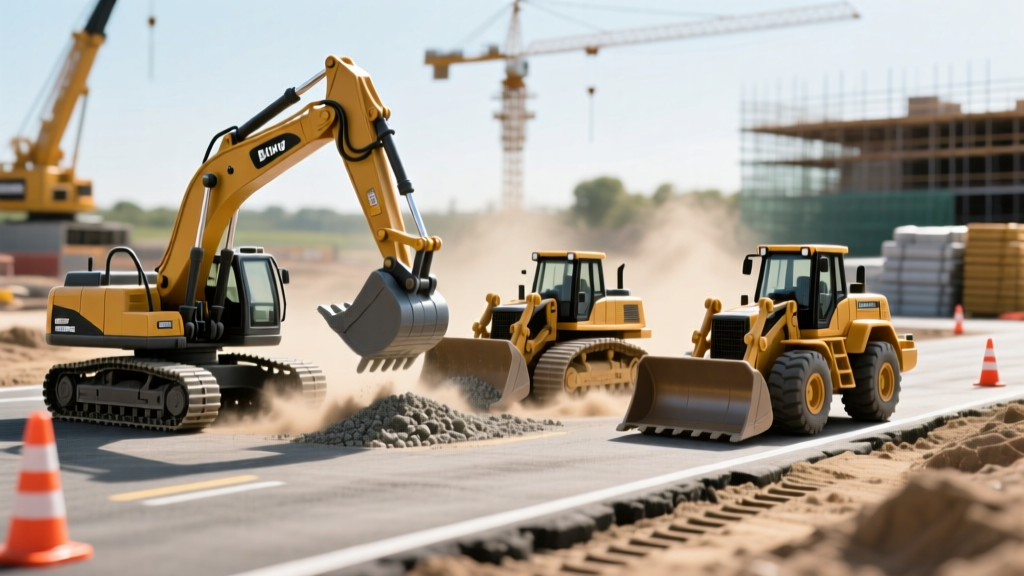
Trainees participate in a simulated road-widening project. Multiple operators must sequence their RC graders, rollers, and pavers within a coned-off 'work zone' while scale traffic (remote-controlled cars) passes. This tests spatial awareness, communication, and equipment classification knowledge under pressure.
Cost-Benefit Analysis: Seat Time vs. Sandbox Time
The financial argument for integrating high-end RC fleets into operator training is compelling when analyzing the overhead of traditional methods.
| Cost Factor | Full-Scale Equipment Training | RC Scale Fleet Training |
|---|---|---|
| Hourly Fuel / Energy Cost | $35 - $65 (Diesel) | $0.05 (LiPo Battery charging) |
| Insurance Liability | High (Property damage, rollover risk) | Negligible (Equipment replacement max $3,500) |
| Wear & Tear (Undercarriage/Ground Engaging Tools) | $15 - $25 per hour | $1 - $3 per hour (Brass gears, plastic tires) |
| Instructor-to-Student Ratio | 1:1 or 1:2 (Requires spotter) | 1:6 (One instructor can monitor multiple RC units) |
Recognizing the Limits of Scale Training
Despite the immense value in teaching equipment classification and spatial logic, training coordinators must recognize what radio controlled heavy equipment toys cannot simulate. Scale models do not replicate the G-forces experienced when an articulated haul truck navigates a 10% grade, nor do they simulate the hydraulic feedback and cab vibration that operators rely on to 'feel' the density of a compacted base course.
Furthermore, the reaction times of 2.4GHz RC servos are instantaneous, whereas full-scale hydraulic systems exhibit distinct lag, especially in cold weather conditions. Therefore, RC fleets should never replace final seat-time evaluations in real machinery. Instead, they serve as the ultimate pre-requisite filter—ensuring that by the time a trainee climbs into a $600,000 Volvo ABG paver or a Caterpillar 14M grader, they already possess an ingrained, tactile understanding of the machine's geometry, material flow dynamics, and classification role within the broader road construction ecosystem.