2026 LEGO Heavy Equipment Guide: Airport Ground Support Modeling
Discover how aviation planners use LEGO heavy equipment models to simulate airport ground support, optimize apron logistics, and train GSE crews.
The Role of LEGO Heavy Equipment in Aviation Logistics
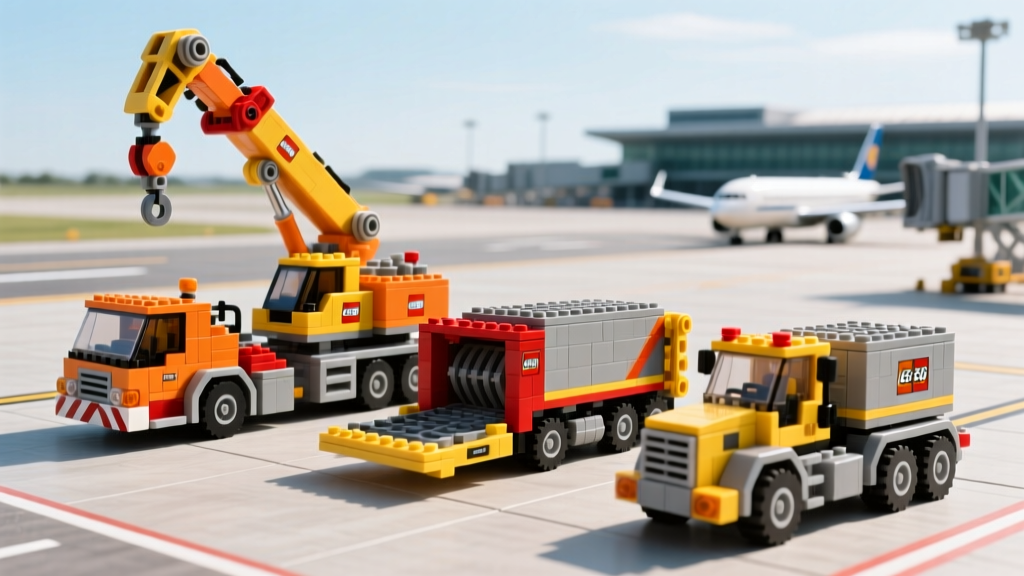
Airport aprons are high-stakes, spatially constrained environments where millions of dollars in aircraft and ground support equipment (GSE) intersect daily. For aviation logisticians, facility planners, and ground operations managers, optimizing turnaround times and preventing apron collisions requires rigorous spatial testing. While digital twins and CAD software are standard, physical scale modeling remains a critical tool for Lean management and Kaizen events. This is where advanced LEGO heavy equipment builds bridge the gap between abstract planning and tactile reality.
Using LEGO Technic and custom modular brick systems, industrial engineers create highly accurate 1:24 and 1:48 scale replicas of airport ground support heavy equipment. These models are not toys; they are functional, motorized physical simulations used to test pushback tractor maneuvering radii, belt loader staging sequences, and aircraft rescue and firefighting (ARFF) vehicle deployment paths. By integrating real-world GSE specifications into modular brick builds, facility managers can physically manipulate apron layouts to identify bottlenecks before pouring concrete or deploying million-dollar machinery.
💡 The 'Micro-Apron' Simulation Concept:In Lean aviation management, a 'Micro-Apron' is a 4x8 foot physical tabletop mapped with magnetic tape to represent aircraft stand clearances, safety zones, and GSE staging areas. Motorized LEGO heavy equipment models are driven through these zones to validate the IATA Ground Operations Manual (IGOM) safety clearances in real-time, allowing teams to spot blind spots and turning radius violations that 2D CAD often misses.
Real-World GSE vs. LEGO Counterparts: A Scale & Spec Matrix
Selecting the right LEGO heavy equipment sets or custom MOCs (My Own Creations) for airport simulation requires matching the brick model's mechanical capabilities to the real-world GSE it represents. Below is a procurement and specification matrix comparing standard airport heavy equipment with their functional LEGO equivalents for 2026 planning workshops.
| GSE Category | Real-World Benchmark | LEGO Equivalent / MOC | Scale | Est. Build Cost (2026) |
|---|---|---|---|---|
| Pushback Tractor | Goldhofer AST-1X (Towbarless) | Custom Technic MOC w/ Linear Actuators | 1:24 | $310 - $380 |
| Aircraft Belt Loader | TLD RB-12 | Modified Technic Hook Loader (42084 base) | 1:24 | $160 - $210 |
| ARFF Vehicle | Oshkosh Striker 3000 | LEGO Technic 42120 (Heavily Modded) | 1:24 | $140 - $180 |
| Cargo Loader | JBT Commander 15i | Custom Scissor-Lift Platform MOC | 1:48 | $250 - $300 |
Deep Dive: Engineering Functional GSE Models
To extract genuine value from LEGO heavy equipment in a professional setting, the models must replicate the kinematic constraints of their full-sized counterparts. Off-the-shelf sets rarely suffice; industrial planners rely on custom engineering.
1. Towbarless Pushback Tractors
Conventional pushback tractors use a towbar, but modern airports rely on towbarless tractors like the Goldhofer AST-1X, which cradle the aircraft's nose gear. Replicating this in LEGO requires high-torque gearing. Builders utilize dual LEGO Control+ L Motors (Part 22169) paired with a 1:40 worm gear reduction to generate enough torque to lift a 2kg scale aircraft model. The cradle lifting mechanism is best achieved using LEGO linear actuators (Part 61927), which provide the precise, slow-extension hydraulics necessary to simulate real-world gear engagement without snapping the axles under load.
2. Aircraft Belt Loaders and Conveyor Systems
Belt loaders must interface seamlessly with aircraft cargo doors at varying heights. When modeling a TLD RB-12 equivalent, the primary challenge is the conveyor belt. Industrial modelers bypass standard LEGO belts, opting instead for flexible tank tracks (Part 38799) driven by a Medium Motor. The tracks provide the necessary friction to move scale baggage containers (ULDs) up a 15-degree incline. The chassis must incorporate a scissor-lift mechanism using Technic liftarms (Part 32526) to simulate the hydraulic bed elevation required to reach the sills of both regional jets and wide-body aircraft.
3. Aircraft Rescue and Firefighting (ARFF) Vehicles
While the LEGO Technic 42120 Rescue Hovercraft provides an excellent baseline chassis for an Oshkosh Striker replica, the steering and suspension must be heavily modified. Real ARFF vehicles require independent suspension to maintain stability at 70+ mph on uneven aprons. Planners upgrade the model using double-wishbone suspension built from standard steering knuckles (Part 32060) and hard-spring shock absorbers. To simulate water cannon articulation, pneumatic cylinders (Part 41414) are integrated into the roof turret, allowing operators to physically test the cannon's field of view and blind spots relative to the vehicle's cab.
"Digital simulations tell you if a vehicle fits in a space. Physical LEGO heavy equipment models tell you if a human operator can actually see the clearance lines while executing a 90-degree turn into a cargo bay. The tactile feedback is irreplaceable for Kaizen events."
— Director of Apron Operations, Major European Hub (2025 Lean Aviation Summit)
Sourcing and Procurement Framework for Facility Planners
Procuring the necessary components for airport GSE modeling requires moving beyond retail toy stores. A structured supply chain is essential for maintaining a fleet of simulation models.
- Instruction Sets & Blueprints: Facility planners source custom GSE schematics from the Rebrickable Custom MOC Database. Searching for 'airport tractor' or 'scissor lift' yields professional-grade CAD-to-brick translations complete with part lists.
- Component Sourcing: Specific Technic pins, axles, and high-torque gears are procured via the BrickLink Secondary Market. Buying 'Lots' from specialized Technic sellers reduces per-part costs by up to 40% compared to retail.
- Motorization & Electronics: For 2026 builds, the LEGO Control+ ecosystem is preferred over legacy Power Functions due to Bluetooth integration, allowing planners to control GSE models via tablets while standing inside the physical 'Micro-Apron' simulation zone.
Implementation: Running a GSE Kaizen Apron Event
To integrate LEGO heavy equipment into your facility's operational planning, follow this structured 3-day Kaizen framework:
- Day 1: The Physical Digital Twin (Mapping)
Construct a 1:24 scale map of your target aircraft stand on a modular table. Use magnetic tape to mark the Equipment Restraint Area (ERA) and Aircraft Safety Envelope. Place your LEGO aircraft model in the center. - Day 2: The Turnaround Stress Test (Execution)
Run a simulated 45-minute narrow-body turnaround. Physically drive the LEGO pushback tractor, belt loaders, and fueling rigs to the aircraft. Use a stopwatch and scale measurements to track staging times. Record where the belt loader's turning radius forces it to encroach on the jetbridge clearance zone. - Day 3: Iteration and Standardization (Optimization)
Identify the spatial conflicts recorded on Day 2. Reconfigure the magnetic tape staging zones. Test the new layout with the models. Once optimized, translate the validated LEGO coordinates back into your CAD software to paint the actual apron markings and update the station's Standard Operating Procedures (SOPs).
✔ Define target scale (1:24 recommended for heavy equipment detail).
✔ Secure Control+ Motors and Linear Actuators for hydraulic simulation.
✔ Source flexible tracks for conveyor/belt loader mechanisms.
✔ Map physical tabletop to IATA safety clearance standards.
✔ Document model kinematics to validate CAD apron layouts.
By treating LEGO heavy equipment as a legitimate industrial engineering tool, airport ground support teams can drastically reduce apron incidents, optimize turnaround times, and train crews on spatial awareness in a zero-risk, highly engaging environment.