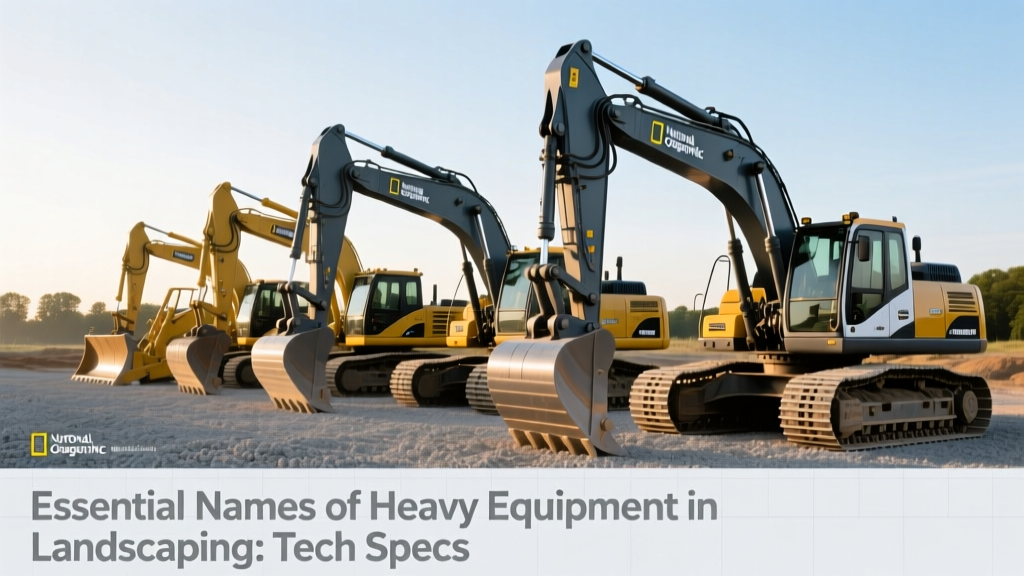
Essential Names of Heavy Equipment in Landscaping: Tech Specs
Explore the technical specifications, hydraulic flow rates, and mechanics behind the top names of heavy equipment used in modern landscaping.
Decoding the Core Names of Heavy Equipment in Landscaping
While the broad names of heavy equipment span from 100-ton mining haul trucks to massive asphalt pavers, the commercial landscaping and grounds maintenance sector relies on a highly specialized subset of compact machinery. In 2026, the emphasis in landscaping equipment engineering is on maximizing auxiliary hydraulic flow while minimizing ground pressure (PSI) to protect delicate turf and root systems. Understanding the technical architecture of these machines—specifically their hydrostatic transmissions, hydraulic pump displacements, and undercarriage geometry—is critical for fleet managers and owner-operators specifying equipment for high-end residential or commercial contracts.
The Ground Pressure Threshold
Healthy turf and uncompacted topsoil require a ground pressure of less than 4.5 PSI. Standard skid steers with pneumatic tires often exert 28 to 35 PSI, causing severe soil compaction that restricts water infiltration and root growth. Modern Compact Track Loaders (CTLs) utilize wide rubber tracks to distribute machine weight, routinely achieving 3.2 to 4.1 PSI. According to Penn State Extension research on soil compaction, keeping ground pressure below 5 PSI prevents the destruction of soil macropores, which is non-negotiable for elite landscaping projects.
Compact Track Loaders (CTLs): Hydraulics and Traction Specs
The CTL has largely replaced the rubber-tire skid steer in premium landscaping fleets. The current market leader, the Bobcat T770 (priced between $72,000 and $84,000 fully optioned in 2026), showcases the technical baseline for this category.
Standard vs. High-Flow Auxiliary Hydraulics
Landscaping attachments dictate hydraulic requirements. Standard flow systems (typically 18 to 23 Gallons Per Minute - GPM) are sufficient for 4-in-1 buckets, pallet forks, and standard earth augers. However, forestry mulchers, cold planers, and chain trenchers demand high-flow or super-high-flow circuits.
- Standard Flow (23.6 GPM @ 3,500 PSI): Adequate for 12-inch augers in loam, grapple rakes, and tiltrotators.
- High-Flow (36.6 GPM @ 5,000 PSI): Required for 60-inch rotary cutters and hydraulic breakers. The higher pressure (5,000 PSI) ensures the hydraulic motor maintains torque when encountering dense clay or embedded limestone.
- Super-High-Flow (42+ GPM): Reserved for heavy-duty mulching heads (e.g., Fecon or Denis Cimaf) processing 6-inch diameter hardwoods.
Technical Note: When running high-flow attachments, the hydraulic oil temperature must be monitored. Continuous mulching can push hydraulic fluid past 180°F (82°C), causing thermal degradation of ISO VG 46 fluid and accelerating pump wear. Machines equipped with auxiliary hydraulic coolers are mandatory for 8-hour continuous mulching shifts.
Mini Excavators: Breakout Force and Swing Torque Mechanics
For trenching irrigation lines, planting mature trees, and grading retention ponds, the mini excavator (1.5 to 5 metric tons) is the primary earthmoving tool. The Kubota KX040-4 (approx. $62,000 MSRP) represents the 4-ton class benchmark.
Calculating Breakout Force
Breakout force is the maximum force exerted at the bucket teeth when curling the bucket or pulling the stick (dipper) inward. The KX040-4 delivers a bucket breakout force of 8,542 lbs (37.9 kN). This metric is governed by the bore diameter of the bucket cylinder and the system relief valve setting (typically 3,800 to 4,200 PSI). In landscaping, high breakout force is essential for penetrating frost lines or fracturing compacted sub-base materials without relying on the machine's travel motors to 'crowd' the bucket, which causes severe undercarriage wear.
Swing Torque and Trenching Safety
Swing torque dictates how fast the upper structure (house) can rotate while carrying a loaded bucket up a slope. A higher swing torque (measured in lb-ft) allows the machine to swing fully loaded on a 15-degree lateral grade without stalling. When trenching near utilities, operators must adhere to strict safety shoring guidelines; OSHA excavation standards mandate protective systems for any trench deeper than 5 feet, a rule that directly impacts how mini excavators are positioned and utilized on tight residential job sites.
2026 Specification Matrix: Landscaping Equipment Comparison
| Specification | Bobcat T770 (CTL) | Kubota KX040-4 (Mini Ex) | Toro Dingo TX 1000 (CUL) |
|---|---|---|---|
| Operating Capacity / Weight | 2,900 lbs (ROC) | 9,095 lbs (Operating Wt) | 1,000 lbs (Tip Capacity) |
| Engine / Emissions | 74 HP / Tier 4 Final | 42.9 HP / Tier 4 Final | 24.9 HP / Tier 4 Final |
| Auxiliary Hydraulic Flow | 23.6 / 36.6 GPM (Opt) | 17.4 GPM | 16.4 GPM |
| Ground Pressure (PSI) | 3.9 PSI (Wide Track) | 4.8 PSI (Rubber Track) | 5.2 PSI (Turf Track) |
| Primary Landscaping Use | Mulching, Grading, Hardscape | Tree Planting, Irrigation Trenching | Turf Repair, Fencing, Tight Access |
| Approx. 2026 Base Price | $72,500 | $62,000 | $34,500 |
Powertrain Architecture: How Hydrostatic Drives Operate
Unlike automotive transmissions that use fixed gear ratios, landscaping heavy equipment relies on hydrostatic transmissions (HST). Understanding HST mechanics is vital for diagnosing performance loss and specifying the right drive system.
The Swashplate Mechanism
A hydrostatic drive consists of a variable-displacement hydraulic pump driven directly by the diesel engine, connected via high-pressure hoses to a fixed-displacement hydraulic motor at the wheels or tracks. The pump contains a swashplate—an angled internal disc. When the operator moves the joystick, the swashplate angle changes. A steeper angle increases the stroke of the internal pistons, pushing a higher volume of hydraulic fluid to the drive motor, which increases travel speed. When the swashplate is perfectly vertical (0 degrees), fluid displacement is zero, and the machine stops instantly, acting as a dynamic brake.
⚠️ Critical Failure Mode: Charge Pressure Loss
The main hydrostatic loop operates at 4,000+ PSI, but it requires a low-pressure 'charge pump' (usually 250 to 350 PSI) to push makeup fluid into the loop and prevent cavitation. If the charge pressure relief valve fails or the charge pump gear wears down, the main drive pump will starve for oil. This causes microscopic bubbles to form and violently collapse inside the pump (cavitation), destroying the bronze slipper pads within 40 to 50 hours of operation. Always verify charge pressure with a flow meter before authorizing a $6,000 main pump replacement.
Compact Utility Loaders (CULs): The Stand-On Revolution
The Compact Utility Loader (often referred to by the proprietary moniker 'Dingo' or 'Vermeer mini skid') fills the gap between manual labor and full-sized CTLs. The Toro TX 1000 utilizes a vertical-shaft diesel engine coupled to a gear pump. Because CULs lack a cab and seat, they bypass several ROPS (Roll-Over Protective Structure) weight requirements, allowing a machine weighing under 3,000 lbs to lift 1,000 lbs.
Attachment PTO Specs: CULs typically use flat-face hydraulic couplers (ISO 16028 standard) to prevent soil contamination when swapping attachments. The universal mounting plate on a CUL is scaled down from the standard skid steer quick-attach, measuring roughly 38 inches wide compared to the standard 60-inch Bob-Tach interface. This allows landscaping crews to utilize specialized narrow trenchers and sod-laying attachments that physically cannot fit on a larger machine.
Decision Framework: Specifying Your 2026 Fleet
Choosing the right equipment requires matching hydraulic output and ground pressure to your specific service offerings:
- Hardscaping & Retaining Walls: Spec a CTL with standard flow and pallet forks. Ground pressure is less critical on gravel/sand bases, but high ROC (Rated Operating Capacity) is required for moving 3,000 lb pallets of wet pavers.
- Land Clearing & Brush Management: Spec a CTL with the High-Flow option (35+ GPM), a 2-speed travel motor for rapid transit between cutting zones, and an enclosed cab with Level 2 FOPS (Falling Object Protective Structure) to protect against snapping branches.
- Irrigation & Drainage: Spec a 3.5 to 4-ton Mini Excavator. The independent boom swing and zero-tail-swing (ZTS) house design allow operators to trench parallel to fences and property lines without the rear counterweight striking obstacles.
By looking past the generic names of heavy equipment and analyzing the actual hydraulic schematics, relief valve settings, and ground pressure calculations, landscaping contractors can drastically reduce machine downtime, eliminate turf damage reparations, and maximize hourly billable output.