Heavy Equipment Scrapers vs Haul Trucks in Quarry Operations
Compare heavy equipment scrapers and haul trucks for quarry overburden removal. Analyze costs, cycle times, and alternatives for aggregate mining.
The Pre-Processing Phase: Moving Overburden to Feed the Plant
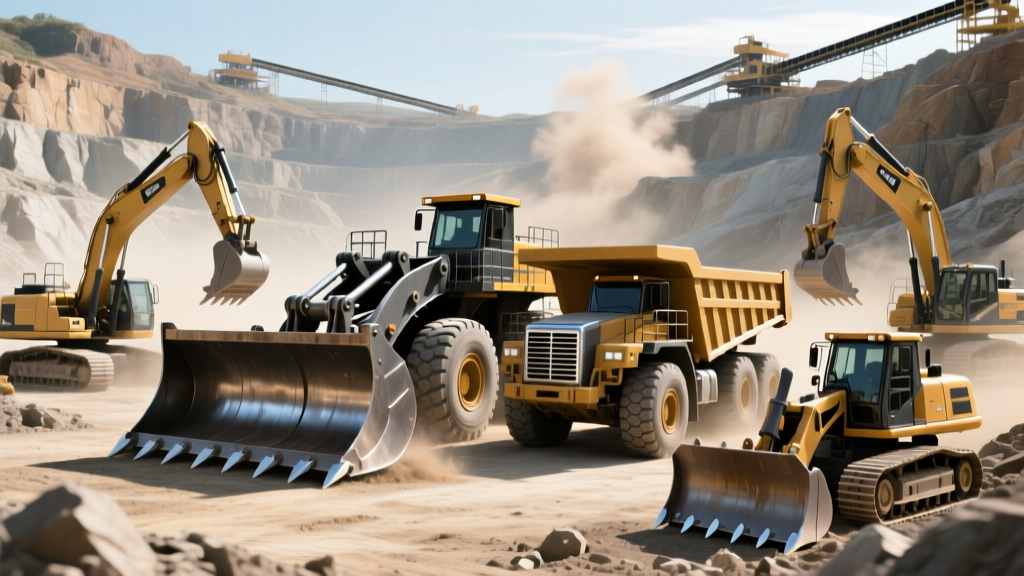
Before a single ton of limestone, granite, or sandstone enters the primary jaw crusher, aggregate producers face a massive logistical hurdle: overburden removal. Quarries are frequently capped with layers of topsoil, clay, shale, and weathered rock that must be stripped to access high-quality aggregate bedrock. While the processing plant relies on crushers and screens, the efficiency of the entire operation hinges on the earthmoving fleet that clears the site and hauls raw material to the primary hopper or stockpiles.
For decades, heavy equipment scrapers have been the backbone of this stripping phase. However, the rise of high-capacity Articulated Dump Trucks (ADTs) and rigid haul trucks has forced quarry managers to re-evaluate their fleets. Selecting the right mobile earthmoving equipment requires a rigorous analysis of haul distances, material shear strength, and cost-per-ton metrics.
Industry Context: According to data tracked by the USGS National Minerals Information Center, the U.S. produces over 2 billion tons of crushed stone and sand/gravel annually. The capital expenditure required to strip overburden for these reserves represents up to 30% of a quarry's total mobile fleet operating budget.Head-to-Head: Heavy Equipment Scrapers vs. Articulated Dump Trucks
The primary debate in modern quarry overburden removal centers on wheel tractor-scrapers versus ADTs. Scrapers are unique because they can self-load (cut, fill, and spread) without the need for a primary loading tool like a hydraulic excavator or wheel loader, provided ground conditions allow. ADTs, conversely, require a loading partner but offer superior traction in muddy, soft-footed conditions.
Fleet Specification Matrix
| Machine Type | Representative Model | Heaped Capacity | Net Power | Loading Requirement |
|---|---|---|---|---|
| Twin-Engine Scraper | Caterpillar 637K | 38 yd³ (29 m³) | 712 hp (531 kW) | Self-loading (Push-pull) |
| Elevating Scraper | Caterpillar 627K | 22 yd³ (17 m³) | 435 hp (324 kW) | Self-loading (Elevator) |
| Articulated Truck | Bell B45E | 41 yd³ (31 m³) | 430 hp (321 kW) | Excavator / Wheel Loader |
| Rigid Haul Truck | Volvo R100E | 65 yd³ (50 m³) | 949 hp (708 kW) | Large Hydraulic Shovel |
The 3,000-Foot Haul Rule: Where Scrapers Dominate
The defining metric for choosing heavy equipment scrapers over trucks in a quarry environment is the one-way haul distance. Scrapers are heavily penalized by rolling resistance and high tire wear on long hauls, but they excel in short-to-medium distances where their self-loading capability eliminates the bottleneck of a primary loading station.
The 3,000-Foot Threshold: In typical aggregate overburden (clay, sandy loam, soft shale), a fleet of twin-engine scrapers operating in a push-pull configuration will consistently beat a matched fleet of ADTs in cost-per-ton if the one-way haul distance is under 3,000 feet (914 meters). Beyond 4,000 feet, the cycle time of the scraper degrades, and ADTs or rigid trucks become the economically superior choice.
When stripping a new quarry bench, the haul distance starts at zero and expands as the cut progresses. Scrapers allow producers to maintain high production rates (up to 1,200 bank cubic yards per hour for a matched 637K fleet) during the critical early phases of site development without dedicating a $600,000 wheel loader to a single loading face.
CAPEX and OPEX Breakdown: The True Cost of Stripping
Quarry managers must look beyond the initial purchase price. The financial viability of heavy equipment scrapers versus trucks relies on a nuanced understanding of capital expenditure (CAPEX) and operating expenditure (OPEX).
Capital Expenditure (CAPEX)
- Scraper Fleet: A new twin-engine scraper (e.g., Cat 637K) costs between $1.3 million and $1.5 million. However, it requires no primary loading tool.
- ADT Fleet: A new 45-ton ADT (e.g., Bell B45E or Volvo A45G) costs approximately $650,000 to $800,000. But to match the production of a single scraper, you need a hydraulic excavator (e.g., Cat 374), adding another $800,000 to the initial capital outlay.
Operating Expenditure (OPEX)
Operating costs dictate the long-term survival of the fleet. Scrapers consume significantly more fuel per hour than ADTs due to the immense parasitic load of the twin engines and the hydraulic elevator or push-pull mechanisms. A 637K can burn 25 to 35 gallons of diesel per hour under heavy cutting loads. Furthermore, scraper tires (typically 33.25R29 or 37.25R35) are subjected to extreme cutting and tearing when operating in rocky overburden, leading to tire replacement costs that can exceed $40,000 per machine annually.
Conversely, ADTs operate at lower fuel burns (12 to 18 gallons per hour) and feature specialized flotation tires that resist sidewall tearing in soft quarry floors. However, the OPEX of an ADT fleet must include the fuel, maintenance, and operator cost of the dedicated loading excavator.
⚠️ Material Warning: Heavy equipment scrapers are highly susceptible to undercarriage and bowl wear when cutting in abrasive, high-silica sandstone or heavily fractured rock. If the quarry overburden contains large, unblasted boulders (>24 inches in diameter), self-loading scrapers will suffer catastrophic edge and apron damage. In these conditions, pre-ripping with a D10 dozer or switching to excavator-loaded trucks is mandatory.Alternatives to Mobile Scrapers: Conveyors and Shovels
While mobile earthmovers dominate quarry stripping, producers are increasingly looking at alternatives to reduce diesel dependency and lower carbon footprints, a trend heavily monitored by organizations like NIOSH Mining Research for both safety and environmental health.
Overland Conveyor Systems
For quarries with a fixed processing plant and a predictable, long-term stripping plan, overland conveyors represent the ultimate alternative to mobile scrapers and trucks. While the CAPEX for a 2-mile overland conveyor can exceed $3 million, the OPEX drops to pennies per ton. Conveyors eliminate the need for scraper operators, diesel fuel, and tire replacements. The trade-off is inflexibility; conveyors cannot easily follow a shifting, multi-directional overburden face.
Mass Excavation with Rigid Trucks
In massive, high-volume aggregate quarries (producing >5 million tons annually), the scale often outgrows both scrapers and ADTs. Producers deploy 100-ton rigid haul trucks (like the Cat 777G or Komatsu HD785) loaded by large cable shovels or front-end loaders. This setup is mandatory when the overburden transitions into hard, blasted rock that scrapers simply cannot penetrate.
Fleet Selection Decision Framework
To determine whether heavy equipment scrapers or an alternative system is right for your aggregate operation, run your site parameters through this four-step decision matrix:
- Analyze Material Shear Strength: Conduct a geotechnical bore of the overburden. If the material is predominantly cohesive clay, sandy loam, or soft shale with a shear strength below 3,000 psi, scrapers are viable. If it is highly cemented or rocky, discard scrapers and opt for excavators and trucks.
- Map the Haul Profile: Calculate the average and maximum one-way haul distances. If 80% of the stripping haul is under 3,000 feet with minimal adverse grades (under 4%), scrapers will yield the lowest cost-per-ton.
- Evaluate Floor Conditions: Assess the quarry floor's bearing capacity during wet seasons. If the clay overburden turns to deep mud, twin-engine scrapers will bog down and require dozer pushing, destroying cycle times. ADTs with 6x6 drivetrains and central tire inflation systems (CTIS) are the required alternative here.
- Calculate Fleet Utilization: Scrapers require vast, open areas to maneuver and turn. If your quarry is constrained by property lines, environmental buffers, or steep highwalls, the tight turning radius and articulation of an ADT will outperform the wide sweeping arcs required by a scraper fleet.
Final Operational Verdict
Heavy equipment scrapers remain an unmatched force for high-speed, low-cost overburden removal in medium-haul, soft-material quarry environments. By eliminating the loading bottleneck, a well-managed scraper fleet can strip millions of cubic yards of topsoil and weathered rock, ensuring the primary aggregate crusher remains consistently fed. However, producers must rigorously monitor haul distances and material abrasiveness; pushing a scraper fleet beyond its geometric and mechanical limits will rapidly erode the cost-per-ton advantage, making ADTs or conveyor systems the smarter long-term investment.