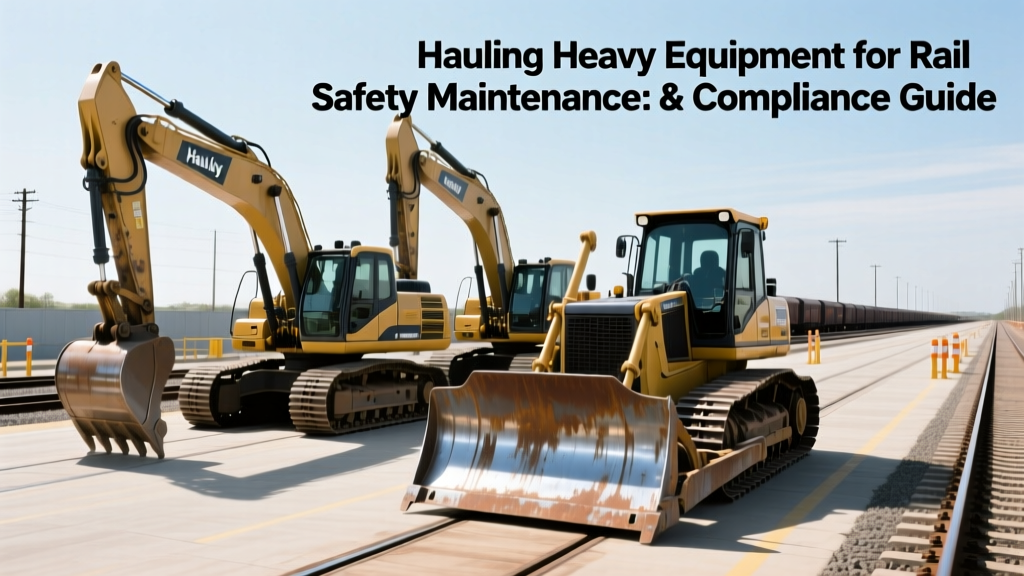
Hauling Heavy Equipment for Rail Maintenance: Safety & Compliance Guide
Master the safety standards and compliance rules for hauling heavy equipment in railroad maintenance, including MOW transport regulations and load securement.
The Jurisdictional Divide: FMCSA vs. FRA Compliance
Transporting railroad Maintenance of Way (MOW) equipment requires navigating a complex regulatory intersection. When hauling heavy equipment like track tampers, ballast regulators, and rail grinders on public highways via lowboy trailers, operators fall under the Federal Motor Carrier Safety Administration (FMCSA) cargo securement rules (49 CFR Part 393). However, the moment that same equipment engages its hi-rail gear and enters the railroad right-of-way, jurisdiction shifts to the Federal Railroad Administration (FRA) under 49 CFR Part 214 (Roadway Worker Protection).
⚠️ Compliance Warning: A common failure point in MOW logistics is assuming highway-compliant tie-downs satisfy FRA on-track movement standards. FRA requires independent secondary retention for hi-rail vehicles to prevent catastrophic derailments if primary hydraulic lockouts fail. Always verify dual-compliance before dispatch.MOW Equipment Weight Profiles and Transport Classifications
Railroad maintenance machinery is uniquely dense, often featuring concentrated center-of-gravity loads due to heavy steel tamping banks, grinding stones, and hydraulic power packs. Standard over-the-road freight securement math often fails when applied to MOW fleets. Below is a breakdown of common MOW equipment and the specific transport parameters required for safe highway transit.
| Equipment Type | Example Model | Operating Weight | Trailer Requirement | Securement Edge Case |
|---|---|---|---|---|
| Continuous Action Tamper | Plasser & Theurer 09-3X | ~115,000 lbs | Multi-axle RGN Lowboy | Tamping banks must be mechanically pinned; hydraulic drift risk. |
| Ballast Regulator | Harsco Track Technologies | ~65,000 lbs | Standard 3-axle Lowboy | Plow wings must be folded and cross-chained to prevent vibration deployment. |
| Rail Grinder | Loram C44 Series | ~250,000+ lbs | Specialized Heavy Haul / Rail Transit | Rarely hauled by road; requires Class 1 railroad clearance and rail transport. |
| Spike Puller | Nordco Auto-Puller | ~42,000 lbs | Flatbed or Step-Deck | High ground clearance requires specific ramp angles for loading. |
Load Securement Standards for Hauling Heavy Equipment
Under FMCSA cargo securement regulations, the aggregate Working Load Limit (WLL) of all tie-downs must equal at least 50% of the cargo's total weight. However, when hauling heavy equipment with specialized MOW attachments, the calculation requires precise attention to indirect versus direct tie-downs.
Chain Grade and WLL Requirements
For MOW machinery exceeding 80,000 lbs, standard Grade 70 transport chain is often insufficient for the primary direct tie-downs due to the sheer number of chains required. Upgrading to Grade 80 or Grade 100 alloy chains reduces the number of securement points while maintaining compliance and minimizing deck clutter.
- 3/8" Grade 70 Chain: 6,600 lbs WLL. (Requires minimum 8 direct tie-downs for a 100,000 lb tamper).
- 1/2" Grade 80 Chain: 11,300 lbs WLL. (Requires minimum 5 direct tie-downs for a 100,000 lb tamper).
- 5/8" Grade 100 Chain: 18,100 lbs WLL. (Requires minimum 3 direct tie-downs for a 100,000 lb tamper).
Hi-Rail vs. Flatbed: Transport Decision Matrix
Deciding whether to haul a piece of MOW equipment via highway flatbed or mobilize it via its own hi-rail capabilities on the tracks depends on distance, track authority, and FRA compliance. The 2026 FRA enforcement directives heavily penalize operators who use hi-rail vehicles for long-distance transit over mainline tracks without proper Class 1 railroad clearance.
| Factor | Highway Flatbed Transport | Hi-Rail On-Track Mobilization |
|---|---|---|
| Primary Jurisdiction | FMCSA / DOT | FRA / Host Railroad |
| Speed Limit | 65-75 MPH (Highway) | 10-25 MPH (Restricted Track Speed) |
| Inspection Requirement | Pre-trip DOT inspection (Brakes, lights, securement) | Daily FRA Part 214 hi-rail gear inspection & lockout test |
| Best Use Case | Inter-state mobilization, moving non-hi-rail attachments | Local work block transit, moving between adjacent project limits |
| Major Risk Factor | Load shift during cornering, bridge height strikes | Hi-rail gear deployment at grade crossings, derailment |
Step-by-Step Pre-Haul Compliance Checklist
To survive a CVSA North American Standard Inspection while hauling heavy equipment for rail projects, dispatchers and drivers must execute the following protocol before leaving the staging yard:
- Hydraulic Lockout Verification: Ensure all hydraulic lockout valves on tamping banks, plow wings, and grinder heads are engaged. Physically insert mechanical safety pins where provided by the OEM.
- Center of Gravity Calculation: Measure the deck height and load height. MOW equipment often exceeds 13'6". Obtain oversized load permits if the total height exceeds state thresholds.
- Track Debris Sweeping: Sweep the trailer deck. Ballast stones trapped under steel MOW wheels act as roller bearings, completely negating static friction and causing load shift during braking.
- Indirect Tie-Down Tensioning: If using indirect tie-downs (chains passing over the equipment), ensure the tension is equalized on both sides to prevent lateral pulling that can bend hi-rail guide wheel arms.
- Clearance Check of Protrusions: MOW machines feature delicate sensor arrays and GPS masts. Verify that chain binders and straps do not crush or bend these protruding components during transit.
Frequently Asked Questions
Do I need a CDL to operate a hi-rail vehicle on the tracks?
No. When a vehicle is operating exclusively on railroad tracks under the authority of the host railroad, it is considered a roadway maintenance machine, not a commercial motor vehicle. However, the operator must be certified under the host railroad's Roadway Worker Protection (RWP) program and possess a valid hi-rail operator qualification card.
How do I secure a machine with no designated tie-down points?
Many older MOW machines lack OEM-rated D-rings. In these cases, FMCSA regulations permit chaining around the axle housings or structural frame members, provided you use edge protectors to prevent the sharp steel edges from shearing the chain links under tension. Never wrap chains around hydraulic cylinders or pivot pins.
What is the penalty for FRA securement violations?
FRA civil penalties for safety violations, including improper securement of on-track maintenance equipment, can exceed $100,000 per violation in the 2026 penalty schedule. If a securement failure results in a derailment or highway grade crossing incident, criminal liability and gross negligence claims can be pursued against the contracting maintenance firm.