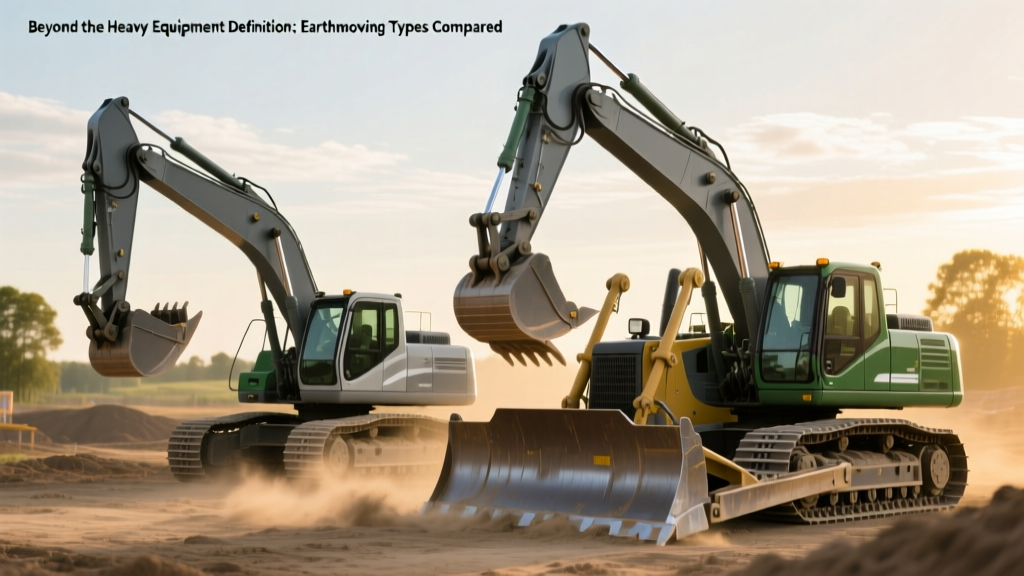
Beyond the Heavy Equipment Definition: Earthmoving Types Compared
Explore the true heavy equipment definition by comparing earthmoving types, applications, and cost-effective alternatives for your construction projects.
Decoding the Heavy Equipment Definition for Earthmoving
When procurement officers and site superintendents discuss fleet acquisition, the heavy equipment definition often becomes a point of friction. Legally, the Occupational Safety and Health Administration (OSHA) outlines equipment standards under regulations like 1926.600, focusing broadly on safety, rollover protection (ROPS), and operator visibility. However, from a practical fleet management perspective, the heavy equipment definition is strictly tied to logistics and transport: any tracked or wheeled machine exceeding 10,000 pounds that requires a Commercial Driver’s License (CDL) and specialized lowboy trailers for mobilization.
The Fleet Manager's Rule of Thumb: If it requires a Class 8 truck and a multi-axle trailer to move between job sites, it falls under the operational heavy equipment definition. This distinction is critical when calculating mobilization costs, which can consume up to 12% of a machine's annual operating budget.
Understanding this boundary is the first step in evaluating earthmoving alternatives. Choosing between a 21-ton excavator and a versatile backhoe loader isn't just about digging depth; it is a complex calculation involving hourly fuel burn, undercarriage wear, and specific soil mechanics. Below, we break down the primary earthmoving categories and analyze the most viable alternatives for modern construction sites.
The Earthmoving Comparison Matrix: Specs and Applications
To move beyond surface-level generalizations, we must look at the hard data. The following matrix compares the flagship models across the four primary earthmoving categories, utilizing current 2025/2026 Tier 4 Final / Stage V emissions-compliant specifications.
| Machine Category | Flagship Model Reference | Operating Weight | Avg. Fuel Burn (gal/hr) | Primary Application |
|---|---|---|---|---|
| Hydraulic Excavator | Caterpillar 320 | 44,500 lbs | 5.2 - 6.1 | Deep trenching, mass excavation, heavy lifting |
| Crawler Dozer | Komatsu D65EX-18 | 45,800 lbs | 6.5 - 7.8 | Bulk material pushing, site clearing, grading |
| Motor Grader | John Deere 872 | 42,100 lbs | 5.8 - 6.9 | Fine grading, road base preparation, snow removal |
| Wheel Loader | Volvo L120H | 41,500 lbs | 5.5 - 6.4 | Truck loading, stockpiling, short-distance carry |
Head-to-Head Alternatives Analysis: Excavator vs. Backhoe Loader
The most common dilemma in mid-sized earthmoving projects is choosing between a dedicated 20-ton class hydraulic excavator and a Tractor Loader Backhoe (TLB). While both machines dig, their operational profiles and cost structures are vastly different.
The 21-Ton Excavator (e.g., Komatsu PC210LC-11)
A 21-ton excavator is a dedicated digging and lifting platform. With a dig depth exceeding 21 feet and a swing torque that allows for continuous 360-degree cycling, it is unmatched for volume. However, the EPA-regulated diesel engines in this class require strict adherence to DEF (Diesel Exhaust Fluid) maintenance, and the machine's footprint is massive.
- Base Acquisition Cost: $260,000 - $310,000
- Mobilization: Requires a 3-axle lowboy trailer and a Class 8 tractor. Transport costs average $3.50 to $5.00 per mile.
- Production Rate: 120-150 cubic yards per hour in medium clay.
The Tractor Loader Backhoe (e.g., Caterpillar 430)
The TLB is the ultimate utility alternative. It sacrifices raw digging depth (typically maxing out around 14 feet) for unmatched versatility. The front loader bucket allows for backfilling, material handling, and site cleanup without needing a secondary wheel loader.
- Base Acquisition Cost: $115,000 - $145,000
- Mobilization: Can be transported on a standard heavy-duty equipment trailer pulled by a Class 6 or 7 truck, drastically reducing transport costs.
- Production Rate: 60-80 cubic yards per hour in medium clay.
The Hidden Cost Factor: Undercarriage vs. Tires
When running an alternatives analysis, fleet managers often overlook ground-engaging wear. A 21-ton excavator relies on a steel tracked undercarriage. If operating in highly abrasive rock or demolition debris, replacing the chains, rollers, and sprockets on a machine like the PC210LC-11 will cost between $14,000 and $18,000 every 4,000 to 5,000 hours. Conversely, a backhoe loader operates on heavy-duty pneumatic tires. A full set of four R1/R4 industrial tires costs approximately $4,500 to $6,000, making the backhoe significantly cheaper to maintain on paved or finished surfaces.
Fleet Sizing Decision Framework
Do not default to the largest machine available. Use this structural framework to determine the correct earthmoving alternative for your specific site conditions.
Site-Specific Earthmoving Decision Tree
1. Evaluate the Dig Depth & Volume Requirement:
- If trenching deeper than 12 feet OR moving >1,000 cubic yards daily ➔ Select 20-Ton+ Excavator.
- If trenching under 10 feet for utilities AND requiring backfill capability ➔ Select Backhoe Loader.
2. Assess Ground Conditions & Surface Finish:
- If operating on finished asphalt, concrete, or sensitive landscaping ➔ Select Wheeled Alternatives (Backhoe or Wheel Loader) to prevent surface destruction.
- If operating in deep mud, high-water tables, or steep inclines (>30%) ➔ Select Tracked Alternatives (Excavator or Dozer) for superior ground pressure distribution.
3. Calculate Mobilization Frequency:
- If the machine moves to a new site more than twice a week ➔ Select lighter, wheeled alternatives to avoid $1,500+ per-move lowboy transport fees.
Emerging Alternatives: Electric and Hybrid Earthmovers
The traditional heavy equipment definition is expanding to include zero-emission machinery, driven by stringent urban air quality mandates and indoor demolition requirements. Compact electric earthmovers, such as the Volvo ECR25 Electric, are no longer just conceptual prototypes; they are viable alternatives for specific use cases.
The ECR25 Electric features a 48 kWh lithium-ion battery package, providing 4 to 8 hours of active runtime depending on the hydraulic load. While the upfront capital expenditure carries a premium of roughly $55,000 to $70,000 over its diesel counterpart, the operational savings are substantial. Eliminating diesel fuel, DEF, engine oil, and air filters reduces daily operating costs by up to 65%. Furthermore, electric excavators produce zero particulate matter, a critical factor when working near occupied buildings or in enclosed spaces where NIOSH silica dust regulations and exhaust ventilation constraints apply.
However, for mass earthmoving and heavy grading, battery density remains a limiting factor. A 20-ton electric excavator would require a battery pack weighing several tons, severely impacting payload capacity and machine balance. Therefore, the current alternative strategy for heavy-duty applications involves hybrid systems—such as parallel hybrid wheel loaders that capture swing and braking energy to assist the diesel engine during peak hydraulic demand, reducing fuel burn by 15% to 20% without sacrificing runtime.
Strategic Procurement Takeaways
Redefining your fleet based on a practical heavy equipment definition requires looking past the brochure specifications. A 21-ton excavator will always out-dig a backhoe loader, but if your project involves shallow utility trenches across multiple dispersed city blocks, the transport logistics and undercarriage wear of the excavator will destroy your profit margins. Align your equipment choices with the specific cubic-yardage requirements, surface conditions, and mobilization realities of your site to maximize return on invested capital.