Safety Compliance When You Drive Heavy Equipment: Ag vs Construction
Compare Ag and construction safety standards. Learn the legal requirements, ROPS rules, and compliance steps when you drive heavy equipment across sectors.
The Regulatory Friction of Mixed-Sector Fleets
Fleet managers who oversee mixed-use machinery face a severe compliance trap. The moment you drive heavy equipment originally designated for agricultural use onto a commercial construction site, the regulatory jurisdiction shifts instantly. What is legally compliant in a soybean field can trigger thousands of dollars in fines on a commercial grading site. Understanding the precise boundary between agricultural standards (governed by ASABE) and construction standards (enforced by OSHA and ANSI) is not just a matter of best practices; it is a critical liability shield.
⚠️ Liability Warning: Taking an agricultural tractor onto a commercial construction site immediately shifts regulatory oversight to OSHA 1926 enforcement. If the machine lacks a certified FOPS (Falling Object Protective Structure) and the operator is not wearing a hard hat, your company faces fines exceeding $16,100 per serious violation.The Regulatory Divide: ASABE vs. OSHA/ANSI
Agricultural equipment design is heavily influenced by the American Society of Agricultural and Biological Engineers (ASABE), which prioritizes operator visibility, soil compaction reduction, and slow-moving vehicle (SMV) roadway transit. Conversely, construction equipment falls under the strict purview of OSHA 1926 Subpart O and ANSI/ITSDF standards, which prioritize impact resistance, falling object protection, and strict operator certification.
| Safety Feature | Agricultural (ASABE / ANSI/ASAE) | Construction (OSHA / ANSI) |
|---|---|---|
| ROPS Standard | ANSI/ASAE S318 (Focus on lateral roll on soft soil) | OSHA 1926.1002 (Dynamic testing for rocky/uneven terrain) |
| FOPS Requirement | Rarely required; optional on high-clearance sprayers | Mandatory (ANSI/ITSDF B56.1) for excavators and loaders |
| Seatbelt Interlocks | Operator dependent; manual engagement common | Mandatory electronic interlocks preventing boom operation |
| Cab Pressurization | ISO 11173 (Focus on pesticide/dust filtration) | ISO 10263 (Focus on silica dust and heavy particulate) |
Machine-Specific Safety Profiles: Ag Tractors vs. Construction Loaders
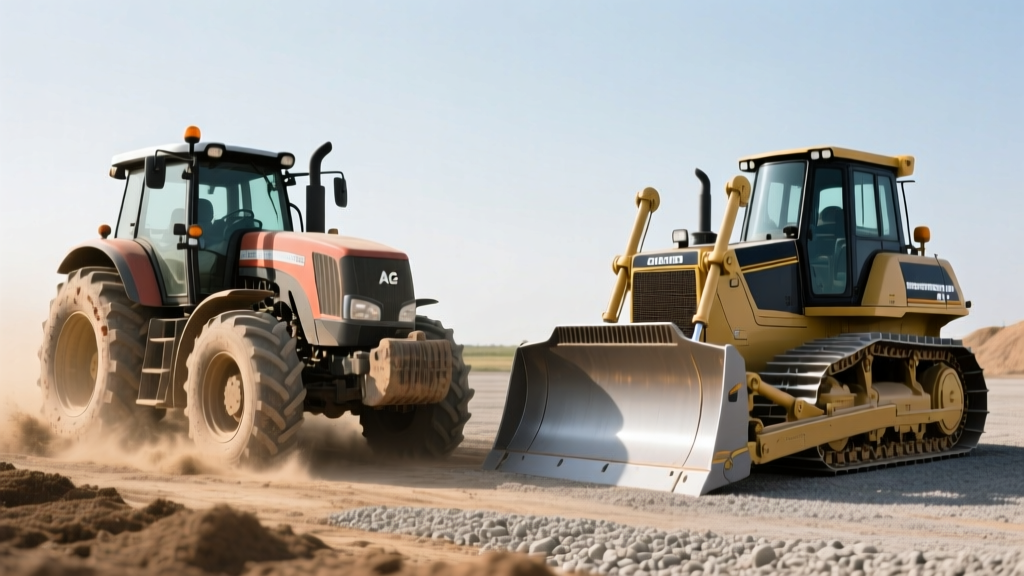
To understand how these standards manifest in the real world, compare two common heavy machines: the John Deere 8R 410 (Agricultural) and the Caterpillar 966 GC Wheel Loader (Construction). When you drive heavy equipment like the 8R 410, the cab is engineered for 360-degree visibility to monitor planting implements, featuring expansive glass that inherently compromises structural integrity against falling objects. The ROPS is designed to protect the operator if the 12-ton tractor tips into an irrigation ditch.
In contrast, the Caterpillar 966 GC features a heavily reinforced steel cab with integrated FOPS mesh. The glass area is minimized and protected by heavy-duty grating. The OSHA-mandated 1926.602 standard requires that earthmoving equipment possess a braking system capable of holding the machine fully loaded on a 15% grade, a specification that agricultural tractors—designed for flat or gently rolling topography—frequently fail to meet when pushed to their payload limits on a gravel embankment.
"The most common compliance failure in mixed fleets is assuming an agricultural ROPS rating satisfies construction FOPS requirements. A falling rock on a grading site exerts entirely different kinetic energy than a tractor rolling on soft loam. Cross-pollinating these machines without structural retrofitting is a catastrophic liability."
— Adapted from safety audit guidelines published by the National Education Center for Agricultural Safety
Cab Pressurization and HVAC Compliance
A frequently overlooked aspect of safety compliance when you drive heavy equipment across sector lines is cabin air quality. Modern agricultural tractors utilize positive-pressure HVAC systems compliant with ISO 11173, designed specifically to keep out crop dust and chemical aerosols during spraying operations. However, these systems are not rated for the heavy silica dust generated during commercial concrete demolition or trenching.
The Silica Dust Hazard
If an agricultural tractor is used to pull a scraper on a commercial site, the operator is exposed to respirable crystalline silica. OSHA's silica standard (29 CFR 1926.1153) requires engineering controls, which in heavy equipment means a cab pressurization system compliant with ISO 10263, equipped with specific HEPA-grade pre-filters. Retrofitting an ag cab with a construction-grade silica filtration kit typically costs between $2,800 and $4,500, but failing to do so can result in severe OSHA citations and long-term workers' compensation claims.
Certification and Licensing: Who is Legal to Operate?
The legal requirements for the operator change just as drastically as the machine requirements.
- Agricultural Exemption: In most jurisdictions, farm employees operating agricultural tractors on private land or transiting directly between farm parcels are exempt from Commercial Driver's License (CDL) requirements and do not require formalized, documented OSHA certification.
- Construction Mandate: The moment that same employee uses the tractor for commercial earthmoving, they must meet OSHA 1926.1427 (or equivalent earthmoving) operator evaluation standards. This requires a documented, site-specific practical evaluation by a competent person.
- Public Roadway Transit: If the route between the farm and the commercial site requires traveling on a public highway, the operator must adhere to state-specific Department of Transportation (DOT) rules regarding oversize loads and Slow Moving Vehicle (SMV) emblems.
Roadway Transit Compliance: The Overlap Zone
Transiting heavy machinery on public roads is where Ag and Construction standards collide. Agricultural equipment relies on the ASAE S276 standard for the Slow-Moving Vehicle (SMV) emblem—a fluorescent orange triangle with a dark red border. This emblem is legally required for any vehicle designed to travel at 25 mph or less.
However, construction equipment moving between sites often requires pilot cars, specific amber strobe lighting arrays, and temporary permits if the width exceeds 8.5 feet. An agricultural tractor pulling a 12-foot wide tiller on a county road may be legally protected under agricultural transit exemptions, but if that same tractor is pulling a commercial construction scraper, local DOT authorities will treat it as an unpermitted oversize commercial load, resulting in immediate impoundment and fines.
Actionable Compliance Checklist for Fleet Managers
Before authorizing an operator to drive heavy equipment outside of its primary designated sector, run this mandatory compliance matrix:
- Verify FOPS/ROPS Certification Plates: Locate the physical metal stamping on the cab pillars. Ensure the rating matches the kinetic energy requirements of the new site environment.
- Audit the HVAC Filters: Check the particulate rating. If moving from Ag to Construction, upgrade to ISO 10263 compliant silica filters.
- Inspect Seatbelt Interlocks: Bypassing a broken seatbelt switch with a zip-tie is an automatic $16,000+ OSHA fine on a commercial site. Ensure electronic interlocks are fully functional.
- Update Lighting Arrays: Remove agricultural SMV emblems if the machine will be operating in active construction traffic zones where high-intensity amber LED beacons are required by the general contractor's site safety plan.
- Document Operator Evaluation: File a site-specific operator competency sign-off sheet, regardless of the operator's years of experience in the agricultural sector.
Cross-sector equipment utilization is a highly efficient way to maximize fleet ROI, but it demands rigorous attention to the distinct safety frameworks governing each industry. By respecting the engineering and legal boundaries between ASABE and OSHA standards, fleet managers can protect their operators, their balance sheets, and their corporate liability profiles.