Demolition Costs: Keys for Heavy Equipment Budget Planning
Analyze 2026 demolition equipment costs, attachment pricing, and the financial keys for heavy equipment budget planning to maximize fleet ROI.
The True Cost of Demolition Fleet Procurement
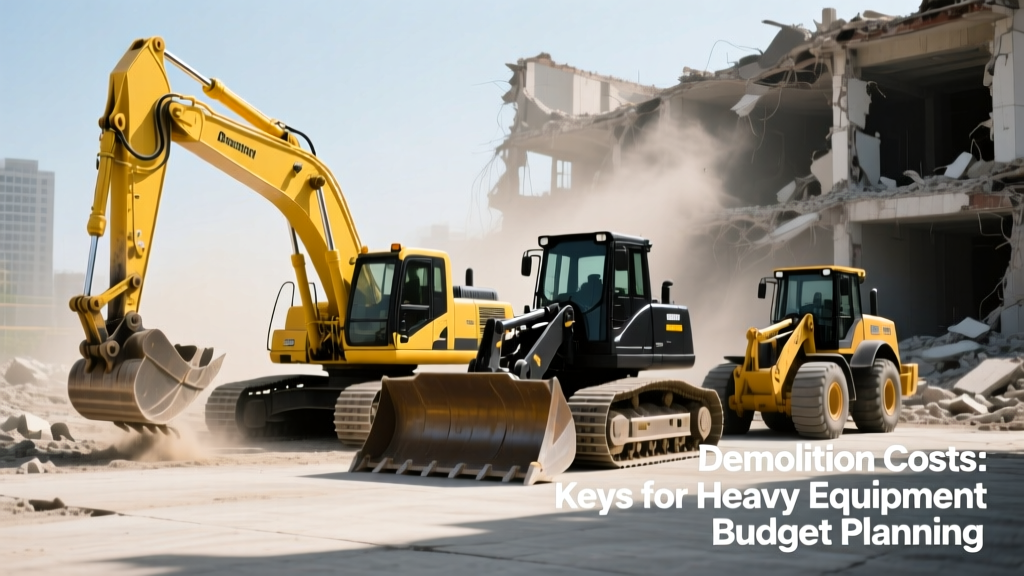
Demolition is arguably the most punishing environment for construction machinery. Unlike earthmoving, where abrasion is the primary enemy, demolition subjects base carriers and attachments to extreme shock loads, high-velocity debris, and severe torsional stress. When evaluating the financial keys for heavy equipment deployment in this sector, fleet managers must look far beyond the sticker price of the base excavator. A miscalculated budget that neglects auxiliary hydraulic requirements, quick-coupler inefficiencies, or accelerated wear-part consumption will rapidly erode project margins.
In 2026, the capital expenditure (CapEx) for a fully rigged, mid-sized demolition fleet (centered around a 35-ton to 50-ton carrier) requires a nuanced understanding of total cost of ownership (TCO). According to data tracked by industry equipment analysts, attachment and ground-engaging tool (GET) replacements now account for up to 22% of the total operating budget on high-volume concrete processing sites, up from 18% just three years ago due to metallurgical supply chain shifts.
⚠️ The 60/40 Budget Allocation Rule
For primary demolition machines, a healthy procurement budget should allocate roughly 60% to the base carrier and 40% to specialized attachments, quick couplers, and initial wear-part inventories. Underfunding the attachment side forces operators to use undersized tools, leading to carrier engine lugging, hydraulic overheating, and premature structural fatigue on the excavator boom.
Base Carrier vs. Attachment Capital Allocation
The 35-ton class excavator remains the undisputed workhorse of mid-scale commercial demolition. Models like the Caterpillar 336 and Komatsu PC360LC-11 offer the optimal balance of transportability and breakout force. In the current market, a new 35-ton carrier configured for demolition (including factory-installed high-flow auxiliary hydraulics, heavy-duty counterweights, and FOPS/ROPS cab guarding) ranges from $385,000 to $430,000.
However, the carrier is merely a power delivery system. The actual demolition work is executed by the attachments. Procuring the correct attachment requires matching the tool's weight and hydraulic flow requirements to the carrier's specifications. Overweighting the boom with a massive shear designed for a 50-ton machine will void the carrier's warranty and accelerate pin and bushing wear by a factor of three.
Hydraulic Flow Matching: The Hidden Budget Killer
The most frequent budgeting error in demolition procurement is assuming a machine's standard auxiliary hydraulic circuit can handle high-demand attachments. A standard two-way auxiliary circuit on a 35-ton machine typically delivers 45 to 55 gallons per minute (GPM). Conversely, a heavy-duty hydraulic shear or large-capacity pulverizer often requires 70 to 90 GPM at 5,000+ PSI to operate efficiently.
- Standard Flow Circuit: Included in base machine price. Suitable for grapples, tilting rotators, and light breakers.
- High-Flow Retrofit: Adding a dedicated high-flow hammer/shear circuit via the dealership costs between $16,000 and $24,000. This includes larger spool valves, heavy-duty hoses, and cooling system upgrades.
- The Cost of Mismatch: Running a 75 GPM shear on a 50 GPM circuit causes the hydraulic oil to bypass the relief valve continuously, generating massive heat. This degrades the hydraulic fluid in under 250 hours and can warp the main control valve, resulting in a $12,000+ repair bill that is entirely preventable.
2026 Demolition Attachment Cost & Lifespan Matrix
To build an accurate operating budget, procurement teams must understand the capital cost and expected lifecycle of primary demolition attachments. The table below outlines current market pricing and operational lifespans for heavy-duty attachments mounted on 35- to 50-ton carriers.
| Attachment Type | Top Tier Models (Examples) | Avg. 2026 CapEx | Expected Lifespan | Primary Wear Cost/Hr |
|---|---|---|---|---|
| Heavy Hydraulic Breaker | Epiroc HB 3600, Montabert SC 50 | $58,000 - $72,000 | 4,000 - 6,000 hrs | $14.50 |
| Multi-Processor / Shear | Genesis GXP 450, Trevi BENN | $95,000 - $125,000 | 8,000 - 10,000 hrs | $22.00 |
| Fixed Pulverizer / Crusher | LaBounty UP25, VT Hydraulic | $48,000 - $62,000 | 5,000 - 7,000 hrs | $11.00 |
| Tilting Quick Coupler | Rototilt R6, Steelwrist | $18,000 - $26,000 | 10,000+ hrs | $3.50 |
As highlighted by safety and operational guidelines from OSHA's demolition standards, utilizing the correct attachment for specific structural elements is not just a budgetary concern, but a compliance requirement. Using a pulverizer to shear structural steel I-beams, for example, causes catastrophic jaw deformation and violates safe operational protocols.
Wear Part Economics: Standard vs. Tungsten Carbide
The ongoing operational expenditure (OpEx) in demolition is dominated by ground engaging tools (GET) and wear parts. Budget planners often default to standard forged steel wear parts to minimize upfront invoice costs, but this is a false economy in high-abrasion environments like reinforced concrete processing.
Breaker Moils and Chisels
A standard forged steel moil point for a heavy breaker costs approximately $350 to $450 and yields roughly 120 to 150 hours of life in high-silica concrete. Conversely, a Tungsten Carbide (TC) tipped moil costs $850 to $1,100. While the upfront cost is more than double, TC-tipped tools routinely achieve 450 to 600 hours of life. Furthermore, the labor cost and machine downtime required to change a broken moil (which involves driving out seized retaining pins, often taking 2-4 hours with a torch and sledgehammer) makes the longevity of TC inserts vastly superior for TCO.
Shear and Pulverizer Jaw Teeth
For shears and pulverizers, the piercing tips and crusher teeth take the brunt of the impact. Manufacturers like Epiroc and other leading attachment specialists now offer weld-on tungsten carbide wear plates and replaceable tooth systems. Budgeting for a set of premium, bolt-on reversible pulverizer teeth ($3,200 per set) allows the operator to flip the teeth when the leading edge dulls, effectively doubling the service interval compared to traditional welded teeth that require an on-site welder to rebuild.
'The most expensive component on a demolition site isn't the excavator; it's the downtime caused by waiting for a welder to hardface a pulverizer jaw. Spec'ing bolt-on, indexable wear systems adds 8% to the initial attachment CapEx but reduces scheduled maintenance downtime by up to 35% over the tool's lifecycle.'
— Fleet Maintenance Director, National Demolition Association Member
Strategic Procurement: Rent vs. Buy Decision Framework
Not every demolition attachment justifies a capital purchase. Budget planning must incorporate a utilization-based decision matrix to determine whether specialized tools should be bought, leased, or rented. The breakeven utilization rate for heavy demolition attachments typically sits between 45% and 55% annually.
The Utilization Threshold Matrix
- High Utilization (>60%): Base Carriers, Hydraulic Breakers, Quick Couplers. These are daily-use items. Purchasing outright or utilizing a 36-to-60-month capital lease with a guaranteed residual value is the most cost-effective route.
- Medium Utilization (30% - 55%): Pulverizers, Scrap Grapples. Consider long-term rental agreements (12+ months) that include maintenance and wear-part allowances, or purchase used equipment from verified auction channels with documented hydraulic testing.
- Low Utilization (<25%): Multi-Processors, High-Reach Shears, Concrete Crushers. Highly specialized tools used only for specific phases of a project (e.g., structural steel takedown) should be rented on a monthly basis. The monthly rental rate for a 50-ton class shear averages $8,500 to $11,000. If the tool is only needed for three months per year, renting saves the company the $100,000+ capital outlay, insurance premiums, and storage costs.
Frequently Asked Questions
How much does it cost to retrofit an excavator for demolition?
Retrofitting a standard earthmoving excavator for demolition typically costs between $25,000 and $45,000. This includes installing a high-flow auxiliary hydraulic circuit, adding a heavy-duty counterweight, upgrading the boom and stick cylinders with rod guards, and installing a FOPS (Falling Object Protective Structure) cab guard and polycarbonate windshield protection.
What is the most common cause of premature attachment failure?
Hydraulic pressure and flow mismatch is the leading cause of internal failure. If the carrier's relief valve is set higher than the attachment's maximum pressure rating (often 5,000 to 6,000 PSI for shears), the internal hydraulic motor or cylinder seals will blow out. Conversely, insufficient flow causes the attachment to 'stall' under load, generating extreme heat that degrades the hydraulic fluid and warps precision-machined valve spools.
Are automatic quick couplers worth the investment for demolition?
Yes. A fully automatic, hydraulic pin-grabbing quick coupler costs $12,000 to $18,000, compared to $3,000 for a manual mechanical hitch. In demolition, where operators frequently switch between a breaker, grapple, and shear, an automatic coupler saves 15 to 20 minutes per changeover. Over a year, this recovers hundreds of hours of billable machine time and keeps the operator safely inside the cab, away from falling debris and pinch points.