Compact vs Full-Size Safety: Heavy Equipment Companies in USA Guide
Navigate OSHA and ANSI safety compliance when selecting compact versus full-size machinery from leading heavy equipment companies in the USA.
The Regulatory Divide: Compact vs. Full-Size Machinery
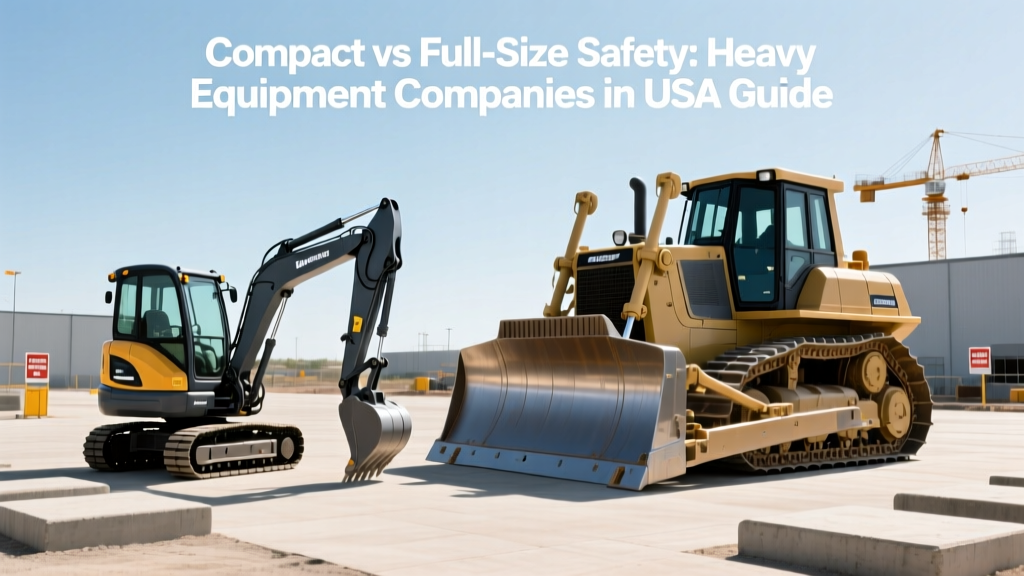
Selecting between compact and full-size construction equipment is fundamentally a risk-management exercise governed by OSHA 1926 Subpart P, ANSI/ITSDF B56.1, and ISO 3471 standards. When sourcing fleets from heavy equipment companies in the USA, safety directors must evaluate more than just production capacity; they must assess how machine geometry, weight distribution, and operator visibility interact with federal compliance mandates. A compact track loader and a full-size wheel loader present entirely different hazard profiles, requiring distinct site-specific safety plans, proximity detection systems, and operator certification protocols.
⚠️ OSHA Compliance Warning: Under 29 CFR 1926.600, employers are strictly liable for ensuring equipment operates within manufacturer-rated safety limits. Utilizing a compact machine on a >15% grade with a suspended load, or placing a full-size machine too close to an unshored trench edge, constitutes a willful violation carrying fines exceeding $161,323 per incident in 2026.ROPS, FOPS, and Overturn Protection Matrix
Roll-Over Protective Structures (ROPS) and Falling Object Protective Structures (FOPS) are non-negotiable. However, the engineering limits of these structures vary drastically between weight classes. Compact machines rely on rigid-frame integrity and low-profile cab designs, while full-size machines utilize massive hydraulic articulation and reinforced cab pillars.
| Safety Metric | Compact Track Loader (e.g., Cat 299D3) | Full-Size Wheel Loader (e.g., John Deere 944L) |
|---|---|---|
| Operating Weight | ~11,500 lbs | ~74,000 lbs |
| ROPS Standard | ISO 3471 (Lateral & Longitudinal) | ISO 3471 (High-Energy Deflection) |
| FOPS Standard | ISO 3449 Level I (Falling Bricks/Debris) | ISO 3449 Level II (Falling Boulders/Trees) |
| Max Safe Grade (Loaded) | 15° - 20° (High Center of Gravity Risk) | 25° - 30° (Articulation Stability Control) |
| Avg. 2026 Procurement Cost | $85,000 - $98,000 | $420,000 - $485,000 |
When procuring from heavy equipment companies in the USA, always request the specific ISO certification plaques and structural weld inspection reports. Aftermarket cab modifications, such as adding unapproved HVAC units or cutting access holes in the roof, instantly void FOPS Level II compliance on full-size loaders.
Blind Spot Mitigation and Proximity Detection
Struck-by incidents remain a leading cause of fatalities in construction. The National Institute for Occupational Safety and Health (NIOSH) emphasizes that equipment size directly dictates the geometry of blind spots, requiring different technological interventions.
Compact Equipment: The 360-Degree Camera Mandate
Compact machines, such as the Bobcat S86 or Kubota KX057-4, suffer from severe rear and right-side blind spots due to the operator's forward-facing seating position and the engine housing directly behind the cab. On a standard compact track loader, the rear blind spot extends up to 14 feet. For 2026 site compliance, safety officers must mandate the installation of 360-degree bird's-eye view camera systems (e.g., Brigade Electronics Backeye®360) and radar-based proximity alarms that trigger automatic hydraulic brake engagement when a ground worker breaches a 6-foot perimeter.
Full-Size Machinery: Radar and LiDAR Integration
A full-size wheel loader like the Komatsu WA500-8 presents a massive blind spot extending up to 45 feet directly behind the machine, alongside a 20-foot right-side blind spot caused by the exhaust stack and engine enclosure. Cameras alone are insufficient for full-size equipment due to screen fatigue and monitor overload. Compliance requires multi-sensor fusion: combining 77 GHz radar for detecting moving personnel through dust and fog, with 3D LiDAR mapping to create a virtual geofence. If a worker's wearable RFID tag breaches the LiDAR zone, the machine's transmission must automatically downshift and lock the boom hydraulics.
Trenching Stability and OSHA Subpart P Compliance
One of the most critical, yet frequently misunderstood, safety differentiators between compact and full-size equipment is the surcharge load applied to trench walls. Under OSHA 1926 Subpart P, heavy equipment operating near excavations creates a surcharge load that can trigger catastrophic soil failure.
- Compact Excavators (e.g., Cat 308 CR, ~18,000 lbs): Can generally operate parallel to a trench edge provided the tracks are kept at least 2 feet back for every 2 feet of trench depth in Type B soil. The lower ground pressure (approx. 4.5 psi) minimizes the risk of inducing shear failure in the trench wall.
- Full-Size Excavators (e.g., Cat 336, ~80,000 lbs): Generates immense ground pressure (approx. 11.5 psi) and dynamic vibration during the swing cycle. OSHA mandates that full-size machinery must either operate outside the angle of repose (often requiring a 15-to-20-foot setback) or the trench must be reinforced with engineered steel trench boxes or sheet piling designed by a registered professional engineer to handle the specific surcharge load of the 80,000 lb machine.
Whole-Body Vibration (WBV) and Cab Ergonomics
Long-term operator health is a compliance issue governed by ISO 2631-1 standards regarding Whole-Body Vibration (WBV). Compact equipment inherently transfers more high-frequency vibration to the operator due to shorter wheelbases, rigid frames, and thinner track pads. Operators in compact skid steers frequently experience WBV levels exceeding 1.15 m/s² over an 8-hour shift, triggering mandatory medical surveillance and restricted operating hours under modern occupational health frameworks.
Conversely, full-size equipment from top heavy equipment companies in the USA features advanced cab isolation mounts, active hydraulic suspension seats, and variable-displacement hydraulic pumps that smooth out operational shock. When specifying equipment for high-production, multi-shift environments, selecting full-size machinery with factory-installed cab suspension is not merely a comfort upgrade; it is a critical intervention to prevent musculoskeletal disorders (MSDs) and maintain compliance with ergonomic safety audits.
Vetting Heavy Equipment Companies in the USA for Compliance
The procurement process must include a rigorous compliance audit of the dealer or manufacturer. When evaluating heavy equipment companies in the USA, safety directors should require the following documentation before signing a purchase or lease agreement:
- Factory ROPS/FOPS Certificates: Serialized documentation proving the exact chassis was tested and certified to ISO 3471/3449.
- Software Lockout Capabilities: Verification that the machine's ECM (Engine Control Module) supports PIN-coded startup restrictions and hydraulic lockouts to prevent unauthorized use by uncertified personnel.
- Telematics and API Access: The equipment must feature OEM telematics (e.g., John Deere JDLink, Cat Connect) capable of pushing real-time fault codes, seatbelt interlock violations, and excessive speed alerts directly to the site safety manager's dashboard via API.
- Right-to-Work and Emissions Compliance: Confirmation that the engine meets EPA Tier 4 Final or Tier 5 standards, ensuring the machine is legally permitted to operate in non-attainment zones (e.g., California's CARB regulations) without facing municipal impoundment.
"The cheapest machine on the lot is often the most expensive on the job site once OSHA audits the proximity detection systems and operator visibility logs. Procurement must be driven by the safety specification sheet, not just the sticker price." — Director of Fleet Safety, National Infrastructure Contractor.
Final Selection Framework
Use this decision matrix to align equipment size with site-specific safety constraints:
- Choose Compact Equipment When: Working in zero-lot-line urban environments, inside existing structures, or on finished surfaces where ground pressure must remain below 5 psi. Mandate 360-degree cameras, RFID personnel tracking, and strict 15% grade limits.
- Choose Full-Size Equipment When: Operating in open earthwork, deep trenching (with engineered shoring), or high-volume material handling. Mandate LiDAR geofencing, active hydraulic lockouts, and engineered surcharge load calculations for trench proximity.
By rigorously applying these safety standards during the selection process, project managers ensure that the machinery deployed not only drives production but fundamentally protects the workforce from the unique hazards inherent to each equipment class.