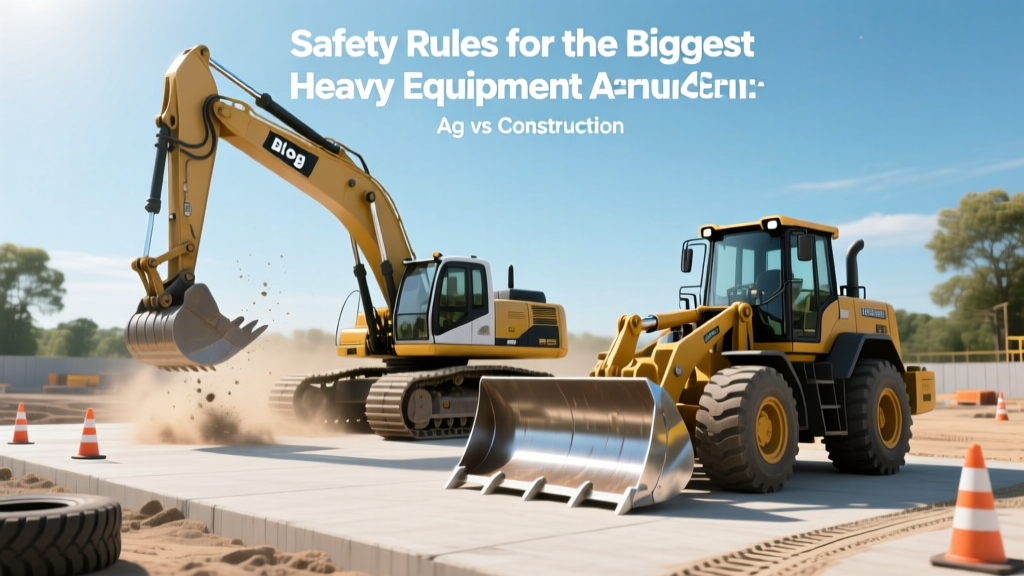
Safety Rules for the Biggest Heavy Equipment: Ag vs Construction
Compare safety standards for the biggest heavy equipment in agriculture versus construction. Learn OSHA and ASABE compliance rules for mega-machinery.
When fleet managers deploy the biggest heavy equipment in their inventory, the regulatory framework governing operator safety splits dramatically based on the machine's primary classification. A 90-ton Caterpillar 395 excavator and a 410-horsepower John Deere 9RX 410 articulated track tractor represent the pinnacle of their respective sectors, often carrying price tags exceeding $800,000. Yet, the compliance architecture surrounding these mega-machines—OSHA 1926 for construction versus OSHA 1928 and ASABE standards for agriculture—operates on entirely different engineering and legal assumptions.
Understanding the divergence in safety standards for the biggest heavy equipment across these two industries is not merely an academic exercise; it is a critical liability shield. Misclassifying a machine's use case or applying agricultural safety guidelines to a construction site can result in catastrophic failure modes and severe federal penalties.
The Jurisdictional Trap: OSHA 1926 vs. 1928
The most common compliance failure involving heavy machinery occurs when agricultural equipment is repurposed for construction tasks, or vice versa. Construction equipment is governed by OSHA 1926.602 (Material Handling Equipment), which mandates rigorous daily inspections, specific operator certification, and strict ground-personnel clearance protocols. Agricultural equipment, conversely, falls under OSHA 1928, a notably sparse regulatory framework that relies heavily on consensus standards from the American Society of Agricultural and Biological Engineers (ASABE).
⚠️ Compliance Warning: The Land-Clearing Edge CaseIf a contractor uses a John Deere 9RX 410 (classified as Ag equipment) to clear wooded land for a commercial building pad, the machine instantly falls under OSHA 1926 construction jurisdiction. The ASABE ROPS (Rollover Protective Structure) certification is legally voided for this task, and the absence of OSHA-mandated construction spotters or proximity radar exposes the firm to willful violation fines exceeding $161,323 per incident.
ROPS Integrity: ISO 3471 vs. ASABE S519
The engineering philosophy behind Rollover Protective Structures (ROPS) differs fundamentally between the two sectors due to the distinct physics of their operating environments. When evaluating the biggest heavy equipment, the mass and center of gravity dictate the testing standards.
| Parameter | Cat 395 Excavator (Construction) | John Deere 9RX 410 (Agriculture) |
|---|---|---|
| Governing Standard | ISO 3471 / OSHA 1926.1011 | ASABE S519 / OSHA 1928.51 |
| Primary Test Vector | Dynamic lateral roll down 30° embankment | Static continuous crush & rearward overturn |
| Operating Mass | ~90,000 kg (198,000 lbs) | ~25,500 kg (56,200 lbs) |
| Deflection Limit (DLV) | Strict volumetric boundary preservation | Allowance for minor cab roof deformation |
Construction ROPS testing (ISO 3471) assumes the machine will encounter rigid, unyielding surfaces like concrete or compacted gravel, requiring the cab structure to absorb massive kinetic energy without intruding into the Deflection-Limiting Volume (DLV). Agricultural ROPS (ASABE S519) is engineered for softer, uneven terrain like plowed soil, where the ground itself absorbs a portion of the impact energy, but where rearward overturns from pulling heavy ground-engaging implements (like deep rippers) are the primary threat.
Proximity Detection and Blind Zone Mitigation
The physical footprint of the biggest heavy equipment creates severe acoustic and visual shadows. A Caterpillar 992K wheel loader or a Case IH Quadtrac 620 possesses blind spots that can easily conceal a light-duty pickup truck or a crew of ground workers.
Construction Mandates: Active Intervention
While OSHA does not explicitly mandate radar on all earthmovers, the agency's General Duty Clause, combined with strict liability in multi-employer worksites, has made active proximity detection an industry standard. Systems like Cat Detect utilize ground-penetrating radar and RFID tags on worker PPE. If a worker enters the 360-degree hazard zone, the system automatically derates the machine's hydraulic travel speed and applies service brakes.
Agricultural Reality: Passive Observation
According to NIOSH agricultural injury data, run-overs and entanglements remain leading causes of fatalities in Ag. However, federal law does not mandate active braking radar on tractors. Manufacturers rely on passive 360-degree camera arrays and acoustic backup alarms. The compliance burden falls on the farm operator to enforce strict 'no-go' zones around the machine during PTO engagement or implement folding sequences, rather than relying on automated machine intervention.
"The assumption that a field is an empty, controlled environment is a fatal error in modern agriculture. With the rise of autonomous-ready tractors and larger multi-family farming operations, the ground-personnel traffic around a 620-HP Quadtrac rivals that of a highway paving crew. Treating Ag blind spots with the same rigor as construction sites is the next frontier of safety compliance."
Stored Energy Dissipation: Hydraulics vs. PTO Drivetrains
Lockout/Tagout (LOTO) procedures under OSHA 1910.147 apply to both sectors during maintenance, but the mechanical reality of dissipating stored energy differs wildly between a 90-ton excavator and a 40-ton articulated tractor.
Construction: Hydraulic Accumulator Bleed-Down
Mega-excavators like the Cat 395 utilize hydraulic accumulators to allow for boom-lowering in the event of an engine stall. Before a mechanic can open a hydraulic valve bank, the operator must perform a specific bleed-down sequence:
- Lower all attachments (bucket, boom, stick) completely to the ground.
- Shut down the engine and remove the master key.
- Cycle all pilot control joysticks and pedals through their full range of motion 3 to 5 times to relieve trapped pilot pressure.
- Engage the physical hydraulic lockout lever inside the cab and apply a LOTO padlock to the lever housing.
- Verify zero pressure using a calibrated gauge on the main pump test port before cracking any hydraulic fittings.
Agriculture: Kinetic Energy and the PTO Entanglement Edge Case
The Power Take-Off (PTO) shaft on a heavy agricultural tractor transfers up to 1,000 RPM of rotational kinetic energy to implements. The danger is not just hydraulic pressure, but rotational inertia and clutch creep.
- Driveline Braking: Modern tractors feature internal PTO brakes, but compliance requires the mechanic to physically verify the brake engagement by attempting to rotate the PTO stub shaft by hand before approaching the implement driveline.
- CVT Creep Hazard: Continuously Variable Transmissions (CVTs) on heavy Ag equipment do not have a traditional 'neutral' mechanical disconnect in the same way a torque-converter does. Hydraulic fluid shear can cause slow drivetrain creep even when the engine is idling. LOTO compliance requires the physical removal of the ignition key and, in some OEM manuals, the physical disconnection of the transmission controller harness to prevent accidental engagement via remote diagnostic tools.
Financial Exposure: 2026 Penalty Matrices
The cost of ignoring the specific safety standards tied to the biggest heavy equipment extends far beyond the immediate physical danger. OSHA's penalty structures have aggressively scaled to combat inflation and corporate negligence.
| Violation Category | Construction (1926) Max Penalty | Agriculture (1928) Max Penalty | Common Trigger Scenario |
|---|---|---|---|
| Serious | $16,131 per instance | $16,131 per instance | Missing daily undercarriage inspection logs |
| Willful / Repeated | $161,323 per instance | $161,323 per instance | Bypassing proximity radar alarms on a trenching site |
| Failure to Abate | $16,131 per day | $16,131 per day | Continuing to use a cracked ROPS mounting bracket |
Strategic Fleet Compliance Framework
For fleet managers overseeing mixed-use assets, relying on the baseline legal minimum is a flawed strategy. Implement a unified internal safety protocol that defaults to the stricter OSHA 1926 construction standards across all equipment, regardless of its OEM classification. Mandate active proximity detection retrofits on all agricultural tractors operating near ground personnel, and enforce construction-grade hydraulic LOTO procedures on Ag PTO systems. By bridging the gap between ASABE engineering guidelines and OSHA construction enforcement, operators of the biggest heavy equipment can eliminate the blind spots that lead to both mechanical failure and federal citations.