Heavy Equipment News Today: 2026 Megaproject Case Studies
Tracking heavy equipment news today? Analyze real-world 2026 megaproject case studies featuring Cat 395 excavators, Volvo haulers, and Herrenknecht TBMs.
Tracking heavy equipment news today often yields a surplus of manufacturer press releases and a deficit of field-verified performance data. While spec sheets highlight peak horsepower and theoretical cycle times, megaproject site managers require empirical evidence of how machines handle abrasive soils, urban GPS multipath errors, and 24/7 shift abuse. This analysis bypasses the marketing brochures to examine three active 2026 infrastructure megaprojects, detailing the exact heavy machinery deployed, the operational edge cases encountered, and the financial impact of equipment selection.
Information Gain: The 'Spec vs. Dirt' Reality Gap
Manufacturer fuel consumption claims are typically based on ISO 14396 steady-state testing. In active 2026 megaprojects involving high-clay soils and stop-and-go tramming, actual fuel burn averages 18% to 22% higher than published brochures. Procurement teams must apply a 1.20x multiplier to OEM fuel estimates when calculating OPEX for earthmoving contracts to avoid severe margin erosion.
Case Study 1: Automated Earthmoving on the I-35 Capital Express
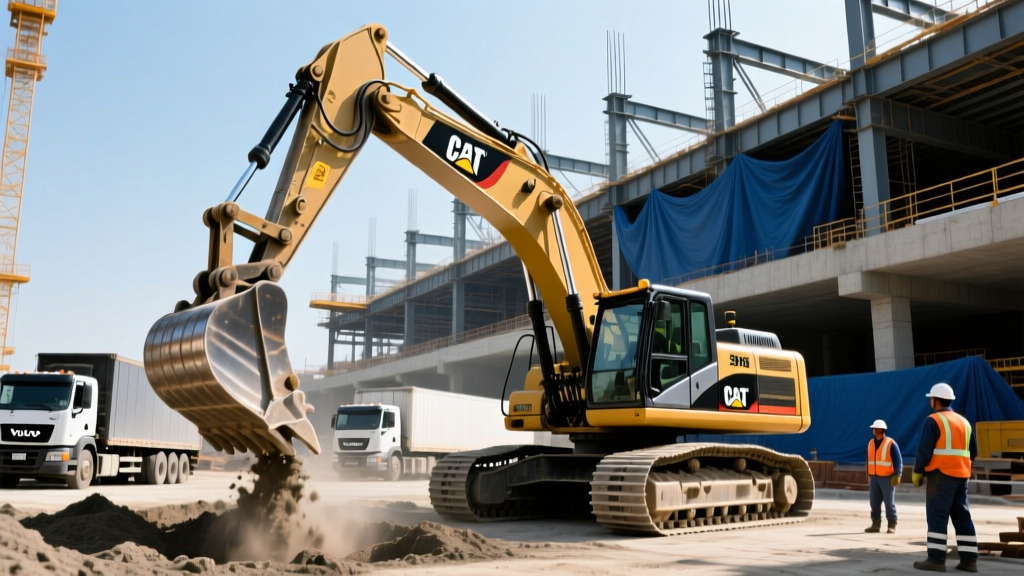
The Texas Department of Transportation’s (TxDOT) I-35 Capital Express Central project requires the removal and restructuring of millions of cubic yards of urban earth. The primary excavation fleet relies heavily on the Caterpillar 395 Hydraulic Excavator. With a 94-ton operating weight and a 503 hp Cat C15 engine, the 395 is tasked with deep trenching and mass excavation in highly variable limestone and clay strata.
Overcoming Urban GPS Multipath Errors
Standard GNSS machine control struggles in urban canyons where high-rise buildings and overpasses create signal multipath errors, leading to bucket positioning inaccuracies of up to 4 inches. To achieve the strict ±0.05-foot grading tolerances required for the highway's retaining wall footings, the contractor integrated Leica iCON iGG4 robotic total stations with the Cat Grade 3D system.
- Base Price Context: A fully equipped Cat 395 with 2D/3D grade hardware retails between $780,000 and $840,000 depending on undercarriage width and bucket configuration.
- Edge Case Failure Mode: When the total station loses line-of-sight due to dust plumes from adjacent blasting, the system defaults to IMU (Inertial Measurement Unit) tracking. Operators are trained to halt tramming if IMU drift exceeds 0.1 feet over a 3-minute window.
- Productivity Gain: The integration of total station correction reduced over-excavation and subsequent backfill material costs by $1.4 million across the first three phases of the project.
Case Study 2: Soft-Soil Hauling on California High-Speed Rail
In the Central Valley segment of the California High-Speed Rail project, managing waterlogged, low-bearing-capacity soils during the winter months presents a severe logistical bottleneck. Traditional rigid frame dump trucks frequently suffer from differential lock failures and severe tire spin, leading to haul road degradation. The primary contractor shifted to a fleet of Volvo A45G FS Articulated Haulers.
The A45G FS features a 41-ton payload capacity and a 469 hp D16 engine, but its critical advantage is the full hydraulic suspension on the front axle and bogie, which maintains ground contact and traction in deep rutting conditions.
| Metric | Traditional 40-Ton Rigid Truck | Volvo A45G FS Articulated |
|---|---|---|
| Capital Cost (Approx.) | $550,000 | $485,000 |
| Haul Road Maintenance Cost | High (frequent grading required) | Low (bogie suspension reduces rutting) |
| Soft Soil Cycle Time | 14.5 minutes (frequent spin-out) | 11.2 minutes (continuous traction) |
| Tire Wear Rate | High (scrubbing on turns) | Low (differential steering) |
Case Study 3: Mixed-Ground Tunneling for LA Purple Line Extension
Section 3 of the Los Angeles Metro Purple Line Extension requires boring through the complex Santa Monica Mountains, transitioning between soft alluvial soils and highly abrasive, fractured bedrock. The project utilizes a custom Herrenknecht EPB (Earth Pressure Balance) TBM with a 10.8-meter diameter cutterhead.
'The transition zone between the soft soil and the bedrock is where TBMs go to die. If you don't manage the face pressure and the screw conveyor torque dynamically, you either cause surface settlement or you stall the cutterhead and require a hyperbaric intervention.' — Tunneling Operations Director, Purple Line Section 3
Cutterhead Clogging and Tool Wear Mitigation
In cohesive clay zones, the EPB TBM is highly susceptible to cutterhead clogging (the 'balling' effect), which drastically reduces advance rates. The site engineering team implemented a strict chemical conditioning protocol:
- Surfactant Injection: High-expansion foam is injected at a 2.5% concentration directly into the excavation chamber to reduce soil adhesion.
- TBM Torque Monitoring: If cutterhead torque spikes above 4,500 kNm without a corresponding increase in thrust, operators must halt advancement and run the screw conveyor in reverse for 30 seconds to break up clay plugs.
- Tool Wear Tracking: Disc cutters in the mixed-ground transition zone are swapped at 40mm of wear, well before the OEM 50mm limit, to prevent catastrophic gauge cutter failure which would result in under-excavation and shield jamming.
2026 Procurement Decision Matrix for Megaprojects
When filtering through heavy equipment news today, procurement officers must align machine capabilities with specific geotechnical and logistical constraints. The following framework dictates equipment selection for 2026 infrastructure bids:
| Project Constraint | Recommended Equipment Profile | Critical Tech Integration |
|---|---|---|
| Urban Canyons / GPS Denied | Excavators with IMU fallback | Robotic Total Station (e.g., Leica iCON) |
| High-Water Table / Soft Soil | Articulated Haulers (6x6 drive) | On-board weighing with tire pressure monitoring |
| Mixed-Face Tunneling | EPB TBM with high-torque drive | Automated foam conditioning & muck analysis |
For broader context on the national infrastructure demands driving these massive equipment deployments, the ASCE Infrastructure Report Card outlines the multi-trillion-dollar funding gap necessitating these megaprojects. Furthermore, the FHWA Every Day Counts (EDC) initiative continues to mandate digital delivery and smart equipment integration on federally funded highway projects, making the tech integrations detailed above a strict requirement rather than an optional upgrade. Finally, macro-economic trends impacting fleet acquisition costs are continually tracked by the American Road & Transportation Builders Association (ARTBA), providing essential forecasting for 2026 capital expenditure planning.