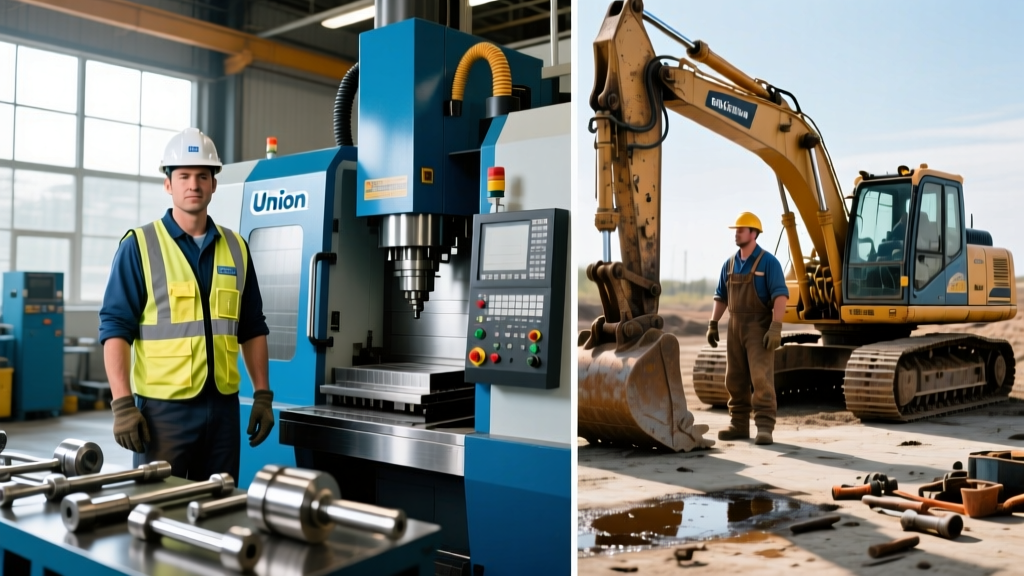
How Much Does a Heavy Equipment Operator Make a Year? Union vs Non-Union
Discover how much a heavy equipment operator makes a year. We break down union vs non-union pay scales, fringe benefits, and apprenticeship step-rates.
The Compensation Architecture: Base Rate vs. Total Package
When analyzing how much a heavy equipment operator makes a year, relying solely on base hourly wages yields an incomplete and often misleading dataset. The heavy construction sector operates on a bifurcated compensation model: the unionized sector (predominantly governed by the International Union of Operating Engineers, or IUOE) and the non-union or 'open shop' sector (often referred to as merit shops). To understand the true financial output of a career in this field, you must examine the Total Hourly Cost (THC) and the annualized compensation formula.
According to the U.S. Bureau of Labor Statistics, the median annual wage for construction equipment operators hovers around $61,000. However, this macro-level data flattens the extreme variances between a non-union residential site in the Southeast and a unionized heavy civil infrastructure project in the Midwest or Northeast. In 2026, with the sustained capital injection from the Infrastructure Investment and Jobs Act (IIJA), prevailing wage requirements on federally funded projects have pushed union operator compensation packages well past the $120,000 annual threshold when overtime and fringe multipliers are applied.
Technical Spec: The Total Compensation FormulaUnion THC = Base Hourly Wage + Fringe Benefits (Health & Welfare, Pension, Annuity, Training Fund, Dues Check-off).
Non-Union Annualized Pay = (Base Hourly Rate × 2,080 hours) + Merit Bonuses + 401(k) Employer Match + Paid Time Off (PTO) Cash Value.
Union Operator Pay Scale (IUOE) Specifications
Union compensation is highly structured, standardized, and tied to collective bargaining agreements (CBAs). The International Union of Operating Engineers negotiates these rates based on geographic cost-of-living indices and equipment classification. The defining characteristic of the union model is the 'Fringe Benefit Multiplier'—an hourly premium paid by the contractor directly into trust funds on behalf of the operator.
Standard Midwestern IUOE Local Wage Breakdown (2026 Data Model)
| Compensation Component | Hourly Rate | Annual Value (Based on 2,000 hrs) |
|---|---|---|
| Base Journeyman Wage | $48.50 | $97,000 |
| Health & Welfare Trust | $14.25 | $28,500 |
| Pension Trust | $11.50 | $23,000 |
| Annuity / 401(k) Trust | $4.75 | $9,500 |
| Training & Apprenticeship Fund | $1.15 | $2,300 |
| Total Hourly Cost (THC) | $80.15 | $160,300 |
Note: The operator's direct take-home gross pay is based on the $48.50 base rate ($97,000), but the total economic value generated for the operator is $160,300. Furthermore, union operators on civil projects frequently work 50-60 hour weeks, triggering time-and-a-half (1.5x) or double-time (2.0x) multipliers on the base rate, easily pushing direct gross income over $130,000 annually.
Non-Union (Open Shop) Pay Structures
Non-union operators, represented by organizations aligned with the Associated Builders and Contractors (ABC), operate on a merit-based compensation architecture. Pay is not dictated by a universal CBA but by individual company profitability, regional labor shortages, and the operator's specific skill matrix.
In the open shop, the fringe benefit multiplier is largely absent or significantly reduced. Instead of guaranteed hourly trust fund contributions, non-union contractors utilize annualized benefit structures:
- Base Hourly Rate: Typically ranges from $26.00 to $38.00 per hour depending on the region and equipment tier.
- Performance / Merit Bonuses: Annual bonuses ranging from 3% to 8% of base salary, tied to project completion metrics and safety records (e.g., OSHA EMR ratings).
- 401(k) Matching: Employers typically match 3% to 5% of the operator's gross salary, vested over a 3-to-5-year cliff or graded schedule.
- Paid Time Off (PTO): 10 to 15 days annually, which non-union operators can sometimes negotiate to be paid out in cash at year-end if unused.
A non-union operator earning $34.00 per hour working a standard 40-hour week (2,080 hours) will gross $70,720 annually. With a 4% 401(k) match and a $3,000 annual safety bonus, the total compensation package reaches approximately $76,500. While the direct take-home cash may be competitive, the lack of a defined-benefit pension and the burden of paying out-of-pocket health insurance premiums often result in a lower net lifetime wealth accumulation compared to the union model.
Equipment Classification and Rate Differentials
A critical technical specification of union contracts is the 'Equipment Group' classification system. How much a heavy equipment operator makes a year is directly tied to the specific machinery they are dispatched to operate. The IUOE categorizes equipment by complexity, risk, and required technical calibration.
Standard Union Equipment Group Classifications:- Group 1 (Premium Rate): Tower cranes, crawler cranes over 50 tons, pile-driving hammers, draglines, and tunnel boring machines (TBMs). Operators in this group receive a premium differential (e.g., +$4.50/hr over base).
- Group 2 (Standard Heavy): Hydraulic excavators (e.g., Cat 390F), dozers (e.g., Komatsu D155AX), motor graders, and large scrapers.
- Group 3 (Mid-Tier): Wheel loaders, backhoes, asphalt pavers, and vibratory soil compactors.
- Group 4 (Base/Entry Rate): Skid steer loaders, telehandlers, forklifts, and small ride-on rollers.
Non-union contractors rarely use formalized group classifications. Instead, they pay a 'machine rate' based on market demand. For instance, an open-shop contractor may pay a standard $30/hr for an excavator operator, but will pay a specialized $45/hr premium for an operator certified in GPS machine control (e.g., Trimble Earthworks or Topcon) or one holding a NCCCO crane certification, bypassing traditional union group tiers entirely.
Apprenticeship Step-Rates: The Earning Progression
For those entering the field, the apprenticeship phase dictates early-career earnings. Union apprenticeships are heavily regulated, typically spanning 3 to 4 years (6,000 to 8,000 on-the-job hours plus classroom instruction). Wages are calculated as a strict percentage of the Journeyman base rate.
| Apprenticeship Period | Percentage of Journeyman Rate | Estimated Hourly Base (Midwest Model) | Fringe Benefits Eligibility |
|---|---|---|---|
| 1st Year (0-2,000 hrs) | 60% | $29.10 | Full Health & Welfare, 50% Pension |
| 2nd Year (2,001-4,000 hrs) | 70% | $33.95 | Full Health & Welfare, 75% Pension |
| 3rd Year (4,001-6,000 hrs) | 85% | $41.22 | Full Health & Welfare, 100% Pension |
| 4th Year (6,001-8,000 hrs) | 95% | $46.07 | Full Journeyman Package |
Non-union apprenticeships, often facilitated through NCCER-accredited programs or direct company training, do not have mandated step-rates. An open-shop trainee might start at $20.00 per hour and receive discretionary $1.50 to $2.00 per hour raises every six months based on foreman evaluations, reaching a journeyman-equivalent rate in 2 to 3 years rather than the rigid 4-year union timeline.
Decision Matrix: Choosing Your Career Track
Selecting between the union and non-union tracks requires evaluating your geographic location, desired equipment specialization, and risk tolerance regarding project downtime.
| Variable | Union (IUOE) | Non-Union (Merit Shop) |
|---|---|---|
| Income Ceiling | Extremely high on mega-projects (bridges, tunnels) due to mandated double-time and show-up pay. | Capped by regional market rates; relies heavily on moving into foreman/superintendent roles to break $100k. |
| Job Security | Dispatched via union hall based on seniority. High risk of cyclical unemployment between projects. | Direct hire. Higher likelihood of being retained during slow periods for equipment maintenance and yard work. |
| Technology Training | Funded by the Training Trust. Access to state-of-the-art simulators and OEM certifications (Cat, John Deere). | On-the-job training. Dependent on the individual contractor's willingness to invest in employee upskilling. |
| Prevailing Wage Access | Dominates Davis-Bacon and state prevailing wage public works projects. | Dominates private commercial, residential, and non-mandated industrial projects. |
The Davis-Bacon Act and Prevailing Wage Mechanics
Understanding how much a heavy equipment operator makes a year on public works requires understanding the Davis-Bacon Act. On federally funded projects exceeding $2,000, contractors must pay the 'prevailing wage.' In heavily unionized states (e.g., Illinois, New York, California), the prevailing wage is almost always the union CBA rate. Therefore, even non-union contractors working on federal highway or dam projects are legally required to pay their operators the union base rate and either provide equivalent fringe benefits or pay the fringe amount as additional cash wages (known as 'fringe cash-out'). This legal mechanism artificially inflates non-union wages on public projects, narrowing the gap between the two sectors in the civil infrastructure space.
Ultimately, the union track offers a highly engineered, predictable compensation architecture with superior retirement and healthcare specifications, optimized for heavy civil and industrial sectors. The non-union track offers agility, faster initial progression, and merit-based scaling, optimized for private commercial and residential earthmoving sectors.