How AI and Telematics Impact the Military Heavy Equipment Operator
Discover how AI, machine control, and VR simulators are transforming the military heavy equipment operator role, from training to semi-autonomous earthmoving.
The Shift from Analog Levers to Digital Command Centers
The modern military heavy equipment operator—whether serving as a U.S. Army 62E (Heavy Construction Equipment Operator) or a USMC 1310 (Engineer Equipment Operator)—no longer relies solely on mechanical feel and analog sightlines. In 2026, the integration of advanced telematics, 3D machine control, and semi-autonomous systems has fundamentally altered the tactical execution of expeditionary earthmoving, route clearance, and Forward Operating Base (FOB) construction. This technological evolution demands a hybrid skill set: operators must now possess traditional diesel-mechanical intuition alongside the digital literacy to manage GNSS networks, interpret CAN bus fault codes, and oversee autonomous grading algorithms.
2026 Tactical Tech Baseline:- Machine Control Adoption: Over 65% of new tactical dozers and motor graders deployed by NATO engineering battalions feature factory-integrated 3D GPS guidance.
- Simulator Training: Virtual reality (VR) pipelines now account for up to 40% of initial seat-time hours for heavy track-type tractor (dozer) certification.
- Teleoperation: Remote-controlled earthmoving is standard protocol for CBRN (Chemical, Biological, Radiological, Nuclear) contaminated zones and IED-laden route clearance.
Teleoperation and Semi-Autonomous Dozing in Hostile Zones
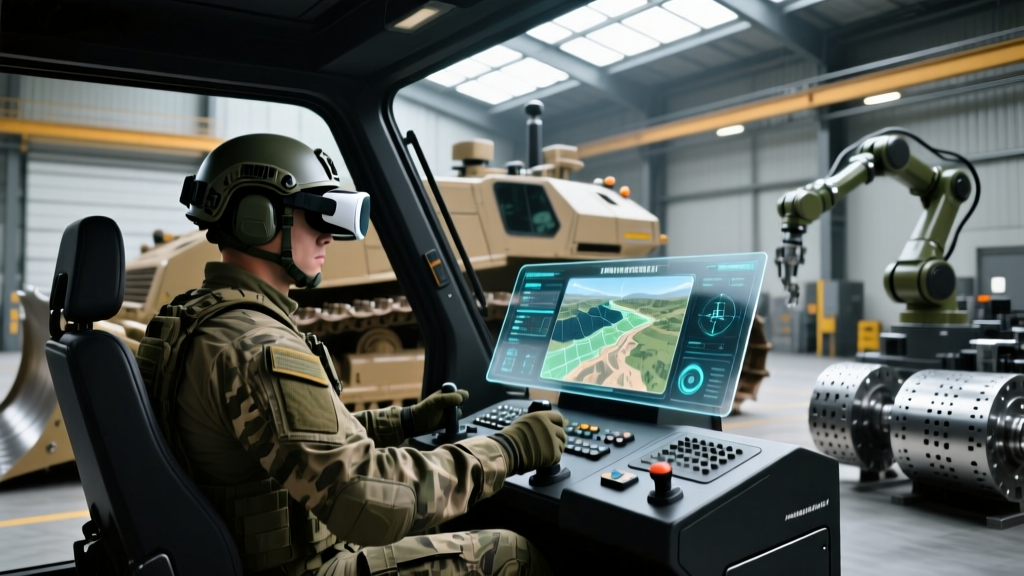
Clearing routes through urban rubble or grading landing strips in contested environments historically exposed operators to sniper fire, indirect artillery, and improvised explosive devices (IEDs). Today, platforms like Caterpillar's Command for Dozing allow military engineers to operate 90,000-pound D8 and D9 dozers from armored, climate-controlled command containers located up to several miles away from the blade.
Latency and Hydraulic Overshoot Constraints
Teleoperating heavy machinery is not as simple as streaming a video feed. Moving dirt requires precise modulation of hydraulic pressure and track speed. When operating over tactical LTE mesh networks or satellite links, network latency is the primary enemy. If latency exceeds 150 milliseconds, operators experience a disconnect between joystick input and machine response, leading to hydraulic overshoot, track spinning, and rapid undercarriage wear. Modern military teleoperation rigs utilize edge-computing nodes that predict operator inputs via AI, smoothing out micro-stutters in the video feed and pre-staging hydraulic valve spools to compensate for network lag.
3D Machine Control: Eliminating the Grade Checker
In traditional military earthmoving, an operator relies on a grade checker standing outside the machine with a laser receiver or GPS rover to call out cut-and-fill depths. In a combat zone, exposing a dismounted grade checker to enemy fire is a critical vulnerability. 3D machine control systems, such as Trimble Earthworks, solve this by loading the CAD-designed terrain model directly into the cab's dual touchscreens.
The system uses dual roof-mounted GNSS receivers and an Inertial Measurement Unit (IMU) to calculate the exact 3D position of the blade's cutting edge 100 times per second. As the operator pushes dirt, the system automatically restricts the blade from dropping below the design subgrade, preventing over-excavation and eliminating the need for rework. For expeditionary airfields requiring strict P-152 or P-154 compaction and grading tolerances, this automated precision ensures the runway can support heavy cargo aircraft like the C-17 Globemaster III on the first pass.
| Earthmoving Method | Personnel Exposure | Fuel Efficiency | Rework Rate |
|---|---|---|---|
| Manual (Analog/Stakes) | High (Requires ground crew) | Low (Multiple passes) | 12-18% |
| 2D Laser Guidance | Medium (Laser setup required) | Medium | 5-8% |
| 3D GNSS Machine Control | Low (Operator only) | High (First-pass accuracy) | < 2% |
| Semi-Autonomous / Remote | Zero (Remote command) | High (AI optimized paths) | < 1% |
Simulator Pipelines: CM Labs Vortex and Cost Reductions
Training a military heavy equipment operator on live iron is extraordinarily expensive and logistically complex. A fully armored, tactical-spec CAT D7 dozer can exceed $400,000 in acquisition costs, burns roughly 8 to 12 gallons of diesel per hour, and requires stringent maintenance schedules. Furthermore, you cannot intentionally roll a dozer or snap a hydraulic hose to teach a recruit how to react to catastrophic failure.
To bridge this gap, military training depots have heavily integrated CM Labs Vortex simulators. These are not arcade games; they utilize complex physics engines that simulate soil deformation, hydraulic latency, and center-of-gravity shifts based on real-world telematics data. Recruits spend their first 80 hours in the simulator mastering blade load management, trench shoring, and multi-machine coordination before ever touching a live ignition key.
"By shifting the first 30% of our track-type tractor and hydraulic excavator syllabus to high-fidelity simulators, we reduced live-fuel consumption by $1.2 million annually per battalion, while simultaneously increasing the volume of emergency-failure drills a recruit experiences from zero to over fifty."
— Defense Engineering Training Command Analysis, 2025
Telematics and the J1939 CAN Bus Revolution
The days of diagnosing a stalled military grader by listening to the engine knock and checking the dipstick are fading. Modern tactical equipment is governed by complex Engine Control Modules (ECMs) communicating over a J1939 CAN bus network. When a Tier 4 Final emissions system throws a fault code due to contaminated Diesel Exhaust Fluid (DEF) or a clogged Diesel Particulate Filter (DPF), the machine will immediately enter 'limp mode,' restricting RPMs to prevent engine damage.
Today's military heavy equipment operator must be proficient in using ruggedized Panasonic Toughbooks connected via Bluetooth CAN bus adapters to read live telematics data. Platforms like JDLink and Cat Product Link allow engineering platoons to monitor the health of an entire fleet of scrapers, compactors, and dozers from a centralized tactical operations center (TOC). Operators are now expected to analyze fuel burn rates, idle times, and hydraulic pressure trends to predict component failures before they strand a convoy in hostile territory.
Frequently Asked Questions: Career & Tech Integration
Does machine control eliminate the need for manual surveying skills?
No. While 3D machine control automates the blade movement, military operators must still understand how to set up and calibrate GNSS base stations, verify control points using robotic total stations, and troubleshoot multipath GPS errors caused by heavy canopy or urban canyons. The operator transitions from a manual laborer to a systems manager.
How do exoskeletons factor into heavy equipment operation?
While exoskeletons like the Lockheed Martin ONYX are primarily used by dismounted infantry and logistics personnel for load-bearing, they are increasingly being tested by combat engineers for tasks that require exiting the cab, such as manually rigging heavy lifting chains, clearing jammed track links, or performing undercarriage maintenance in the field. They reduce lumbar strain and delay the onset of fatigue during 14-hour operational shifts.
What is the civilian transition value of these military tech skills?
Immense. A military heavy equipment operator who has mastered Trimble Earthworks, remote teleoperation, and J1939 CAN bus diagnostics is highly sought after in the civilian sector. Commercial mining, large-scale infrastructure, and autonomous quarry operations actively recruit veterans with this specific blend of heavy iron experience and digital systems management, often commanding starting salaries 20-30% higher than traditional analog operators.
Strategic Takeaway for Aspiring Operators
The military heavy equipment operator of 2026 is a hybrid technologist. Success in this MOS requires looking beyond the dirt and mastering the data. Focus your professional development on understanding GNSS coordinate systems, mastering 3D CAD model interpretation, and becoming fluent in digital engine diagnostics. The iron may get heavier, but the interface is entirely digital.