Certified Heavy Equipment Mechanic to Safety Instructor Career Path
Learn how a certified heavy equipment mechanic can transition into a safety instructor career, mastering OSHA compliance and training standards.
Transitioning from the service bay to the classroom is one of the most lucrative and physically sustainable career pivots available in the heavy machinery sector. For a certified heavy equipment mechanic, the leap into a heavy equipment safety instructor role leverages years of hands-on diagnostic experience into a high-demand compliance niche. With mining, heavy civil construction, and forestry sectors facing intense regulatory scrutiny in 2026, companies are aggressively hiring instructors who possess actual wrench-turning credibility rather than just theoretical safety knowledge.
⚠️ Liability Shift Warning: As a mechanic, your liability is tied to equipment failure and warranty. As a safety instructor, your liability shifts to human life and regulatory compliance. If you train an operator on Lockout/Tagout (LOTO) procedures and they are injured due to an omitted step in your curriculum, your training documentation and syllabus will be subpoenaed. Precision in curriculum design is non-negotiable.Core Safety Certifications Required for Instructors
A certified heavy equipment mechanic already holds ASE, NC3, or OEM-specific credentials (like Cat or John Deere master tech status). However, teaching safety compliance requires an entirely different certification stack governed by federal and state agencies.
OSHA Train-the-Trainer Pathway
To teach OSHA 10-hour and 30-hour outreach courses, you must complete the OSHA 500: Trainer Course in Occupational Safety and Health Standards for the Construction Industry. This requires a prerequisite of OSHA 510 and a minimum of five years of construction safety experience. A mechanic's time spent servicing heavy earthmoving equipment on active job sites qualifies toward this requirement. The OSHA 500 course costs approximately $950 and requires renewal every four years via the OSHA 502 update course. You can find authorized training centers through the OSHA Training Institute Education Centers.
MSHA Instructor Approval
If your target market is mining or quarry operations, the Mine Safety and Health Administration (MSHA) requires instructors to be formally approved. MSHA Part 46 covers surface non-metal mining (where most heavy equipment mechanics work), while Part 48 covers underground and metal mining. You must submit a formal application detailing your experience and proposed training plans to the local MSHA district office to become an MSHA Approved Instructor.
Mechanic Credentials vs. Instructor Credentials
| Credential Type | Primary Focus | Average Cost & Time | Renewal Cycle |
|---|---|---|---|
| ASE Medium/Heavy Truck (T-Series) | Mechanical repair, diagnostics, drivetrains | $300-$500 / 2-4 hours per test | 5 Years |
| OEM Master Technician | Brand-specific hydraulics, CAN bus, emissions | Employer-sponsored / 2-5 years | Annual OEM updates |
| OSHA 500 (Construction) | Regulatory compliance, hazard communication, fall protection | ~$950 / 4 days (Prereq: OSHA 510) | 4 Years (via OSHA 502) |
| MSHA Part 46/48 Approval | Mine site safety, ground control, mobile equipment hazards | Free application / 30-60 days processing | Continuous (subject to audit) |
Designing a Compliance-First Training Curriculum
The biggest mistake former mechanics make when teaching is focusing on how to fix the machine rather than how to interact with it safely. Your curriculum must be built backward from the regulatory standard. For example, when teaching crane and derricks safety, your syllabus must explicitly map to OSHA 1926.1400 Subpart CC, covering assembly/disassembly, power line encroachment, and ground conditions.
Effective safety curricula for heavy equipment utilize a three-tier framework:
- Regulatory Baseline: What does the law explicitly require? (e.g., OSHA 1926.1412 for equipment inspections).
- OEM Engineering Limits: What do the manufacturer's load charts and hydraulic pressure tolerances dictate?
- Field Application: How do we execute this in mud, rain, or confined urban job sites?
Real-World Scenario: Teaching LOTO on a Cat 390F Excavator
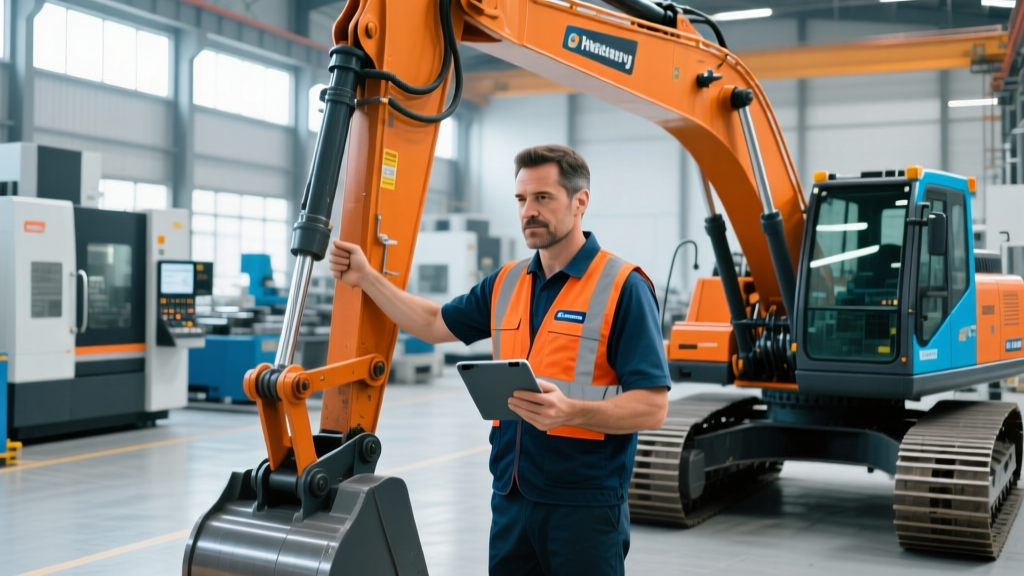
Generic LOTO training fails in the heavy equipment sector because standard electrical lockouts do not account for stored hydraulic and pneumatic energy. When designing a module for a Caterpillar 390F hydraulic excavator, your training must go beyond turning the key.
Instructor Blueprint: Cat 390F Zero-Energy Verification1. Implement Lowering: Teach students to physically lower the bucket and stick to the ground. If a cylinder fails, gravity must not be a hazard.
2. Accumulator Bleed-Down: The 390F features pilot hydraulic accumulators. Instruct students to cycle all joystick controls in a specific pattern (e.g., boom up/down, stick in/out, bucket curl/dump) for 30 seconds post-engine shutdown to relieve pilot pressure.
3. Battery Disconnect Lockout: Apply a universal battery disconnect lockout device (e.g., Brady 65672) at the rear battery box.
4. Swing Lock Engagement: Manually engage the mechanical swing brake lock pin to prevent upper carriage rotation during maintenance.
5. Verification: Attempt to start the machine and cycle joysticks to verify zero stored energy before issuing the wrench.
Salary, Job Market, and Employer Types
The financial upside of moving from the shop floor to the training room is substantial, particularly when factoring in the reduction of physical wear-and-tear on the body. In 2026, the demand for compliance instructors is outpacing supply due to an aging mechanic workforce and stricter corporate Environmental, Health, and Safety (EHS) mandates.
- Dealership Technical Trainer: $85,000 - $110,000. Focuses on OEM safety protocols, warranty compliance, and new-hire mechanic onboarding. Includes heavy travel.
- Heavy Civil / Mining Safety Instructor: $95,000 - $135,000 + per diem. Focuses on MSHA/OSHA compliance, daily tailgate safety, and incident investigation.
- Independent Safety Consultant / Auditor: $120,000 - $180,000+. Requires establishing an LLC, carrying $2M+ liability insurance, and bidding on corporate training contracts.
Step-by-Step Transition Framework
Execute this 12-month roadmap to successfully pivot your career:
- Months 1-3 (Documentation): Compile a portfolio of your 5+ years of field experience. Gather pay stubs, job site logs, and letters from site supervisors verifying your hands-on heavy equipment exposure to meet OSHA 500 prerequisites.
- Months 4-6 (Certification): Complete OSHA 510 (Prerequisite) followed immediately by OSHA 500. If targeting mining, submit your MSHA Part 46 instructor application concurrently.
- Months 7-9 (Curriculum Development): Build three proprietary training modules (e.g., Heavy Equipment LOTO, Confined Space Entry in Excavator Trenches, Rigging and Load Chart Math). Use 3D CAD models or OEM service manuals to create visual aids.
- Months 10-12 (Market Entry): Approach regional heavy equipment dealerships (like Finning or Ziegler CAT) or general contractors (like Kiewit or Bechtel) to offer contract-based safety training while you apply for full-time corporate EHS roles.
Frequently Asked Questions
Do I need a college degree to become a heavy equipment safety instructor?
No. While a bachelor's degree in Occupational Safety and Health can help you reach corporate EHS Director roles faster, the foundational requirement for field instruction is verifiable industry experience and OSHA/MSHA train-the-trainer certifications. Your status as a certified heavy equipment mechanic carries more weight with field crews than a generic safety degree.
Can I teach safety for equipment I haven't personally repaired?
You can teach general regulatory compliance (like OSHA 1926 Subpart O for motor vehicles) for any equipment. However, to teach OEM-specific safety procedures, LOTO sequences, or hydraulic hazard mitigation, you must have documented training or verifiable experience on that specific make and model. Teaching a LOTO procedure for a Komatsu PC8000 when you have only worked on John Deere excavators is a severe liability risk.
How do I integrate VR into my safety training curriculum?
Virtual Reality is highly effective for teaching spatial awareness and blind-spot hazards without risking physical machinery. Platforms like CM Labs or Heavy Equipment Safety Simulators allow you to teach OSHA 1926.1400 crane swing-radius hazards in a classroom. As an instructor, you do not need to code the VR; you license the software and build your classroom facilitation guides around the VR scenarios, debriefing students on their compliance failures in the simulation.