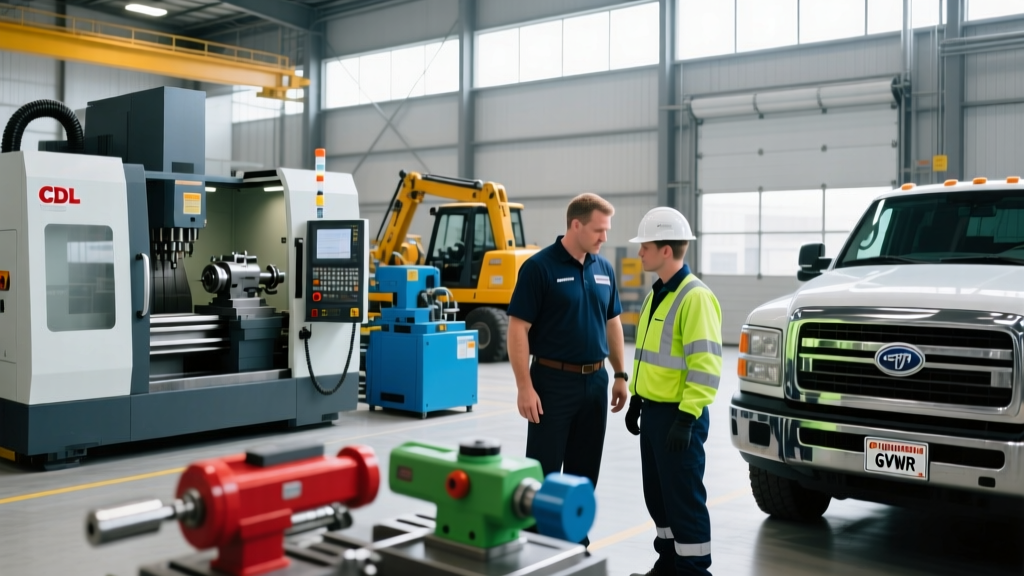
CDL Transport Rules for Heavy Equipment Operator Training Indiana
Discover how heavy equipment operator training in Indiana covers CDL transport compliance, GVWR limits, INDOT regulations, and cargo securement standards.
The Gap Between Operating and Transporting Heavy Machinery
Operating a 50,000-pound excavator on a closed, private job site requires a vastly different skill set than legally transporting that same machine down Interstate 70. In Indiana, the intersection of equipment operation and highway transport compliance is a critical, yet frequently overlooked, component of comprehensive heavy equipment operator training in Indiana. Many contractors assume that if an employee is certified to operate a skid steer or dozer, they are automatically legally cleared to haul it. This assumption leads to catastrophic compliance failures, massive Indiana Department of Transportation (INDOT) fines, and severe safety liabilities.
Advanced operator training programs in Indiana bridge this gap by integrating Federal Motor Carrier Safety Administration (FMCSA) regulations with state-specific weight thresholds. Understanding Commercial Driver's License (CDL) requirements, Gross Combination Weight Rating (GCWR) limits, and precise cargo securement mathematics is mandatory for any operator tasked with moving machinery between Hoosier job sites.
Understanding Indiana's 26,001-Pound Threshold
The foundational metric for CDL compliance in Indiana is the 26,001-pound threshold, governed by Indiana Code 9-24-4-1. However, the application of this rule changes depending on whether you are looking at a single vehicle's Gross Vehicle Weight Rating (GVWR) or a truck-and-trailer combination's GCWR. Heavy equipment operator training in Indiana emphasizes the distinction between these metrics to prevent operators from inadvertently driving commercial motor vehicles (CMVs) without the proper licensure.
| Vehicle / Combination Type | Weight Metric Evaluated | Indiana License Required | Common Equipment Scenario |
|---|---|---|---|
| Single Straight Truck | GVWR ≥ 26,001 lbs | Class B CDL | Volvo articulated dump truck hauling site material |
| Truck + Trailer Combo | GCWR ≥ 26,001 lbs (Trailer > 10,000 lbs) | Class A CDL | Ford F-350 pulling a 14,000 lb trailer with a mini excavator |
| Truck + Light Trailer | GCWR ≥ 26,001 lbs (Trailer < 10,000 lbs) | Class B CDL | F-550 pulling an 8,000 lb equipment trailer |
| Non-Commercial Combo | GCWR < 26,001 lbs | Standard Class D (Operator's License) | Half-ton pickup pulling a small skid steer on a 5k trailer |
A common trap for landscaping and light excavation contractors in Indiana is the "F-350 Trap." A standard Ford F-350 has a GVWR of roughly 11,500 pounds. If that truck pulls a trailer with a GVWR of 14,000 pounds, the combined GCWR is 25,500 pounds, which falls under the 26,001-pound threshold, requiring only a standard license. However, if the contractor upgrades to an F-450 (GVWR ~14,000 lbs) and uses the same 14,000 lb trailer, the GCWR jumps to 28,000 pounds. Because the trailer exceeds 10,000 pounds and the GCWR exceeds 26,001 pounds, the driver now legally requires a Class A CDL. Failing to recognize this shift is a primary focus of compliance modules in Indiana training curricula.
The Air Brake Restriction: Hidden Compliance Failures
When transporting heavier machinery, such as a John Deere 85G mid-size excavator or a large wheel loader, operators frequently utilize trailers equipped with air brakes or air-over-hydraulic braking systems. Under Indiana BMV regulations, if a vehicle requires a CDL and is equipped with air brakes, the driver must pass the air brake knowledge test and complete a skills test in a vehicle with an air brake system.
If a driver holds a CDL but failed to take the test in an air-brake-equipped vehicle, their license will carry an "L" restriction (No Air Brakes). Heavy equipment operator training in Indiana specifically drills students on checking the trailer's brake actuator type before hitching. Pulling a 30,000-pound lowboy trailer with air brakes using a Class A CDL that carries an "L" restriction is a severe moving violation that will result in an immediate out-of-service (OOS) order at any INDOT weigh station.
FMCSA Cargo Securement: The Working Load Limit (WLL) Math Trap
Operating the machine safely is only half the battle; securing it to the trailer is governed by strict federal law under FMCSA 49 CFR Part 393. The most critical concept taught in Indiana compliance training is the Working Load Limit (WLL) aggregate calculation.
Federal law dictates that the aggregate WLL of all tie-downs used to secure a piece of heavy equipment must be at least 50% of the equipment's total weight. Furthermore, any equipment weighing 10,000 pounds or more requires a minimum of four tie-downs.
⚠ The 3/8-Inch Chain Compliance Trap
Many operators mistakenly believe that four 3/8-inch Grade 70 transport chains are sufficient for any mid-size excavator. A standard 3/8-inch Grade 70 chain has a WLL of 6,600 pounds. Four chains yield an aggregate WLL of 26,400 pounds. If you are transporting a Caterpillar 320 Excavator weighing 53,000 pounds, 50% of the cargo weight is 26,500 pounds. Your four 3/8-inch chains fall 100 pounds short of the legal minimum. INDOT inspectors will place the load out of service. Training programs mandate the use of 1/2-inch Grade 70 chains (WLL 11,300 lbs each) for machinery in the 40,000 to 60,000-pound class to ensure a safe compliance buffer.
Proper Securement Geometry and Edge Protectors
Beyond raw WLL mathematics, the angle of the tie-down drastically affects its legal holding power. Tie-downs must ideally be placed at an angle between 45 and 60 degrees relative to the trailer deck. Angles steeper than 60 degrees lose lateral securing force, while angles shallower than 45 degrees lose vertical downward force. Additionally, when securing equipment with sharp steel tracks, operators must use edge protectors or wrap the chains with heavy-duty nylon sleeves to prevent the track grousers from cutting into the chain links under highway vibration, which compromises the chain's structural integrity and WLL.
Real-World Scenario: Hauling a Cat 320F Down I-65
To synthesize these concepts, consider a standard scenario covered in advanced Indiana operator courses: transporting a 53,000-pound Caterpillar 320F excavator from Indianapolis to Lafayette via I-65.
- Vehicle Selection: The contractor uses a Kenworth T880 sleeper cab (GVWR 35,000 lbs) and a 55-ton capacity lowboy trailer (GVWR 110,000 lbs). The GCWR is well over 26,001 lbs, and the trailer exceeds 10,000 lbs. A Class A CDL is mandatory.
- Weight Distribution: The operator must position the excavator's center of gravity directly over the trailer's rear axles to ensure the truck's steer axle remains above the 12,000-pound legal limit and the drive axles do not exceed the 34,000-pound tandem limit per INDOT Motor Carrier regulations.
- Securement Execution: The operator uses four 1/2-inch Grade 70 chains (Total WLL: 45,200 lbs), exceeding the required 26,500 lbs (50% of 53,000 lbs). A fifth chain is used as a secondary backup for the boom arm.
- Routing and Bypass: The truck is enrolled in the Drivewyze PreClear bypass program. Because the operator's credentials, IFTA fuel tax records, and safety scores are compliant, the truck receives a bypass signal at the Lebanon weigh station, saving 45 minutes of transit time.
Frequently Asked Questions (FAQ)
Do I need a CDL to transport a skid steer on a trailer in Indiana?
It depends on the combined GVWR. If your pickup truck has a GVWR of 10,000 lbs and your equipment trailer has a GVWR of 14,000 lbs, your GCWR is 24,000 lbs. Because this is under the 26,001-pound threshold, you do not need a CDL, provided the transport is not for-hire (commercial freight). However, if you use a heavier truck that pushes the combined rating over 26,001 lbs, a Class A CDL becomes legally required.
Are farmers exempt from CDL requirements when hauling tractors?
Yes, Indiana offers a Farm Exemption (Restricted CDL or Class D farm endorsement) under specific conditions. The vehicle must be controlled and operated by a farmer, used exclusively to transport agricultural products, farm machinery, or farm supplies to or from a farm, and operated within 150 air miles of the farm. This exemption does not apply to commercial landscaping or general excavation contractors.
What happens if my tie-downs fail an INDOT inspection?
If an Indiana State Police commercial vehicle enforcement officer or INDOT inspector finds inadequate tie-downs (e.g., insufficient WLL, damaged chains, or improper angles), the vehicle will be issued an Out-of-Service (OOS) order. The truck cannot move until the securement is corrected. This results in severe delays, potential fines ranging from $300 to over $1,000 per violation, and negative marks on the carrier's Compliance, Safety, Accountability (CSA) score.
Integrating Compliance into Career Development
For heavy equipment professionals in Indiana, mastering the machine's hydraulics and controls is only the baseline of career competency. The ability to legally, safely, and efficiently transport that machinery across the state's highway network elevates an operator from a simple joystick-puller to a highly valuable, compliance-aware logistics asset. By prioritizing CDL transport rules, weight distribution mathematics, and FMCSA securement standards within heavy equipment operator training in Indiana, contractors protect their bottom line, and operators protect their livelihoods and the safety of the driving public.