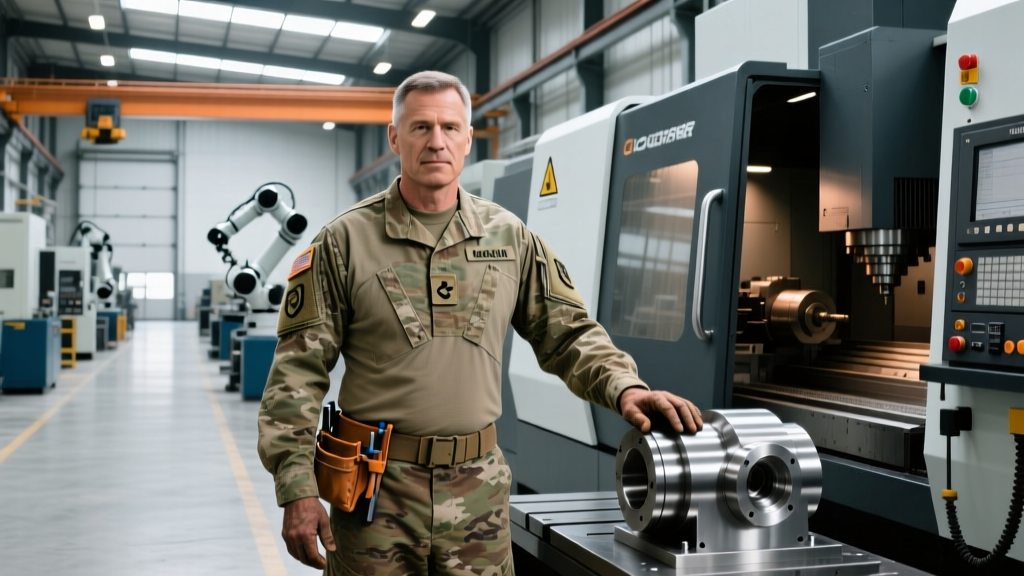
Army MOS Heavy Equipment Operator to Foreman: Maintenance Edge
Transition from an Army MOS heavy equipment operator to a civilian foreman by leveraging military PMCS and maintenance scheduling expertise.
The Maintenance Mandate: Why Operators Make the Best Foremen
The leap from operating heavy iron to managing a multi-million-dollar civilian fleet requires a fundamental shift in perspective. While civilian operators often adopt a "run it until it breaks" mentality, an army mos heavy equipment operator is indoctrinated with a strict adherence to Preventive Maintenance Checks and Services (PMCS). This military doctrine provides a distinct, measurable advantage when transitioning into a civilian foreman or fleet superintendent role.
In the civilian earthmoving and heavy civil sectors, equipment uptime dictates project profitability. A foreman who understands the intricate service schedules of Tier 4 Final and Stage V emissions-compliant machines—such as the Caterpillar 336 or Komatsu PC210LC-11—can save a project hundreds of thousands of dollars annually. The military background in tracking fluid analysis, undercarriage wear limits, and daily fault codes translates directly to the core responsibilities of a civilian heavy equipment foreman.
Veteran Transition Insight: Civilian hiring managers rarely understand the depth of DA Form 5988-E (Equipment Inspection and Maintenance Worksheet). When interviewing for a foreman position, do not just say you "did maintenance." Translate your experience: explain how you managed 100% PMCS compliance for a $15M motor pool, tracked S•O•S (Scheduled Oil Sampling) trends, and mitigated Class III leaks in high-tempo environments.Translating Military PMCS to Civilian CMMS Platforms
The modern civilian foreman does not use paper forms to track fleet health. By 2026, mid-to-large heavy civil contractors rely on Computerized Maintenance Management Systems (CMMS) like HCSS Equipment360 or Trimble Viewpoint to automate service intervals. The analytical rigor required to maintain military vehicles prepares an army mos heavy equipment operator to master these platforms rapidly.
Mapping Military Doctrine to Civilian Software
- Daily/Before-Operation Checks: Translates from military PMCS to civilian "Daily Walkaround Inspections" logged via mobile tablets (e.g., assigning fault codes for a low DEF warning on a John Deere 850L dozer).
- Weekly/Deadlining: Translates to civilian "Red-Tagging" protocols. If a machine has a Class III hydraulic leak (fluid dripping at a rate that forms drops), the foreman must lock it out in the CMMS until the mechanic replaces the hose assembly.
- Dispatching: Military motor pool dispatching mirrors civilian equipment allocation, requiring the foreman to balance machine hour accumulation to ensure no single asset hits its 500-hour service interval mid-sprint on a critical path excavation.
The 250/500/1000-Hour Service Matrix
A primary duty of a heavy equipment foreman is planning around OEM service intervals to prevent taking machines offline during peak production. Below is a standard service matrix for a fleet of 20-ton class excavators (e.g., Cat 320 / Komatsu PC200), contrasting civilian OEM specs with military equivalents to highlight the technical crossover.
| Interval | Component System | Civilian OEM Specification | Military Equivalent Standard | Foreman Action Required |
|---|---|---|---|---|
| 250-Hour | Engine Crankcase | API CK-4 15W-40 (e.g., Cat DEO) | MIL-PRF-2104H | Pull oil sample; verify DEF dosing module integrity. |
| 500-Hour | Hydraulic System | ISO 46 / CAT HYDO Advanced 10 | MIL-PRF-5606 / 2104 | Replace pilot and return filters; clean magnetic plugs. |
| 1000-Hour | Undercarriage | 40% pin/bush wear limit | TM 5-3805-262-10 limits | Ultrasonic thickness testing on track links; rotate idlers. |
| 2000-Hour | Cooling / Emissions | ELC (Extended Life Coolant) flush | TM 10-8400-201-10 | Pressure test DPF (Diesel Particulate Filter) soot load. |
Financial Accountability: The True Cost of Downtime
In the military, a deadlined vehicle impacts mission readiness. In the civilian sector, it impacts the bottom line with brutal mathematical precision. A foreman with an army mos heavy equipment operator background understands readiness rates, but must learn to quantify them in dollars.
The $4,000 Hose Failure Scenario:
Ignoring a minor hydraulic hose abrasion during a daily walkaround on a Cat 336 Excavator leads to a catastrophic blowout two weeks later in a trench.
Reactive Cost: $1,250 (daily rental equivalent/lost production) + $850 (emergency field mechanic call-out fee) + $400 (hose and 15 gallons of lost ISO 46 fluid) + $600 (environmental cleanup/soil remediation) = $3,100+ in pure losses.
Proactive Cost: $400 hose replacement scheduled during the machine's lunch break or shift change. Foremen are paid to protect the margin.
Managing these costs requires the foreman to implement a strict Component Life Expectancy Tracker. For example, knowing that a set of Berco track chains on a D6 dozer yields roughly 4,500 hours in abrasive sand, but only 2,000 hours in high-impact shot rock, allows the foreman to adjust the capital expenditure forecast and schedule undercarriage replacements before catastrophic failure occurs.
Bridging the Certification Gap
While military experience provides unparalleled practical discipline, civilian contractors require standardized, third-party validation of safety and maintenance knowledge. To solidify the transition from operator to foreman, veterans should target specific industry certifications that validate their maintenance management capabilities.
The National Center for Construction Education and Research (NCCER) offers standardized Heavy Equipment Operations and Maintenance credentials that are widely recognized by top-tier general contractors like Bechtel, Kiewit, and Fluor. Additionally, pursuing OEM-specific certifications—such as Caterpillar’s Certified Equipment Manager (CEM) or John Deere’s Fleet Management training—provides the software and telemetry expertise required to manage modern machine data.
Telematics and Predictive Maintenance
Modern foremen do not just read dipsticks; they read data streams. Familiarity with OEM telematics (e.g., Cat VisionLink, Komtrax, JDLink) is mandatory. These platforms alert the foreman to impending failures, such as a dropping hydraulic main pump pressure trend or an escalating engine coolant temperature anomaly. An army mos heavy equipment operator who masters these predictive dashboards transitions from a reactive supervisor to a proactive fleet strategist, ensuring that service schedules are executed based on actual machine load and fuel burn, rather than arbitrary calendar dates.
Executing the Transition Strategy
For the transitioning veteran, the path to a foreman role hinges on demonstrating that you view heavy equipment not just as tools to move dirt, but as complex, depreciating assets that require rigorous lifecycle management. Update your resume to highlight specific fleet sizes, the dollar value of the motor pool you managed, and your direct involvement in executing 250/500/1000-hour service intervals. By framing your military PMCS discipline through the lens of civilian cost-savings and uptime maximization, you position yourself as an indispensable leader in the heavy civil sector.
For further reading on military maintenance doctrine and its civilian applications, refer to the core manuals available via the Army Publishing Directorate, specifically DA PAM 750-1, which outlines the foundational maintenance policies that shape the operational readiness mindset every top-tier civilian foreman needs.